

Would a Taser, rather than bullets, have been the better way to subdue a bat-wielding man during a mental health crisis?
More than 15,000 law enforcement and military agencies have them in widespread use. The Buffalo Police Department, which has been urged to employ them for the sort of situation that unfolded on Genesee Street on Saturday, is not among them.
While Mayor Byron W. Brown's team, after years of delay, has decided to equip officers with Tasers, the program is now on hold. At a news conference Monday, Brown and Police Commissioner Byron C. Lockwood said the city does not have the money to buy them this year.
Neither elaborated on when the city might buy Tasers, which cost about $1,800 each and require replacement cartridges at about $100 each. In the midst of the pandemic, $1.6 million was cut from the police department budget for 2020-21.
People are also reading…
"The plan is not to get Tasers in the meantime," Brown said. "The funds are not there."
The city's finances are reeling from the pandemic. In June, the city borrowed $25 million to close out the last fiscal year. And its current budget relies on $65 million in federal pandemic assistance that has yet to be approved by Congress.
Thomas Burton, an attorney who is an expert on New York's laws governing the use of force and often represents Buffalo police in such cases, said a Taser might have made a difference on Genesee Street. But no uniformed officer at the scene had one, he said.
"Nobody has a crystal ball to be able to determine whether a Taser at the scene would have eliminated the need to use a handgun," said Burton, who has talked to officers involved in the incident and believes the shots were justified. "But there's no doubt a Taser would have given the officers another option before the guns came out."
Also known as stun guns, Tasers shoot prongs that deliver a 50,000-volt jolt that can temporarily disable a person. Tasers are designed to offer a non-lethal, or at least less lethal, option for subduing an unruly or emotionally disturbed person.
For years, there was resistance at police headquarters to Tasers. Former Commissioner Daniel Derenda didn’t think they were right for Buffalo. People hit with Tasers can die, too, he reasoned. Studies have shown they can stop the heart. And, Derenda would argue, they don’t always work on someone covered by the many layers of clothing needed in a typical Buffalo winter.
While some studies have shown that Tasers are not always effective, their maker, Axon Enterprises, cites a U.S. Justice Department-funded study that found Tasers cause no significant injuries more than 99% of the time. The union that represents Buffalo police wants them.
“To my knowledge, there has been no movement on equipping our officers with a less lethal instrument, a Taser,” the Buffalo Police Benevolent Association’s current president, John T. Evans, wrote to the Common Council – in 2017. Studies have shown they “dramatically reduce the number of injuries to police officers and suspects alike,” he wrote.
That year, a Buffalo police officer shot and killed an unarmed man, Jose Hernandez-Rossy, who the officer mistakenly believed had shot his partner. Hernandez-Rossy was 26.
The state Attorney General’s Office decided not to charge the officers involved. But in their final report, the investigators urged the Buffalo police to equip officers with Tasers.
"While it is impossible to know what would have happened if either of the BPD officers had access to a Taser to subdue Mr. Hernandez-Rossy, studies have shown that outfitting officers with Tasers can significantly reduce injuries to suspects and officers alike," said the report, which came out in 2018.
In 2019, the current police commissioner, Lockwood, set out to try Tasers over a 30-day period with about two dozen officers from B District, which is centered in downtown Buffalo. The test was considered a success. Police in January reported that the mere threat of being hit with a Taser led one distraught man with a knife to surrender.
In February, Lockwood asked the Common Council to approve a contract with Axon Enterprises to buy 620 Tasers and have them maintained over a five-year period. The Council, records show, approved the arrangement.
The Common Council clearly supports Tasers for the police department, said Niagara District Council Member David A. Rivera, who heads the Police Oversight Committee. Another Police Oversight Committee member, South District Council Member Christopher P. Scanlon, agrees.
On Saturday afternoon, Capt. Jeffrey D. Rinaldo gave an account of the shooting: A man with a baseball bat was yelling at people along Genesee Street around 2:54 p.m. Officers, including one trained in crisis intervention, encountered him at Genesee and Ellicott streets. He became “very agitated,” got up from where he was sitting and walked east on Genesee. Rinaldo said the man – since identified as Willie Henley, 60 – made striking motions with the bat at the police, and a couple of rounds of pepper spray did not subdue him.
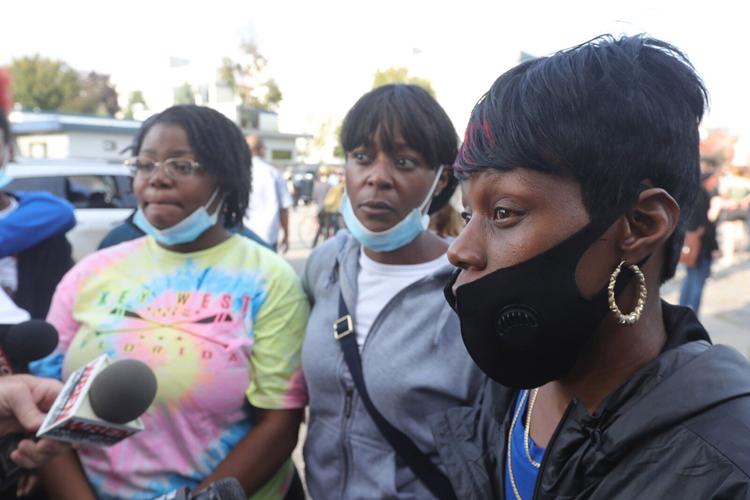
Near Ash Street, the man hit a female officer with the bat, Rinaldo said. As he prepared to swing at her again, her partner fired two rounds, hitting the man once in the abdomen, Rinaldo explained. The man was later listed in stable condition at Erie County Medical Center. His daughter Iesha Henley told The News on Sunday that he is still recovering but doing better.
Staff writer Maki Becker contributed to this report.


