

![308898[1]](https://bloximages.chicago2.vip.townnews.com/tucson.com/content/tncms/assets/v3/editorial/3/48/348e6408-2df9-5439-98eb-bb36b054856f/69a0ad3edf022.image.jpg?resize=375%2C500)
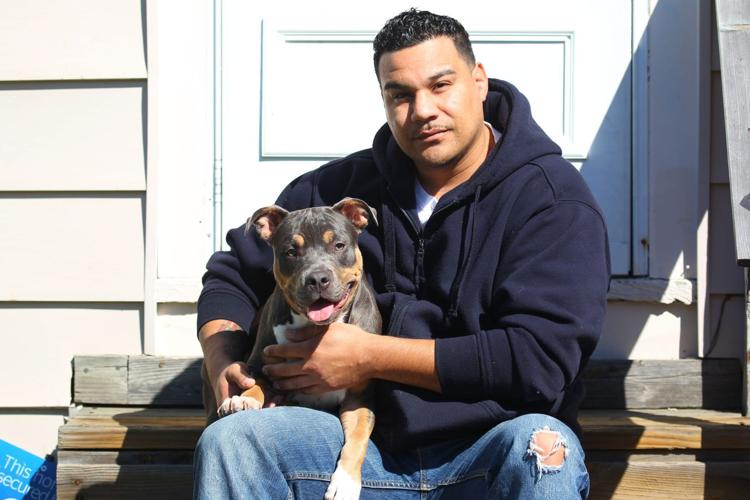
Adam Arroyo waited two years to get a new best friend.
And even then, the memories of his old pal’s death, still raw and unexplained, compelled him to make a statement of sorts.
Arroyo, an Iraq War veteran, named his new friend “Justice.”
Now 7 months old, she’s a pit bull puppy, and, thanks to her name, a constant and welcome reminder of Arroyo’s two-year fight to make the Buffalo Police accountable for his last dog’s death and, it turns out, the deaths of more than 70 other dogs that Arroyo’s lawyer claims were shot by police in recent years.
The focus of Arroyo’s lawsuit is Cindy, the 2-year-old pit bull killed in June 2013, but it also suggests dozens of other dogs died unnecessarily at the hands of Buffalo narcotics detectives.
Arroyo’s lawyer, in fact, claims one detective alone shot and killed 25 dogs over a three-year period.
People are also reading…
“It was just me and her,” Arroyo said of Cindy, a rescue dog he adopted upon his return from combat duty in Iraq. “I would do anything to have her back.”
Arroyo’s lawsuit, filed in federal court in Buffalo, is new, but the allegation that Cindy’s death was the result of a botched police search dates back to her killing two years ago.
The shooting, like a lot of dog shootings by police, attracted national media attention and, with the help of social media, suddenly cast a spotlight on Buffalo police.
“My impression over the years is that it’s SOP, standard operating procedure,” Barbara Carr, executive director of the SPCA Serving Erie County, said of dog shootings in Buffalo. “And I’ve been told off the record that police officers have been instructed to shoot first rather than risk attack.”
Carr said she understands the dangers police officers face when they find themselves confronted with a dog, often a pit bull, and she’s quick to suggest that the high number of dogs killed by police is rooted in a larger societal fear of certain dogs, an unfounded fear often fueled by the media.
“If the world was filled with cocker spaniels, we wouldn’t have a problem," she said.
Police officials said Arroyo’s lawsuit prevents them from talking about his allegations, but they claim the number of dog shootings is down dramatically from past years.
Police Commissioner Daniel Derenda attributed the decline to new training, specifically a series of videos on everything from how to read a dog’s body language to why alternatives to deadly force should be considered by police coming face-to-face with a canine.
“We’ve given them extra training on how to handle dogs,” Derenda said. “And we continue to look at other departments and best practices.”
Carr is skeptical.
The local SPCA, she said, offered to find and pay for training that would help Buffalo police officers better handle the dogs they come across on a daily basis. Similar offers have been made by other groups as well, she said.
The city’s response?
“No response,” Carr said.
National issue
The Buffalo Police Department is not the only police force under scrutiny for how it handles dog encounters.
In Milwaukee, police shot and killed 434 dogs between 2000 and 2008, an average of 48 per year, according to a similar lawsuit there. Milwaukee, like Buffalo, claims the number is on the decline and was down to a low of 28 by 2012.
Dogs are also getting shot in Chicago.
Since 2008, police officers there have shot and killed 488 animals, the large majority of them dogs, according to an independent police authority. In addition, a federal court jury in 2011 awarded a Chicago dog owner $333,000 after police officers searched his home and shot his dog. The search turned up no evidence of criminal activity at the house.
“We’ve seen settlements in excess of a million dollars,” said Randall Lockwood, senior vice president of the American Society for the Prevention of Cruelty to Animals. “And settlements in the tens of thousands are not unusual.”
Lockwood, who has been studying the issue for more than 15 years, said a day doesn’t go by when he doesn’t hear at least one account of a police officer shooting a dog.
The core of the problem, he said, is that police departments, despite the emphasis on community policing, are ill prepared to deal with the reality that one out of every three households in the country is home to a dog.
Often, these deadly encounters occur as part of a police raid and, when the dead dog turns out to be a family pet or companion, not a drug dog, it’s sometimes a raid that went bad.
In Berwyn Heights, Md., a SWAT team burst into Cheye Calvo’s home seven years ago and, convinced he was a drug smuggler, shot and killed his two black Labrador retrievers, Chase and Payton.
Calvo, still in his boxer shorts, said he was handcuffed, pushed to the floor and held at gunpoint while his mother-in-law looked on in horror.
“I noticed my two dead dogs lying in pools of their own blood,” he told CNN at the time.
Only later did the SWAT team learn that Calvo is the mayor of Berwyn Heights.
It seems the raid was based on a package of marijuana sent to Calvo’s home and later found to be part of a scheme in which marijuana was sent to unknowing recipients and then intercepted by drug dealers.
Austin, Texas, Police Chief Art Acevedo also knows about the fatal canine consequences, and embarrassment, that can come with a bad police search.
In 2012, one of his officers arrived at the wrong address while responding to a 911 call for a domestic disturbance and drew his gun when Michael Paxton and his dog Cisco greeted him. When Cisco moved toward the officer, he shot and killed the dog.
Later, when Paxton appeared on a local radio station, Acevedo called in to apologize.
“Regardless of whether or not it’s justified or not justified, Mr. Paxton saw his dog killed, saw his dog die, and my heart goes out to him,” Acevedo said on KLBJ Radio in Austin. “I just want to say I’m sorry on behalf of all the department. I’m sorry you saw that. I know the pain’s real. We all love our pets and I hope we can get through it.”
Lockwood thinks a lot of these incidents can be avoided with training that focuses on risk assessment and alternatives to deadly force.
Most police departments, in his eyes, set a low bar when it comes to the threshold for shooting a dog and should instead adopt the “deadly force doctrine” that suggests killing a dog is warranted only if the officer or others are in serious danger.
Lockwood says officers also need to remember the alternatives to firing their weapon, including using pepper spray and hitting the dog with a baton.
“There are plenty of other tools at the disposal of law enforcement,” he said.
Seeking justice
For Arroyo, the fact that fewer dogs in Buffalo are getting shot is welcome news.
He wants Cindy’s death to mean something and, if one of the consequences of her killing is a change in how officers deal with dogs, he could find some peace of mind in knowing she helped bring about reform.
“He lived by himself and that dog was his world,” Matthew Albert, Arroyo’s lawyer, said of his client and his bond with Cindy. “He was beyond devastated.”
There’s no mention of the declining numbers in Arroyo’s lawsuit but WGRZ-TV, which has tracked the number of dogs killed each year, recently cited records obtained under the Freedom of Information law and reported that two dogs were killed between November of last year and May of this year.
Albert said Arroyo’s suit is also about the failed police search, including the detectives’ decision to ignore the warnings of neighbors, who reportedly told them they had the wrong apartment.
The suit also says the neighbors warned the police about Cindy and the fact that, because she often chewed Arroyo’s shoes when he wasn’t home, she was tethered to the kitchen sink.
“She was restrained,” Albert said.
Arroyo says the police never apologized and never acknowledged they had the wrong apartment. His lawyer says the police, even well after the raid, continued to claim his client was a drug dealer who put his dog at risk.
“We want justice and justice comes in many forms,” Albert said, “but we won’t settle for anything less.”


