

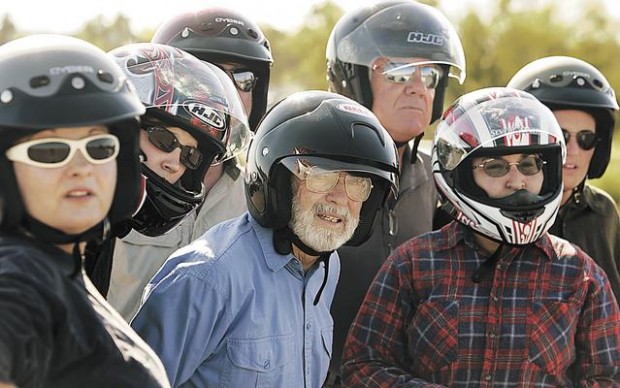
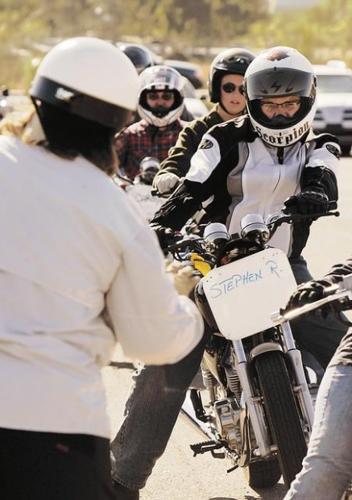
With more people in the Tucson area turning away from their gas-guzzling vehicles and hopping on motorcycles, proper safety training is vital for new riders, police and experts say.
Motorcycle registrations in the last four years have increased 37 percent in Arizona and 46 percent in Pima County, according to state Motor Vehicle Division statistics.
The increase continues in Pima County, with local sellers saying the spike in gasoline prices is forcing more people to turn to the two-wheelers to get around, and additional safety classes are being held to accommodate the many new riders.
Steve Spreter, owner of Renaissance Motorcycles, 4411 E. Speedway, said his business is seeing a big sales jump.
Even more popular than motorcycles are the smaller scooters, which Spreter said seem a little less intimidating to new riders.
People are also reading…
"They inherently get much better fuel mileage, and it's a fun way to get around," he said. "I've seen people come in and they've bought a big pickup, and the gas prices have doubled in the intervening time. Some of them are coming back in again from previous experience, and some of them are pretty green."
The upward trend in motorcycle registrations is sending more people to safety classes, said Larry Rising, office manager for T.E.A.M. Arizona, which offers the training.
"There's definitely a spike in the attendance and the requests," Rising said. "We have weekend classes and weekday classes, so we're trying to cover all the bases."
T.E.A.M.'s Tucson classes during the weekends are booked until August, but weekday classes have openings starting in July. Rising said riders also can get into classes at other locations, including the Phoenix area, earlier if they need to.
"The safety training is without a doubt the most beneficial thing a rider can do," said Ron Kool, safety officer for the Harley Owners Group in Tucson. "Start out slow and be extra careful" in learning to ride.
All motorcyclists should wear safety equipment and take safety classes, even continuing through to the most advanced courses, said Tucson police Sgt. Mark Robinson, a rider since 1962 who spent 10 years supervising the motorcycle unit.
"I see both extremes. I see riders with little protection and no helmet, wearing shorts and flip-flops, exceeding the speed limit and weaving in and out of traffic," Robinson said
"On the other extreme, I see riders wearing appropriate safety equipment, including a helmet, heavy clothes and boots, who are following traffic laws and signaling their intentions to other motorists."
At least seven motorcyclists have died in crashes on Tucson-area roads so far this year, according to Arizona Daily Star archives. In Arizona, fatal motorcycle crashes fell slightly in 2007, when 135 motorcyclists died. There were 142 fatal motorcycle crashes in 2006.
Gas cost changed mom's mind
Soaring gasoline prices were the reason Kathryn McLean's mother was finally sold on the idea of her teenage daughter's buying a motorcycle.
"My mom wouldn't let me get a bike earlier, but now, because of gas prices, she's letting me get one," the teen said.
McLean took her Honda Rebel home Friday after taking a training course offered by T.E.A.M. Arizona.
"It's really free to be in the wind," McLean said. "I just really like it."
McLean borrows her mother's vehicle, which can get about 30 mpg. She said her entry-level motorcycle gets about 70 mpg.
Paul Kyle, 60, recently bought a Suzuki scooter to make his 70-mile round-trip commute to work a little less painful on his wallet.
Kyle, who took the same course as McLean, lives south of Three Points and works in Tucson.
His Suzuki scooter can get up to 65 mpg. He said his Toyota pickup gets about 20 mpg.
Kyle's recent purchase was mainly a result of gas prices, but he had other motivations as well.
"It's many things working together. Right now, it's gasoline," he said. "I'm going to retire in a couple of years, and I'm going way south to Central America," he said. "These are very common down there, rather than cars and trucks."
Steve Reynolds, 19, bought a Suzuki motorcycle as a way to counter rising gas prices, and he said safety is his top priority.
He also took a motorcycle training course.
"Safety is the biggest thing," Reynolds said. "If I'm safe and I don't fall off my bike, that's more time on my bike to practice and get better. I don't feel like breaking any bones."
1981 safety report still cited
The most extensive study on motorcycle accidents is the Hurt Report, compiled in the late 1970s by Harry Hurt, a University of Southern California professor who collected data on thousands of them. Though the final report was issued in 1981, no similarly comprehensive study has been done since, and the basic findings are still cited by riders.
Hurt found that roughly 75 percent of the crashes involved another vehicle, and of those, two-thirds were caused by the other motorist violating the motorcyclist's right of way.
Local riders agree that basic fact hasn't changed.
"I think there should be motorcycle-awareness training as part of getting your driver's license. There are so many instances where the rider just didn't have a chance," Kool said.
But rider error is by far the most common cause of the 25 percent of motorcycle crashes that don't involve another vehicle.
"There are a good number of motorcycle fatalities that occur because riders don't follow the basic safety tenets and try to ride beyond their skill level," Robinson said.
The danger to a motorcyclist in a crash is obvious, Robinson said. Most crashes result in the rider's becoming separated from the motorcycle. "That's like jumping out of the back of a pickup truck going 25 mph."
People who use motorcycles for daily commuting should take extra caution and be aware that rush-hour travel poses the peak number of hazards on the road.
"There are more hazards in city driving because of the law of averages," Robinson said. "There are pedestrians; there is cross traffic; there are intersections. I see riders who are obviously looking out for the mistakes of drivers and riding defensively. You can see them come up to a car and then slow and pass cautiously."
Robinson said it's not extremely difficult to ride a motorcycle, and nearly everybody who takes the time to prepare to be a safe rider can do it. But there still are good and bad riders.
"When I went through (the Police Department's) motorcycle training, one of the trainers told me the motorcycle training would make me a better driver of an automobile, and it does," he said. "The same basic rules apply — being able to recognize hazards and being prepared to react to them."
On StarNet: See a video highlighting this workshop at go.azstarnet.com/ localvideos.
Get a PDF of the Motorcycle Handbook from the Arizona Department of Transportation at azstarnet.com/pdf.
Law, fuel and costs
Arizona law requires a specific motorcycle license or endorsement, which involves passing a written test and an on-cycle skill test. Riders over age 18 are not required by law to wear helmets.
Motorcycle fuel mileage varies, depends on driving conditions, just as with cars. But most motorcycles are capable of about 40 to 60 miles per gallon, with scooters often being slightly more efficient.
Costs vary greatly as well. Some scooters and motorcycles sell for about $2,000, while most are in the $5,000 to $10,000 range, and some high-end models cost much more.


