

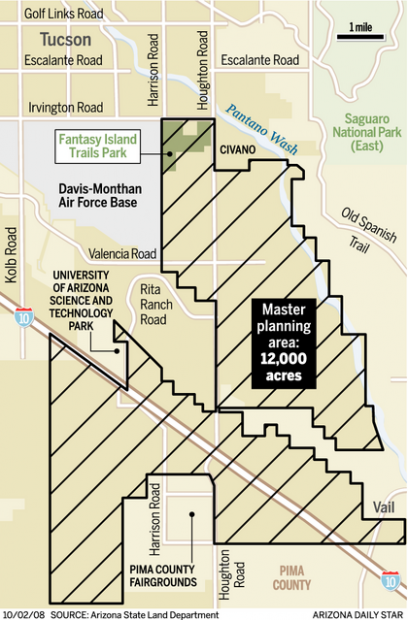
A 12,000-acre development on the Southeast Side will be so large that it will affect other parts of Tucson, attendees of a recent town hall meeting said.
Phoenix-based developer Westcor is creating an overview plan for residential, commercial, industrial and retail development on nearly 12,000 acres of state land in Ward 4, along South Houghton Road.
It would be a 20-year project in a perfect world, but more realistically it's a 30- or 40-year project, said Mitch Stallard, vice president for Westcor.
In January, the State Land Department gave Westcor an urban panning permit for the area, which is the second-largest state land parcel ever designated for master planning.
Though Westcor will create the plan for the area, the state is still the property owner and the land will be sold in parts by public auction.
People are also reading…
Stallard and lead Tucson consultant Jim Portner gave a presentation on the project Sept. 22 at Ward 2's Eastside City Hall, 7575 E. Speedway.
About 20 people attended the meeting, which included a question-and-answer session with Stallard and Portner. They told attendees they are looking at all uses for the area, from residential to commercial to civic.
Ward 2 Councilman Rodney Glassman explained why his ward held a meeting about a development that will take place in neighboring Ward 4.
"It's a significant portion of our city. It will both create additional burdens on our infrastructure as well as opportunities for our residents," Glassman said.
The development will lead to more traffic but also more jobs on the East Side, he said.
West Side resident Tracy Williams said she has questions about the development.
"I'm very concerned about natural resources and the impact that this very large development will have on the quality of life for all of us," said Williams, a lifelong Tucson resident of 50 years.
The biggest question asked at the meeting was who will pay for the infrastructure, she said.
But Ward 4 Councilwoman Shirley Scott disagrees the development's infrastructure requirements will be a burden to taxpayers and spoke of the area's future benefits to Tucson.
"Since the new development can pay for that itself, then the 'pressure on infrastructure' question is moot," she said.
One way the area could pay for itself is if the City Council set up a community facilities district, she said. If that occurs, someone buying property in the district would pay an extra fee based on the property's assessment.
"I think it is a good idea to plan a large area within the city limits of Tucson," Scott said. "I think the benefits will be city-wide and not limited to the general location."


