

Single-family homes will emerge on the banks of the Tanque Verde Wash on a site that supported a significant Hohokam Indian population more than 800 years ago.
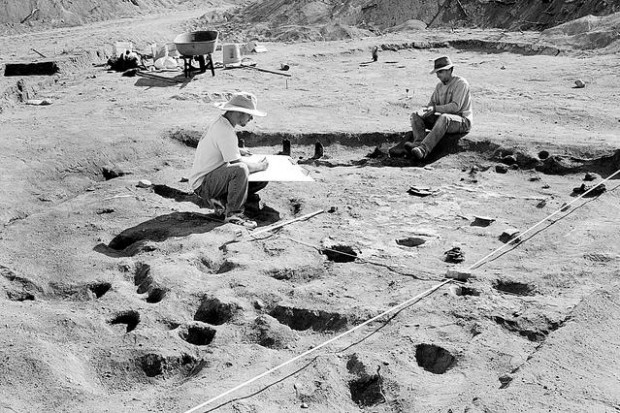
For the past seven weeks, a crew from Desert Archaeology Inc. — a business that specializes in cultural resources research — has worked painstakingly to collect information and artifacts from the site. Over the next two years, archaeologists will compile the information and write an extensive report detailing their findings.
It's part of striking a balance between preserving the area's archaeological history and allowing for growth, said a Tucson historic-preservation officer, Marty McCune.
"We know the archaeology (site) is going to be destroyed," McCune said. "But we're spending time and money to try and preserve some of that."
The developer of the property, Jim Campbell, the president of OasisTucson Inc., said he would like to integrate the new homes with open space that retains the historic significance of the site.
People are also reading…
"I'm sure some developers view is it as a hassle, but I believe it's part of the process," he said. "It's part of our history."
The remains of about 40 prehistoric homes lie in the mesquite bosque on the southern bank of the Tanque Verde Wash just north of Speedway between Harrison and Houghton roads.
From about A.D. 1000 to 1200, with the rugged peaks of the Catalina and Rincon mountains towering in the distance, anywhere from 50 to 100 Hohokam Indians called the location home.
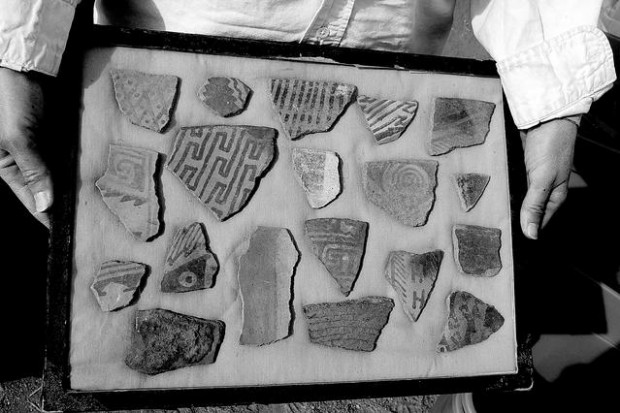
Intricately decorated pottery shards, animal bones and other items discarded by the Native Americans are scattered throughout the site.
Archaeologist Mark Elson said he and his crew examine the garbage left by the inhabitants and analyze the remains of houses to theorize about the prehistoric Indians' lifestyle.
They also work closely with members of the Tohono O'odham Nation — the nearest descendants of the Hohokam Indians.
The Hohokam lived in brush- and mud-covered houses supported with beams of mesquite trees. Extended families may have lived in groups of homes surrounding a common area. Irrigation canals and floodwater sustained their crops.
Elson said he knows what materials they used to build their homes and that they subsisted primarily on corn, beans, squash and rabbit meat. But he knows very little about their day-to-day lives.
Around A.D. 1400, for unknown reasons the Hohokam culture that extended throughout the Southwest crumbled.
The Indians who lived along riverbanks and washes did not even refer to themselves as the "Hohokam," Elson said to a group of people who had gathered to tour the archaeological site March 3.
When Spanish explorers traveled through the Southwest hundreds of years ago and asked the Pima Indians — who resided on the land — what people had built the ruins scattered throughout the Tucson Basin, the Pima Indians told them: Hohokam.
In the language of the Pima Indians, the word "hohokam" means "all used up," Elson said.
The site, which had been all used up more than 600 years ago, will once again be a place people call home.
With Tucson's burgeoning growth, preserving such sites poses a challenge for city and county officials, developers and residents.
"We try to preserve them, but that's not always practical so the trade-off is data recovery," McCune said.
Elson said the artifacts they've recovered will be analyzed and go into a body of research that preserves the story of those who once lived at the site.
"That's why we're here, so this is not lost forever," Elson said.
Campbell said he would like some of the artifacts to stay on the site, so residents and visitors can see the historic significance of the location.
East Side resident Karen Scheibe said she was fascinated to find Hohokam ruins within a stone's throw of her own home.
"The fact that they're studying them as opposed to just bringing in the bulldozers, and giving us this history is really interesting," she said.


