

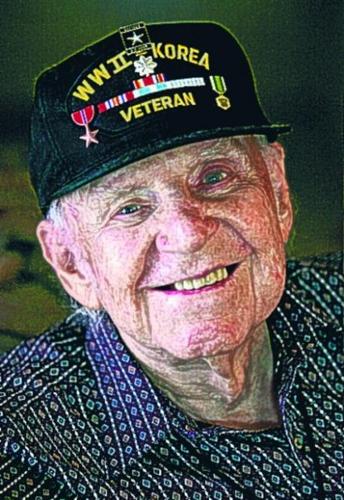
Edward L. Lindsey credits the Civilian Conservation Corps with shaping his life, and saving a nation.
At 93, this East Side resident calls the Great Depression years among the greatest of his life.
"It saved us. What really happened … is it avoided a revolution because people were about to do just that," he said. "It created job opportunities for young men who didn't have any, and it got them off the streets."
Tucsonan J.J. Lamb and other Arizona historians are working to preserve stories like Lindsey's to teach future generations about the CCC's role in Arizona.
Last week, the Pima County Parklands Foundation received a $6,025 grant from the Arizona Humanities Council for a project called "The New Deal in Arizona: Connections to Our Historic Landscape."
Lamb, who is overseeing the project, said researchers are planning to record Arizona's top CCC projects. This includes an interpretive map on 100 Arizona New Deal projects, 1933-42.
People are also reading…
They also plan to catalog all of Arizona's CCC projects.
Next March marks the 75th anniversary of the New Deal projects, which were started to help American families pull out of the Great Depression.
In 1933, President Franklin D. Roosevelt put the New Deal in place to get Americans back to work. The CCC was part of that.
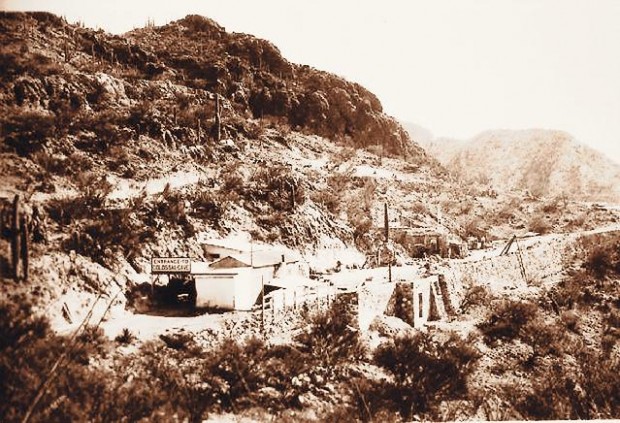
The agency is now gone, but the impact has not been forgotten, said Lamb, also the director of education at Colossal Cave Mountain Park.
Lamb said in addition to the grant money, project members also received a $3,000 donation from an anonymous benefactor as well as about $19,000 in matching services from people from all over the state.
"This is an incredible grant because there's also so much being donated," she said.
The group has applied for a second grant it hopes will enable it to involve more of the community, as well as some Vail High School students, in putting together a Web site of the New Deal projects in Arizona.
"We hope we'll take Arizona residents and tourists on a historical trip of discovery," she said.
The others working on the project include Robin Pinto, a cultural and landscape architect; Michael Smith, Southwest Regional Director of the National Association of Civilian Conservation Corps Alumni; Peter Booth, a scholar with the Arizona Heritage Council; and Robert Leighninger, a sociology professor at Arizona State University.
"If there are folks out there that were participants in the New Deal, we'd like to hear from them," she said. "If there is information that wasn't documented, we would love to have that oral history."
Willis Canady, 81, credits the Civilian Conservation Corps with helping his family.
Canady said he was nearly 5 when his father moved Canady and three other sons to Tucson. The boys' mother had just died of tuberculosis.
"The doctor said to my dad that if you want to live, you'd better get (to) a drier climate," Canady said.
When Canady was 9, however, his father also died of tuberculosis.
The four boys, now homeless, were sent to live on a farm in Sonoita, where they cared for animals while also attending school.
"It was work, work, work," Canady said of those years.
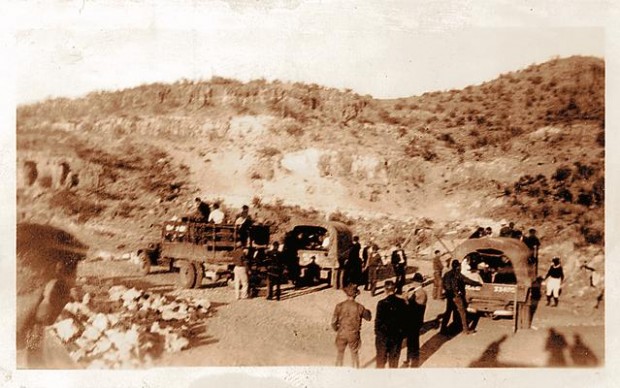
Eventually Canady and two of his brothers became involved with the Civilian Conservation Corps. Canady said he spent about six months in Yuma putting in canals. After that, he moved to western New Mexico, where he worked for the U.S. Forest Service.
Canady said he is constantly reminded of the work that was done by the Civilian Conservation Corps around the state.
His brother, Tom Canady, now deceased, helped build low-water dams and other structures in Sabino Canyon.
Lindsey, who moved to Tucson in the early 1960s, was 20 when he enrolled in the Civilian Conservation Corps. As an Army second lieutenant, he went on to become a commander at camps in Alabama and Georgia. His work, which took him to several states, included building dams, planting trees, developing new roadways and running miles of telephone wire.
Lindsey said he started in the CCC without a high school diploma and eventually went on to earn a master's degree in political science.
He retired from the Army as a lieutenant colonel.
"It has guided me in my life," he said. "I learned how to eat properly and how to sleep well. I learned that liquor is not good for you and smoking definitely was out."
For more on CCC, New Deal
● For more information on the anniversary of the New Deal and the Civilian Conservation Corps, log on at http://www.newdeallegacy.org.
● Got a story to share about Civilian Conservation Corps work in Arizona? Contact J.J. Lamb at 647-7121.


