

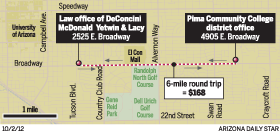
A three-mile stretch of Broadway may be the priciest drive in town for local taxpayers.
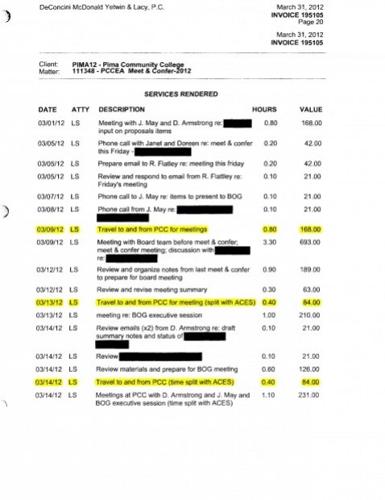
Each time attorneys from a certain firm travel it back and forth, they charge the public $168 - billing 48 minutes for the round trip that's a 15-minute drive.
The practice of charging a $200-plus hourly rate for short jaunts down the street is frowned upon by legal ethicists, and it's added thousands to the ballooning legal bills of Pima Community College, an Arizona Daily Star review of public records shows.
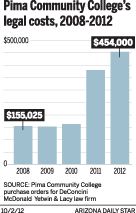
PCC's legal costs have soared nearly 200 percent in recent years as the school faced a string of controversies.
In one recent month, the college spent an average of $3,500 a day on lawyers.
The law firm PCC uses - DeConcini McDonald Yetwin & Lacy - doesn't charge at least one of its other local education clients for the time lawyers spend driving to and from those offices.
People are also reading…
But PCC recently was charged for 25 of the $168 trips down Broadway in one month, adding nearly $4,600 to that month's legal tab without anyone at the college questioning the fees.
PCC spokesman C.J. Karamargin said the college gets a good deal from its attorneys.
The law firm discounts its normal rates and often gives PCC thousands of dollars of free legal service, he said in an email last week.
"As a publicly funded institution, PCC takes very seriously the fiscal responsibilities that come with the stewardship of tax dollars," he said.
The Star analyzed six months of itemized legal billings from November 2011 to April 2012, and eight years worth of PCC purchase orders for amounts paid to the law firm.
In those six months, the public paid more than $15,000 for lawyers to travel back and forth on the three-mile stretch of Broadway.
The Star obtained the purchase orders through a public records request. The billings were obtained the same way by a citizens group, the Coalition for Accountability, Integrity, Respect and Responsibility, which has raised concerns about PCC practices and has asked the college's accreditor to investigate the school.
SOARING COSTS
Two years ago, the college spent $162,400 on lawyers. That rose to $380,000 in 2011 and $454,000 in the 2012 budget year that ended in June.
The jump in legal spending was caused by a combination of unforeseen events and costly decisions by college leaders, records show.
Last year, PCC landed in court after The Arizona Republic sued to force the college to release internal emails about killer Jared Lee Loughner, who attended PCC in 2010.
This year, PCC paid lawyers more than $40,000 to investigate accusations from eight current and former female employees that the school's former chancellor, Roy Flores, had sexually harassed them. Flores denied wrongdoing and was allowed to retire for health reasons.
The college also has an ongoing court dispute with Santa Cruz County - the legal bill so far is at least $28,000 - over the cost of educating students from that county at PCC.
While those events were causing spikes in legal costs, PCC also was upping the tally from within.
For the last two years, for example, PCC has been paying lawyers to conduct the school's union negotiations - work that used to be done by the college's senior administrators - at an added cost to taxpayers of up to $35,000 a year.
The decision to farm out the union work was made because Flores, the former chancellor, felt it was too time-consuming for administrators and "unduly strained their day-to-day relationship with employees," Karamargin said. "The cost of an outside attorney was justified to preserve employee-administrative collegiality and to allow administrators to work most efficiently."
How well the new approach works is unclear. At public forums PCC held last month, its employees described a workplace that's far from collegial, one steeped in morale problems and fractured by fear and mistrust.
Records show the college uses attorneys for a range of tasks, from editing news releases, drawing up talking points and planning "PR strategy" to weighing in on tuition hikes and admissions standards.
PCC also added to its legal tab last year when Flores had to cancel for health reasons a trip to San Diego where he'd agreed to speak at a government relations conference.
Rather than send another college administrator, PCC paid $3,600 to send a lawyer to give Flores' speech, titled: "Crisis and Controversy Management - Learning From Experience."
"NICKEL AND DIMING"
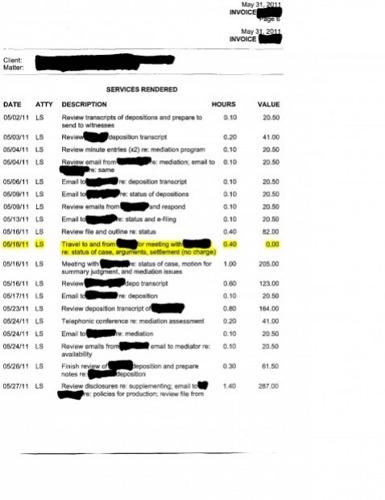
The $168 trips down Broadway aren't just driving time. Lawyers also are on the clock for time they spend walking up and down office hallways and across parking lots, said PCC's lead attorney, John Richardson, a shareholder in the law firm.
Richardson's explanation was provided to the Star by PCC spokesman Karamargin.
Karamargin said a "typical trip" covers the time it takes for Richardson to leave his law office, walk to the parking lot just outside his office, drive to PCC and park there and walk from his vehicle to the college chancellor's office.
The law office is at the corner of Broadway and Tucson Boulevard. PCC's office is on Broadway just east of Swan Road.
"It is standard practice for attorneys to bill clients for travel time," Karamargin said.
Legal ethicists say that may be true when lawyers travel substantial distances, but not for trips a few miles down the street.
"Would I bill a client for sitting in my car and driving five or six miles? Of course not," said Linda Shely, a leading Arizona expert in legal ethics.
"That's nickel and diming them, and clients hate it when you do little things like that," said Shely, a former ethics director for the Arizona State Bar who teaches legal ethics as an adjunct professor at the University of Arizona.
Ted Schneyer, who recently retired after 20-plus years as an ethics professor at UA's College of Law, said the thought of lawyers billing taxpayers for such trips is "kind of ugly."
"If I were the client, I would certainly raise questions about it," he said.
Shely and Schneyer commented without knowing the name of the law firm or the tax-funded entity involved. They stressed that while the billing practice in question may be unsavory, it's probably not something a lawyer would be disciplined for.
Richardson said he's not sure why his firm bills PCC for travel, but doesn't charge Tucson Unified School District, which is also a short distance from the law office, because he's not the lead attorney for TUSD. Sunnyside Unified School District told the Star that the district isn't billed for travel either, though Richardson said it is.
Karamargin said PCC still gets a bargain because the law firm charges the college around $200 an hour when other clients pay $300 or more. Five other contracts examined by the Star show the firm's other education clients pay about the same $200 rate as PCC.
Karamargin also said the law firm often knocks off thousands of dollars on especially large bills.
In April, for example, lawyers charged PCC nearly $74,000 - an average of $3,500 each business day - because that month included many costs for the Flores sexual harassment probe.
The April bill would have been closer to $80,000 if the firm hadn't given PCC about $5,000 in "courtesy credits," Karamargin said.
The Star wasn't able to examine a copy of PCC's current contract with the law firm because the college doesn't have its own contract. Instead, PCC said it piggybacks onto the contracts of other educational clients using the same firm.
END OF ERA?
The era of soaring legal bills may be winding down at PCC.
Karamargin said college leaders realized after the Jan. 8, 2011, shooting by Loughner that the school needed its own attorney, but didn't start advertising for one until last month - 20 months later.
The ad went up one week after the Star started asking PCC about the terms of its relationship with DeConcini McDonald.
Asked why the college didn't act sooner when its legal spending was soaring, officials cited two factors.
It took time to identify a vacant administrative post that could be converted into the $98,000-a-year in-house counsel job, Karamargin said.
That finally happened in February, he said, though seven more months went by before the position was advertised.
Karamargin said that delay was intentional because the law firm has been dealing with complex matters that are ongoing.
"No one wanted to change horses in midstream," he said.
PCC will still use outside attorneys sometimes, he said, but once the college has its own attorney it will be able "to use taxpayer dollars more efficiently and effectively."
External audit possible
Pima Community College said Monday it's conducting a "comprehensive review" of its contracts with all its vendors.
The school's public information department made the announcement as the Arizona Daily Star was preparing to publish results of its investigation of PCC's legal costs.
"The review could take months to complete and could be supplemented by an independent external audit of college contracts," a PCC news release said
A Star reporter has been questioning college officials for the past six weeks about the terms of its contractual relationship with Tucson law firm DeConcini McDonald Yetwin & Lacy.
The news release said PCC's review "began two months ago." It didn't say why the college waited until Monday to announce it.
- Carol Ann Alaimo
Lawyers overcharged PCC for two years
The law firm that represents Pima Community College has been overcharging the school by $5 an hour for the last two budget years, the Arizona Daily Star has learned.
The error, which added more than $21,000 to the college's legal bills, came to light a few days ago when a reporter questioned discrepancies in billing rates shown in a number of public records.
The law firm plans to issue a credit to the college and will work with PCC to determine the proper amount, said PCC's lead attorney John Richardson of the Tucson law firm DeConcini McDonald Yetwin & Lacy.
The firm offered to provide a credit "immediately upon discovery of the mistake," Richardson said in a statement the newspaper received Thursday from college spokesman C.J. Karamargin.
On Friday, Karamargin sent a second letter from Richardson. That one said during the time PCC was overcharged, the college also received about $31,000 in "courtesy credit" discounts from the law firm.
PCC's legal costs have been at record levels for the past two budget years, with total billings of $834,000 for 2011 and 2012 combined.
The error occurred against the backdrop of a somewhat muddy contract relationship between PCC and the legal firm. The last time PCC sought bids for legal services was in 2003, and the contract that resulted then expired in 2008, records show.
Since then, PCC has been issuing blanket purchase orders to the law firm without a contract of its own.
Instead, college officials said PCC piggybacked onto the contract terms of the law firm's other educational clients.
The contract PCC said it was piggybacked onto called for hourly billing rates of $205 an hour, but the college was charged $210 an hour.
The firm doesn't know how the mistake happened, Richardson said.
- Carol Ann Alaimo


