Advocacy groups that helped establish and expand public school choice for parents over the past three decades say the authorization of a religious charter school in Oklahoma, if successful, would spark years of litigation across the nation and could spell the end of the only means of school choice altogether in some states.
Much of the focus on the appeal of St. Isidore of Seville Catholic Virtual School to the U.S. Supreme Court has been on how the case may test established legal doctrine on the separation of church and state in this country.
But ahead of oral arguments April 30, more than 75 organizations within the charter school community, as well as former officials from across the country who helped develop the public charter school system as it currently exists, made moves this week to warn the Supreme Court justices that St. Isidore’s entire case is based on the false or mistaken belief that a charter school is anything other than a public school.
People are also reading…
“Charter schools were enacted into law as, and remain, public schools. Since their creation in the early 1990s, charter schools have followed the same model. They are publicly funded open-enrollment schools that operate within a state’s system of public education,” states the argument within the newly filed amicus brief of nine former elected and appointed state, local and federal officials from across the United States — both Republicans and Democrats — who played a key role in developing and expanding charter schools as they currently exist.
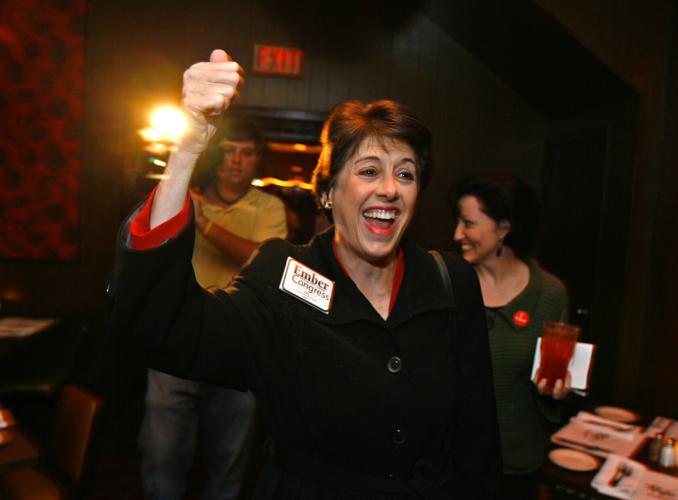
“Over 30 years ago, I authored into law, with a strong bipartisan coalition, the first charter school law in the country, allowing publicly-funded open-enrollment schools to operate within a state’s system of public education,” former Minnesota state Sen. Ember Reichgott Junge said in the brief. “Since then, the law has been enacted in 45 states (now 46 states), in each case reinforcing that charter schools were always public schools.”
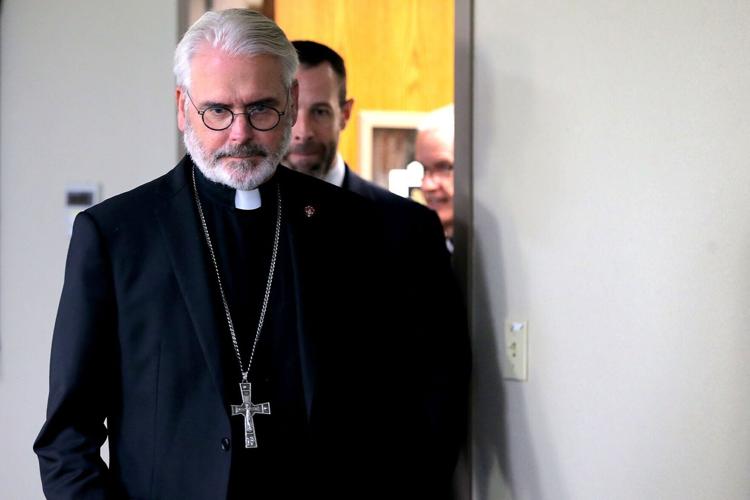
Oklahoma Catholic leaders claim that charter schools are actually private schools and that denying them access to government funding to open one to provide greater access to Catholic school education across the state would violate their right to free exercise of religion.
They secured state sanctioning for St. Isidore of Seville Catholic Virtual School in 2023, despite state statute here defining charter schools as public schools, as well as state statute and federal regulation specifically prohibiting them from affiliation with a nonpublic sectarian school or religious institution.

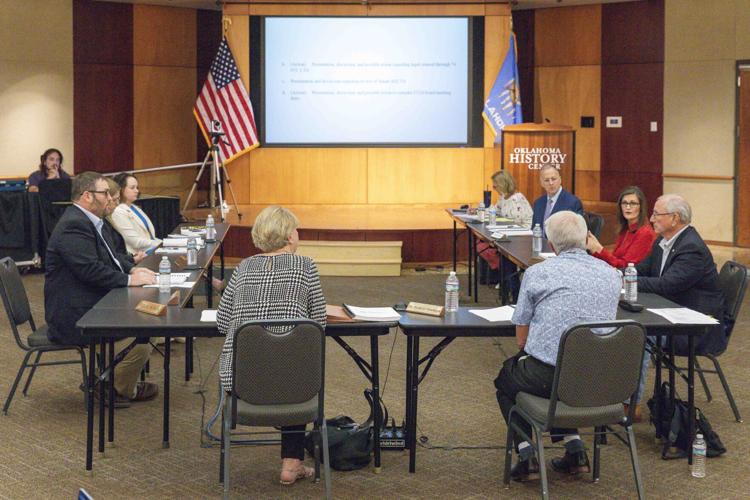
Members of the Oklahoma Statewide Virtual Charter School Board discuss the St. Isidore of Seville Catholic Virtual School on June 19, 2023. Oklahoma Attorney General Gentner Drummond has assailed the state sponsorship of the private school as “clearly unconstitutional” and against his office’s repeated legal warnings.
Oklahoma Attorney General Gentner Drummond sued, and the Oklahoma Supreme Court ruled in June that a religious charter school is unconstitutional, halting St. Isidore’s planned August 2024 opening for its 200-plus applicants.
Eighteen attorneys general also filed briefs with the U.S. Supreme Court to convey their concern about a ruling in favor of St. Isidore’s appeal potentially upending charter school laws in their states.
The high court’s decision is expected this summer.
‘They are going to wreck it for everyone else’
The National Alliance for Public Charter Schools was among 76 organizations from within the charter school movement — including charter school authorizers or sponsors, school leaders and parents — that submitted briefs this week in favor of the Oklahoma Supreme Court’s 2024 decision.
In an interview with the Tulsa World, Starlee Coleman, president and CEO of the National Alliance for Public Charter Schools, said: “The implications beyond the separation of church and state are not well-understood. This is a huge, huge issue.”
The new amicus brief from the leading national nonprofit organization on advancing the public charter school movement claims that if charter schools are not treated as public schools, the per-pupil funding for public schools that charter school founders and advocates fought for years to access could be lost, putting charter school operations and facilities in jeopardy.

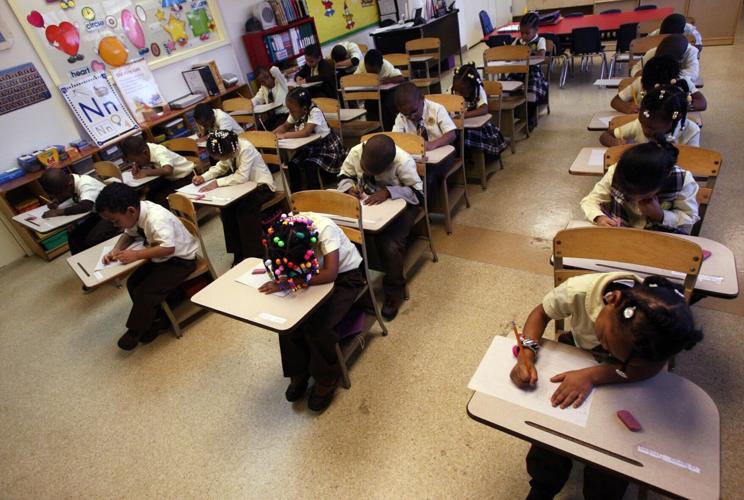
The Deborah Brown Community School was one of the first charter schools in Tulsa when it opened in 2000.
Further, the brief states that another ripple effect of charter schools being found to be private entities would likely call into question charter school teacher participation in many states’ retirement or health care programs for public school educators.
“The thing we just keep coming back to is what exactly are these people after? Because there is already a mechanism to fund private school programs with taxpayer money in Oklahoma and dozens of other states. What is this really about? Because it does not feel like an effort to expand school choice for students who do not have it,” said Coleman. “We don’t have a value judgment on the value of private schooling or religious education or parochial schooling. For millions of people across the country, that is already an excellent choice.
“The only way the Supreme Court gets to a ‘yes’ in this case is to say, ‘Yes, charter schools are actually private schools.’ If we are private schools, then we cannot access per-pupil funding. They’re not going to get what they say they want, which is money — and they are going to wreck it for everyone else.”
The three-decade-old charter school movement was founded and driven by people seeking a different kind of public school — but a public school, nonetheless, and recognition as such was hard-won in the early years, Coleman added.
“The people who start charter schools have chosen to start public schools. If they wanted to start a private school, they could have done that — but they didn’t,” she said. “They believe there is intrinsic value in having choice within the public school system, and the teachers who teach there and the parents who enroll their children there are actively choosing to be in that public school system.
“In some states, charter schools are the only means of school choice. In the blue states, the massive political backlash to publicly funded religious schools that we are worried about is if the choice becomes having religious charter schools or none — then the result could be: ‘We choose none.’”
Religious education already among parents’ choices
In a recently filed legal brief laying out the legal arguments of Oklahoma’s attorney general, St. Isidore of Seville Virtual Catholic Charter School and its supporters’ claim that it is a private entity were labeled “an erroneous conceit” on which the proposed school has staked its legal claim.
Charter schools “bear all the classic indicia of public schools,” states Drummond’s brief. “Public charter schools are free, open to all, established and funded by the state, and can be closed by the state. Moreover, public charter schools are subject to state regulation and oversight concerning curriculum, testing and similar matters. It is thus no surprise that federal law and the laws of 46 states, including Oklahoma, define charter schools as public schools.”
Drummond stated that the “exclusion of religious institutions from generally available benefits programs based solely on religion is odious to the Constitution” and that while he “condemns such discrimination,” he also pointed out that Oklahoma’s other school choice options include tax credits and tuition assistance for religious private schools.
“Oklahoma readily agrees that there is no categorical bar against public monies reaching (and funding) private religious schools, including for devotional instruction and ministry, through such parental choice programs,” states his brief. “No one doubts that such an education can be profoundly valuable. But it is not one that states must provide in public schools.”
The National Association of Charter School Authorizers, a nonprofit organization dedicated to advancing and strengthening the practices by charter school sponsors to ensure high-quality charter schools, filed an amicus brief echoing the claim that all charter schools are public schools.
But it also raised an additional point about that argument, based on the facts that 92% of authorizers or sponsors of charter schools are local or state school boards, school districts and state departments of education and the remaining ones are delegated their authority by the state, such as independent state boards and commissions, colleges and universities, and other entities deputized by the state for that purpose.
These sponsors set academic and operational expectations from the outset, oversee charter school performance, and ensure compliance with applicable laws and policies in determining whether they should remain open or must close.
“If the court sides with the petitioners, the very nature of authorizing (charter schools) will require government-endorsed sponsors to evaluate and approve the religious teachings espoused by each charter school operator that elects to run a religious charter school,” states that organization’s new amicus brief.
“Authorizers are required to make judgments between high-quality and low-quality educational approaches. Approval of some religious charter school proposals but not others risks constant litigation and exposure to regular accusations of animosity to one particular religion or another.”
February video: AG Gentner Drummond explains how he wins the St. Isidore case before the Supreme Court
Oklahoma Attorney General Gentner Drummond explains how he wins the St. Isidore of Seville Catholic Virtual School before the Supreme Court: Drummond explains the case and how he plans to prevail during a Tulsa Press Club Town Hall in February.