

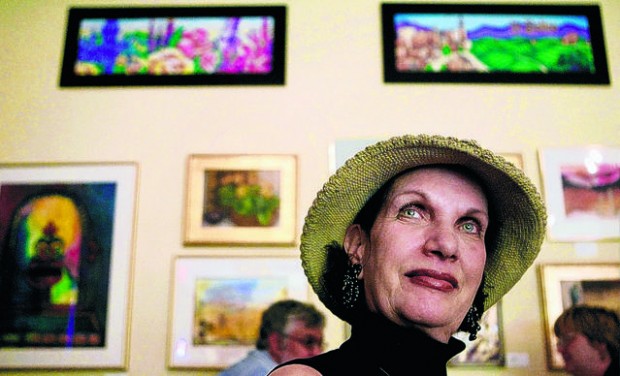
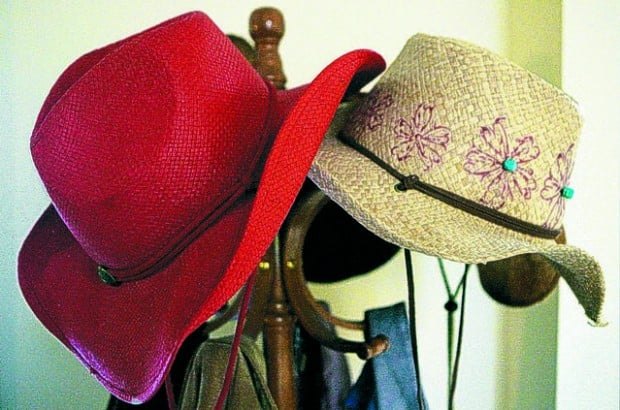
She says people call her "The Hat Lady."
Ball caps, straw hats, cowboy hats and crocheted hats — Barbara Russek wears them all, and as Tucson prepares for another sweltering summer, she hopes she can convince others to put on a hat to help protect against skin cancer.
"A hat is great way to have a little fun and a little fashion and to protect yourself from the sun," the Foothills resident said.
Russek said she has always loved the way hats look, but their function became even more important to her when she moved to sunny Tucson more than 25 years ago.
Now she is making it her mission to encourage others to wear hats as a precaution against skin cancer.
Skin cancer is the most common of all cancers, according to the American Cancer Society.
People are also reading…
Russek, who has known several people affected by skin cancer, said she's amazed, especially in the desert, how many people do not wear hats to shield themselves from the sun.
"I know a lot of people are sun worshippers, but you have to be careful with that," said Russek, a freelance writer and former Tucson Unified School District French teacher who still teaches private French lessons.
Wide-brimmed hats advised
Dr. Robyn Glaesser of Ironwood Dermatology recommends hats with at least a 4-inch brim all the way around for the best sun protection.
And the Tucson dermatologist stresses that hats are only one component of smart skin care. Glaesser also recommends people avoid overexposure to the sun between 9 a.m. and 4 p.m., wear sun-protective clothing — such as pants, tightly woven shirts or specialty clothes with a built-in sun protection factor — and wear a sunscreen high in zinc oxide or titanium dioxide with an SPF of at least 30.
"Arizona is the second-highest location in the world for skin cancer," Glaesser said. "No. 1 is Australia, and I suspect that we'll outdo them at some point because they have a much better sun-protective campaign countrywide than we have."
At 50-plus, Russek doesn't like to share her exact age, even with her closest friends, but she credits her hat-wearing and good sun sense for keeping her skin cancer-free over the years.
Besides protecting against cancer, Russek said hats can also go a long way in shielding the skin from visible sun damage and aging. That's why she recommends wearing a hat as a cheaper alternative to Botox or face-lifts.
She said the fact that she stands out to so many people as The Hat Lady just goes to show that not enough people are covering their heads.
"A certain elegance"
With a collection of 20-plus hats in various styles, shapes and colors, Russek said she rarely leaves her home, near East River Road and North Campbell Avenue, without wearing one of them.
If she's swimming in the pool, she wears a ball cap. If she's country dancing, it's a cowboy hat. Russek even designed special headgear for riding her bicycle — she ties a scarf around her ears and puts on a visor under her bike helmet for added sun protection.
To Russek's friends, hats are just a part of who she is.
"When you live in Tucson it just makes a lot of sense," said friend Miriam Furst. "Plus, she really looks cute. It gives her a certain elegance."
Marcia Gold, who has known Russek more than 20 years, said she sometimes tries to persuade her friend to ditch the hat and show off her locks instead.
"We try to talk her out of it sometimes, because she has beautiful hair. It's naturally curly with no gray," she said.
However, Gold understands all too well the importance of the message Russek tries to send with her headgear.
Gold has been treated for melanoma and basal cell carcinoma, and she was scheduled to undergo surgery today for a form of skin cancer called squamous cell carcinoma.
Gold blames years of youthful sunbathing in Chicago for the cancer. "We didn't know any better then," she said.
While knowledge about sun protection has come a long way, Russek continues to wonder where all the hat wearers have gone.
In the meantime, she said she'll keep urging her friends to avoid the midday sun and to wear sunscreen, sunglasses and something on their heads.


