

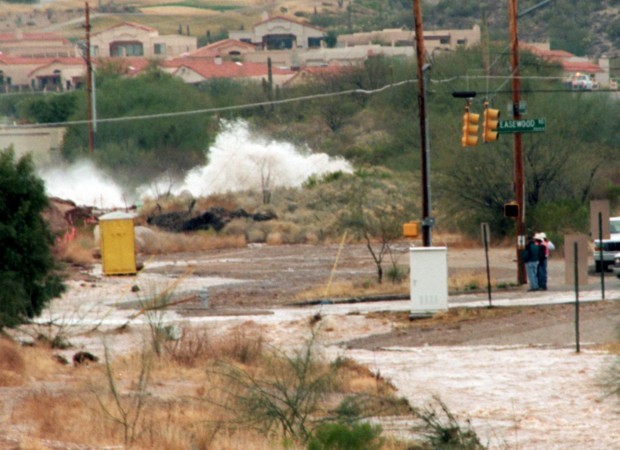
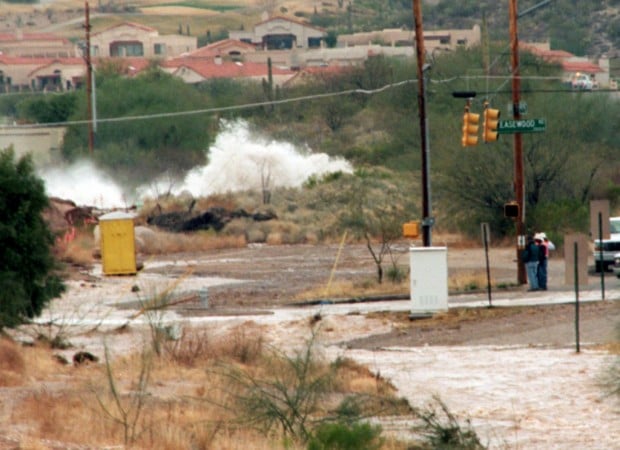
The same waterline that broke and flooded a west-side neighborhood in 1999 has shown signs that it is about to blow again.
But this time there will be no repeat of the earlier disaster, which spilled 38 million gallons of water into the Paseo Vista Neighborhood and cost the city $2.5 million, in part to buy four homes and fix dozens of others.
Since the 1999 flood, the city has installed a sensor to warn it about the problem, and fixes are under way to avoid putting any more homes under water.
The troubled section of pipeline, at Starr Pass Boulevard and Greasewood Road, is just upstream from where the same 96-inch main broke 13 years ago.
Fernando Molina, Tucson Water spokesman, said the difference between now and then is the pipeline monitoring system.
In 2007, Tucson Water installed fiber optic cables along 20 miles of its main waterlines at a cost of about $5 million. The cables operate by picking up sounds along the pipe and transmitting them back to Tucson Water.
People are also reading…
"It gives us a heads-up warning," Molina said. "We get automatic, instantaneous notifications. … We don't have to wait around for something bad to happen before" we react.
In this instance, the cables indicated wire bands wrapped around the outside of the 9-inch-thick concrete pipe began to snap.
When the wires become corroded, they start to break.
"As soon as you get one snap, you get a weak point," Molina said. "We were concerned because we noticed lots of snaps in a short period of time in the same pipe."
Molina said crews are draining the pipe in advance of excavating the site to determine what repairs are necessary. He added that motorists are able to maneuver around the workers at this time and do not need to take a detour.
He said that although it's too early to be certain, "significant work" will begin on the pipe next Monday with the goal of having the line back in service by Aug. 31.
Because the problem was detected before a serious break, Tucson Water was able to activate groundwater wells so no one's water service will be affected.
Molina said that's improvement in how the utility handles pipeline repairs.
"In the past," he said, "we would have to sit there and wait until the pipe burst, and then we would go into reactive mode, where we would be trying to manage the break and trying to manage getting people back on water.
"Right now, at a reasonable pace, we make sure we have the alternate water supply set up and ready to go," he said. "While we are doing that, we can have people preparing to do the excavations and repairs."
On StarNet: Read the Star's local politics blog, Pueblo Politics, at azstarnet.com/pueblopolitics
Contact reporter Darren DaRonco at 573-4243 or ddaronco@azstarnet.com


