
Power shovels used to excavate the earth have proved essential to the mining industry, including open-pit and coal mining in the United States, for 150 years.
Made up of a boom, dipper stick and open-topped bucket, power shovels’ sources of energy include steam, gasoline, gasoline-electric, diesel, diesel-electric and electric power.
Chassis improvements included metal tracks, wheels, caterpillar tracks and mobile steel railroad-track-mounted tables capable of a 360-degree revolution.
Before the late 19th century, pick-and-shovel laborers and animal power were the sole means of excavation for construction projects. William Smith Otis, credited with having invented the world’s first land-based “steam shovel”-type excavator in 1835, patented it four years later.
By the 1870s, the Industrial Revolution was in full gear in the U.S. with mining, railroads, steel production and construction. Two major American power shovel producers were Bucyrus Foundry and Manufacturing — which produced its first steam shovel in 1882 — and Marion the following year.
People are also reading…
Steam shovels began to mine iron ore in 1891. Stripping coal since 1877, steam shovels began copper-ore excavation in 1896 and became standard equipment in quarry operations a decade later.
Although steam shovels had built railroad cuts earlier in Arizona, including the El Paso & Southwestern rail line to Tucson in 1911, the New Cornelia Mine was the first mine to employ steam shovels in Arizona mining operations beginning in 1916.
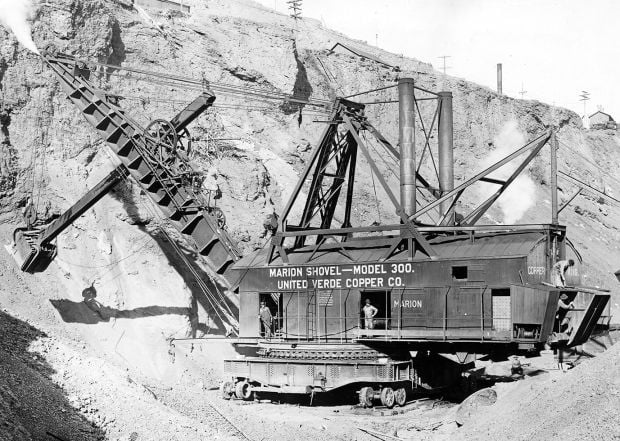
Two years later, the Marion 300 steam shovel, used in building the Panama Canal, was employed in open-pit mining operations in Jerome, cutting into the tough diorite rock.
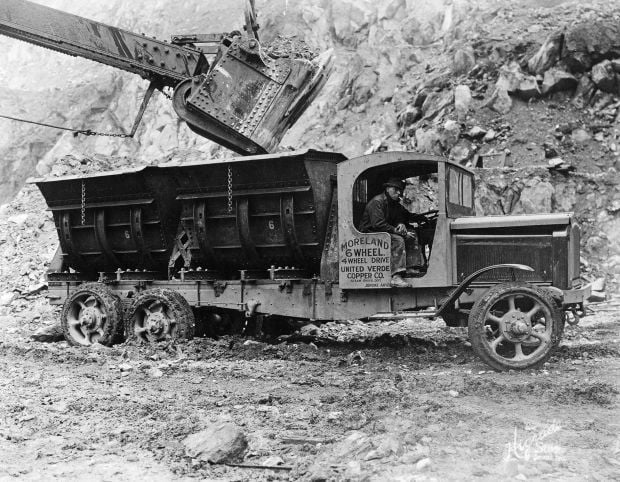
Permanently placed on a mobile railroad-track-mounted table and featuring an 8-cubic-yard dipper and two coal-fired boilers, it was operated by a four-man crew consisting of an engineer, a crane man, a fireman and an oiler to load ore onto railroad dump cars for shipment to the concentrator. Some of these shovels were taller than a 12-story building.
The driving force operating a steam shovel is steam provided by a boiler and a giant water tank. The fireman’s job was to stoke the boiler’s flames with coal, producing the power channeled by high-pressure steam necessary to operate the shovel’s pistons and main engine.
By 1931, Bucyrus-Erie 120-B, 4-cubic-yard electric shovels were used at Jerome, replacing the old Marion 300, 8-cubic-yard, coal-fired steam shovel, and Osgood Model 120, 4-cubic-yard, railroad-type steam shovels employed at Jerome since the initial stripping and waste removal for the open pit began in 1918.
Operating at less than a third the cost of their predecessors, this is the first instance of their use in Arizona. Examples of associated cost savings include the ability to successfully operate with one man and the reduction of coal cars needed to fuel the shovel. It also involved a reduction in labor needed to load the shovel and removed the challenge of supplying it under unfavorable circumstances such as logistics (such as when the steam shovel was working on a narrow ledge of an open pit).
The need to supply the boilers of steam shovels with continuous amounts of water was challenging due to availability, freezing temperatures and water impurities.
Finally, there were benefits in regenerative braking involving saving power and reducing brake wear.
Between 1918 and 1940, the United Verde Open Pit at Jerome produced high-grade ore averaging 3.4 percent copper, 2.07 ounces of silver and 0.071 ounces of gold per ton. During that period, the pit reached a depth of 1,100 feet below the rim, with more than 2.5 million tons of ore removed.
Electric shovels, many powered by 4,160 volts of electricity, continue the tradition of efficient coal and ore extraction in Arizona, including at the coal fields at Kayenta on the Black Mesa in Northern Arizona, and the porphyry copper mines of Bagdad, Mission, Ray and Silver Bell.
William Ascarza is an archivist, historian and author of six books. Email him at mining@tucson.com. For a list of the sources used in this story, see the online version at tucson.com