

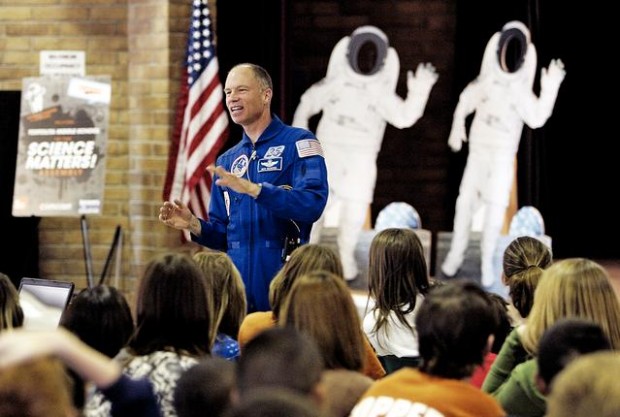
Former NASA astronaut Rick Searfoss knew the question would come. It always does.
A student at Tortolita Middle School asked, "How do you go to the bathroom in space?"
Searfoss' short answer: "Very carefully."
Actually, Searfoss said, it's a lot like using the bathroom here on Earth.
"Down here on Earth, you have probably never thought about it in your whole life, (but) gravity is your friend when you go to the bathroom," he said.
Searfoss said gravity is replaced in space with a device that circulates the air and moves the waste away from the astronauts.
The Tortolita student asked the question during a "Science Matters" assembly held last week at the middle school to spark students' interest in science.
People are also reading…
The Comcast cable-TV and Internet provider, along with the Science Channel, chose Tortolita to take part in a public-service-announcement challenge.
As part of the challenge, the school received $5,000 from Comcast and the Science Channel, and visits from Searfoss and Discovery Communications' chief scientist, Steve "Jake the Science Guy" Jacobs.
Discovery Communications is the parent company of the Science Channel.
The Marana Unified School District is one of only 15 districts across the country taking part in the Science Matters Initiative.
Both of Marana's middle schools — the other is Marana Middle School — can participate in the public-service-announcement challenge. For the challenge, a class can submit an announcement in any format explaining why students think science matters and how it's relevant to people's daily lives.
The winning class will receive $25,000 for a new science classroom and a video iPod for each student in the class. In addition, the public-service announcement will air on the Science Channel in July.
Science was an integral part of the space shuttle mission that Searfoss commanded in 1998.
Searfoss and his crew studied what effect space travel can have on the human body, specifically the brain and nervous system.
And while the Tortolita students were intrigued by the mission, their interest blossomed when Searfoss spoke with excitement about weightlessness and some of the other highlights of space travel.
"It's just a spectacular feeling of freedom — of feeling more athletic then you really are," Searfoss said about weightlessness. "But as great as that is, it still doesn't compare to the best part of the experience, and that is seeing our incredible, beautiful planet Earth from space."
Searfoss, a retired Air Force colonel, piloted two other space shuttle missions.
"He has a lot of guts to go into space knowing that other missions have failed and people have died," seventh-grader Drew Misner said.
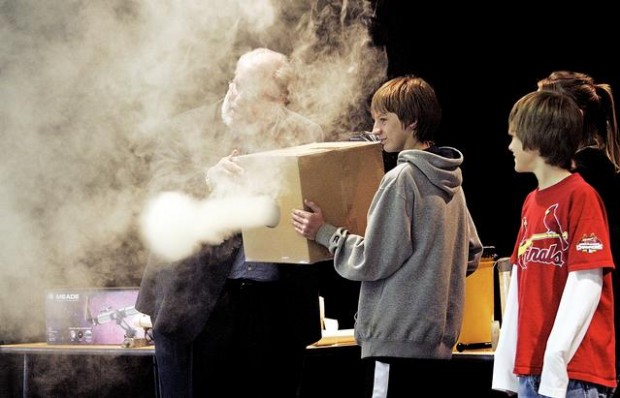
Misner and classmates Andreya Carfagno, Ashley Noel and Ryan Moore were part of Jacobs' science demonstrations — which included proving that air exists even though it can't be seen.
Jacobs, who helps write for the "Mythbusters" television show, also offered some advice to the budding scientists in the room.
"Scientists have to learn how to think before they speak," he told the students. "If you can do that, you are halfway there to becoming a scientist."
Jacobs said he enjoys speaking to students because he doesn't want there to be any misconceptions about who scientists are. "It's not just for old men with beards in laboratory coats," he said.
Students liked the approach Jacobs took to illustrate how science can be fun.
"I think it was cool he came and showed us hands-on science, because it might show kids a different view of science," said Noel, a seventh-grader. "Labs can be boring, (but) you can make it fun."


