

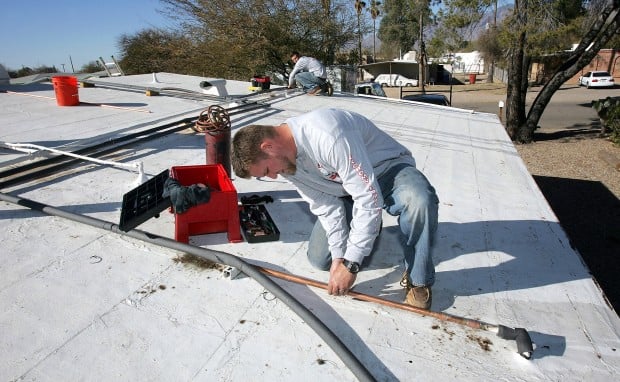
Here's what we know about the four-day freeze that swept through the area earlier this month.
It left plumbers booked for days.
The freeze recorded the second-coldest February temperature in the annals of Tucson weather, behind a 17-degree day in 1899.
Tucson Water demand went from 76 million gallons on Wednesday to 111 million gallons on Thursday, as leaks erupted in water pipes and other facilities.
Water workers counted at least 300 instances of damage to their own facilities, from reservoirs and booster pumps, to pipes and equipment, and had to shut down service to 3,000 customers.
And it could absolutely happen again.
"What this really comes down to is, Arizona wasn't ever prepared for anything like this," said Bryan Foerster, owner of Economy Plumbing Service, who said his phone started ringing at 3 a.m. that first day. He got so many calls, the battery to his cell phone surrendered altogether, and he could barely check messages with the volume coming in.
People are also reading…
Building officials readily acknowledge the plumbing codes are not adequate to prevent wide-scale problems in deep freezes like one we just experienced.
And certainly, Tucson wasn't the only warmer-weather area having problems.
After 72 hours of below-freezing weather triggered breaks and leaks throughout El Paso's water system, that city, too, suffered a water shortage. The water utility asked consumers to boil their water and refrain from using water for anything but drinking, including showering, using dishwashers and washing cars, and the mayor declared an emergency.
There are ways to make sure freezing temperatures don't bust pipes and equipment. In cold-weather places in the Midwest and north, pipes are buried deeper in the ground. They come up inside of walls instead of on the exterior of buildings. Pipes sometimes carry larger volumes. Equipment might be sequestered inside a vault instead of exposed to the elements.
Larry Cummings, owner of Arico Plumbing, formerly made his home in Oregon, where people know how to deal with cold.
Developers there have to bury pipes at least 3 feet deep. Pipes can't come up an outside wall.
Here? He's going to be busy for two months because of that four-day run when temperatures dropped to 18 over two nights in a row.
While customers aren't waiting 45 minutes on the phone anymore, and aren't calling with stories of water spraying off their roofs or running down their drywall, they're now attending to the lesser damage incurred in the storm, such as fixing irrigation lines.
The system didn't zap just the people who didn't take precautions. There were plenty of broken pipes even though they were wrapped in insulation.
Plumbers note insulation only slows down heat loss. If there's another four-day cold snap when temperatures stay consistently subfreezing, insulation isn't going to be the salvation. "People think if they wrap their pipes, they're good, but that's not the case," Cummings said. "If it's cold enough for long enough, they will freeze."
While most point to how long it was cold - instead of simply that it was cold - the stretch didn't break a record for sustained cold. The record was in 1913, when there were 16 days in a row below freezing. There were six days in a row in 1937 and eight in 1971.
Yves Khawam, the chief building official for Pima County, said plumbing codes are predicated on certain climate zones - and the area's design temperature is set to 32 degrees.
That's because building codes set a minimum threshold, he said, but aren't intended to anticipate every emergency. He drew a parallel with wind speeds. Buildings are designed to withstand winds of 90 mph, he noted, which is usually fine - until a 140-mph microburst tears your roof off.
Plumbing codes require pipes to be buried a certain threshold under the "frost depth" - or how deep into the soil a freeze will penetrate.
While foundations on Mount Lemmon have to be set below 24 inches, Tucson has no frost depth. The code requires pipes to be set 12 inches deep, but that's more to protect the pipe itself from a gardener with a green thumb and a sharp trowel, for example.
The department also doesn't regulate where pipes are running, so developers can run them inside or outside a structure and the code doesn't have much to say about it, except for some energy-efficiency requirements on hot-water pipes, for example.
"If we were to regulate every possible failure in a building," Khawam said, "the cost of the building and the onerous requirements would be truly egregious. That's the balance we always face."
He noted regulators have been on the receiving end of bad press for complaints that they've set up overweening requirements on businesses and developers. That, compounded by a stubborn economy, means "adding more requirements is not a solution I deem viable at this time."
Those sentiments were echoed by Ron Boose, Khawam's counterpart at the city of Tucson.
He's from Minnesota and was initially surprised to see Tucsonans had pipes running along the outside of their homes or over their roofs.
His former home state sets pipes 5 feet deep and eight to 12 inches inside the wall, while homeowners blow out their irrigation systems when winter settles in.
Those types of interventions run up the cost of construction, he said, and would probably only apply to new construction - which wouldn't end up helping most homeowners out there anyway. "In this economic climate, I would tend to resist anything that would add to the cost of a home because people are really struggling right now."
Still, he said, he might be willing to run some of the ideas by a citizens' advisory panel to see if they're interested in having the discussion. After all, he said, other parts of the country build to sustain earthquakes - and those don't happen very often either.
Tucson Water notes it has standard maintenance procedures which allows it to continue operations without much disruption in the low 20s.
Spokesman Fernando Molina said the utility is examining prevention techniques and already has identified some simple fixes, such as installing heater cables at some vulnerable sites. But, he said, the utility will have to examine the merits of more aggressive measures - such as installing equipment in underground vaults. The staff will weigh the added costs, which he said would be significant, against the possibility of encountering such extreme weather in the future.
"What this really
comes down to is, Arizona wasn't ever prepared for anything like this."
Bryan Foerster
owner of Economy Plumbing Service
Contact reporter Rhonda Bodfield at rbodfield@azstarnet.com or 573-4243.


 Analysis: These 9 TUSD schools are at highest risk of merging or closing


