
Editor's note: This is the second in a two-part series about the colorful "Colonel" William C. Greene, who is credited with developing mines in Cananea, Sonora.
The years 1899 through 1906 were profitable for "Colonel" William C. Greene, whose title was honorary and not bestowed by the military.
During that time, he amassed a fortune of more than $12 million through his many business ventures, including the Sierra Madre Land and Lumber Co., which supplied lumber to the Cananea Mines. He established the Rio Grande, Sierra Madre and Pacific Railroad with the dual intent of transporting timber and providing accessibility between Cananea and the West Coast. He also founded the Greene Cattle Co. in Arizona and the Cananea Cattle Co. in Mexico.
His other lucrative investment companies included the Greene Gold-Silver Co. and the Greene Consolidated Gold Co. These firms made money buying up gold and silver mines in northern Sonora, Mexico.
People are also reading…
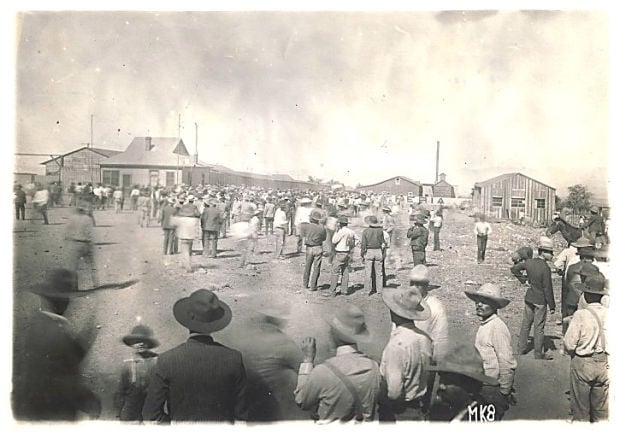
The year 1906 marked a turn in fortune for Greene. Although his copper enterprise was producing 50 million pounds of copper a year, on June 1 the Cananea miners instigated a strike, temporarily setting back production.
The strike was led by a newly formed junta (committee) of the Liberal Party organized by the Flores Magón brothers based in St. Louis, Mo. The junta pushed Mexican miners in Cananea to address their grievances for higher wages and less foreign (American) control over the mine.
At the time, American miners were paid $5 for working 10 hours, while Mexican workers were paid 3 pesos, or $1.50, for the same amount of work.
Mexico's president, Porfirio Diaz, supported foreign investment in his country and the opening of formerly inaccessible regions to commercial enterprises such as mining. But his 30-year rule over Mexico was considered by many of his countrymen to be imperial, and an underground labor movement with connections abroad sought his removal from office.
The strike began in the lumberyard of the Cananea Consolidated Copper Co. and ended in gunfire and violence that left more than 20 miners and six company men dead. Greene called in Capt. Thomas Rynning of the Arizona Rangers along with 275 Bisbee volunteers to quell the strike.
On the Mexican side, 75 rurales (a federal rural militia) arrived under the command of Russian-Mexican cavalry commander Lt. Col. Kosterlitzky. The strike ended after two days, but the unpopularity of the Diaz government led to the Mexican Revolution in 1910.
Greene's additional burdens included increasing costs of production combined with lower-grade copper ore (less than 3 percent) being produced.
Greene was heading toward bankruptcy. By the end of the year, powerful copper investors with the Amalgamated Copper Co. (Anaconda), Thomas F. Cole and John D. Ryan, provided the $6 million needed to sustain Greene's mines in Cananea. However, they effectively took control of the enterprise, forming the Cananea Central Copper Co.
Although Greene survived the crisis of 1906, his fortunes were forever lost. He lived until August 1911, succumbing to pneumonia caused by a carriage accident.
Greene left a far-reaching legacy - along with being known as the moving force in the development of the copper-mining industry in Cananea. For more than a half-century after his death, various landholdings in Southeastern Arizona and Mexico remained under his family's influence.
Writer William Ascarza is an archivist, historian and author of five books, including "Arizona-Sonora Desert Museum," available at Antigone Books, Cat Mountain Emporium and the Arizona-Sonora Desert Museum. Email him at mining@azstarnet.com Sources: Bernstein, Marvin D., "Colonel William C. Greene and the Cananea Copper Bubble," Bulletin of the Business Historical Society, Vol. 26, No. 4; Hadley, Diana, "Landholding Systems and Resource Management in the Sky Island Borderlands," 2005, USDA Forest Service Proceedings RMRS-P-36; Sonnichsen, C.L., "Colonel Greene and the Copper Skyrocket: The Spectacular Rise and Fall of William Cornell Greene, Copper King, Cattle Baron and Promoter," Arcadia Publishing, 1974; and Sonnichsen, C.L., "Col. W.C. Greene and the Cobre Grande Copper Company," The Journal of Arizona History, Vol. 12, No. 2 (Summer 1971).


 Analysis: These 9 TUSD schools are at highest risk of merging or closing