

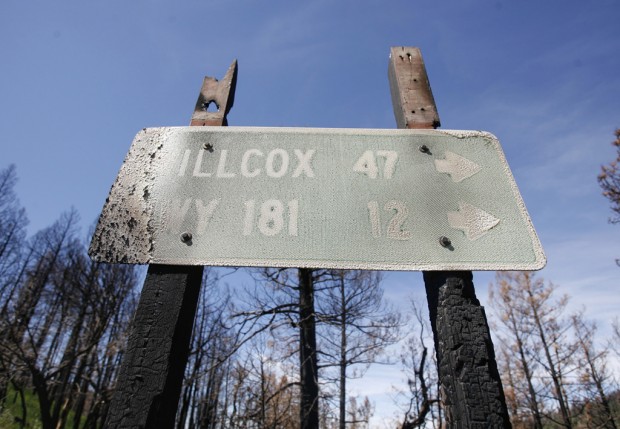
Everything comes back after a fire - even a big wildfire like the 223,000-acre monster that blazed through the Chiricahua Mountains for 45 days this summer.
The grasses are first, greening up the blackest hillsides, assisted by seed dropped from helicopters.
Wildflowers bloom on the apron of the "42 Road" - the unpaved transmountain route between the Willcox and Portal sides of the Chiricahuas.
From the western or Willcox side, the road follows Pinery Canyon into scenes of devastation. This is where the fire got away from its managers, who had kept it tame on the eastern flanks, then failed to hold it along the crest of the range.
Incessant wind blew flames through historically dry timber, brush and grass.
Many of the oaks and pines of Pinery Canyon were blasted into charcoal, but even here, identified on the burn-severity map as "high-intensity," there are green trees on slopes where the wind did not push the flames. Oak leaves sprout from blackened trunks.
People are also reading…
Where the road winds above 8,000 feet in elevation, Rustler Park is greened up and dotted with yellow flowers.
Towering black skeletons of huge pines overhang the picnic tables, ready to drop limbs in a stiff breeze.
Bill Edwards, ranger for the Douglas district of the Coronado National Forest, wants to clear the trees this winter, rebuild the burned restrooms and erect ramadas to re-create shade these trees once afforded.
If all goes well, Rustler Park, the most popular summer site in the Chiricahuas, will be ready to welcome guests next summer.
Rustler is another area of high-severity burn, a category that covers 12 percent of these mountains. And here, as in Pinery Canyon, not all is lost.
On the ridges trees are mostly blackened, but there are green stands and others with a good percentage of green needles.
They will survive, said Edwards, if they get some rain this winter and the beetles don't infest them.
Better news awaits on the east, or Portal, side.
Here, where the Horseshoe 2 Fire began, a series of firefighting teams forced it to burn slowly.
Cave Creek flows clearly through a riparian mix of sycamores, ash trees, oaks and conifers.
In South Fork, where birders come from around the world to observe neo-tropical birds at the northern limit of their range each spring and summer, you have to look closely to see the singed bottoms of the trees, now masked in grasses.
Animals are following the returning vegetation back into their forest habitat, said Gilbert Gonzales, wildlife manager for the Arizona Game and Fish Department.
Gonzales predicts healthy populations will grow fat on fire-stimulated forage.
The hunters will follow the animals.
The birders will follow the birds.
The campers will return.
The fragile tourist economy, reliant on this forest, will rebound.
That message was the purpose of a Wednesday tour, organized by the U.S. Forest Service and the office of U.S. Rep. Gabrielle Giffords, D-Ariz., to spread the word that this forest is open.
Fire will also return, said Edwards, and will be easier to manage because of the clearing this one has done.
"This is a unique opportunity to allow fire to perform its natural role in the forest," he said.
Contact reporter Tom Beal at tbeal@azstarnet.com or 573-4158.


