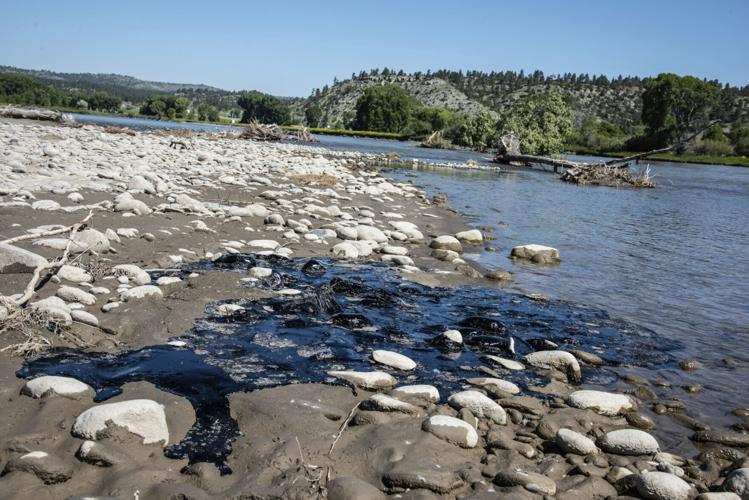
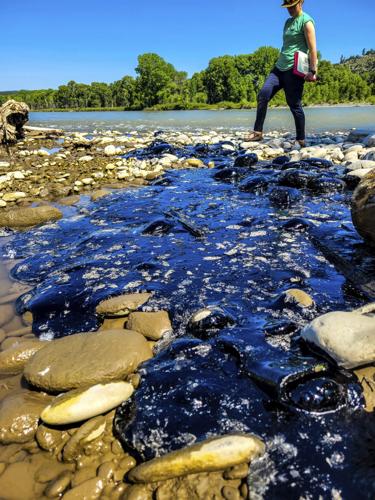
HELENA, Mont. — Globs of asphalt binder that spilled into Montana's Yellowstone River during a bridge collapse and train derailment could be seen on islands and riverbanks downstream from Yellowstone National Park a week after the spill occurred, witnesses report.
Officials with the Environmental Protection Agency said cleanup efforts began on Sunday, with workers cooling the gooey material with river water, rolling it up and putting the globs into garbage bags. It will probably be recycled, said Paul Peronard with the EPA.

Petroleum products cover areas along the banks of the Yellowstone River July 1 near Columbus, Mont.
Alexis Bonogofsky, whose family's ranch was impacted by an oil spill on the Yellowstone River near Billings in 2011, took pictures Saturday of the refined petroleum product covering rocks and sandbars. She also snapped an image of a bird that had died in the black substance.
“This killdeer walked across the asphalt, which had heated up in the sun, and it got stuck and died with its head buried in the asphalt," Bonogofsky wrote in the caption of an image she posted on social media. "You could tell where it had tried to pull itself out.”
People are also reading…
A bridge over the river collapsed as a train crossed it early on June 24 near the town of Columbus and 10 cars fell into the water, spilling liquid asphalt and molten sulfur, officials said. Both materials were expected to cool and harden when exposed to the cold water, and officials said there was no threat to the public or downstream water supplies, officials said.
However, the asphalt binder behaved differently.
“This stuff is not sinking in this water,” Peronard said. “It adheres really well to rock, and we can roll it up like taffy on the sand.”
Bonogofsky, in another of her photos, captured a sheen on the water. She said the spilled material heated up with warmer temperatures and “you can smell it.”
The Montana Department of Environmental Quality, the EPA and Montana Rail Link — the entities managing the cleanup — said more asphalt product was released Friday as a rail car was being removed from the river.
“Initial assessments indicate the release was minimal based on the amount of material believed to still be remaining in the impacted car,” the statement said.

Rocky Mountain College Environmental Science summer research student Josephine Eccher examines a mat of petroleum products more than 10 feet long and several inches thick along the Yellowstone River on June 30 near Columbus, Mont.
Professor Kayhan Ostovar with the Yellowstone River Research Center at Rocky Mountain College also took pictures Friday of the petroleum product that had washed onto the riverbank about 6 miles downstream from the spill.
Ostevar's team has been conducting turtle surveys below the derailment and is sharing the GPS locations of sensitive sites that are near areas where the asphalt binder has come to rest.
Turtles are particularly vulnerable to this type of spill, Ostovar said, because they are leaving the water right now to seek out nesting sites on gravel bars and basking in the sun.
The center was created after the 2011 ExxonMobil pipeline breach to gather better baseline information on species of concern that live in and around the Yellowstone River.
Statements from the agencies and the railroad over the past week have asked people to report the sighting of asphalt materials on the riverbank via email to rpderailment@mtrail.com, and have listed a phone number — 888-275-6926 — for the Oiled Wildlife Care Network to report animals with oil on them.
Bonogofsky argued it shouldn't have taken more than a week to develop a cleanup plan, especially since it’s known what materials the trains haul through Montana, as well as the damage the 2011 oil pipeline spill caused.
“We should have plans in place for this and we should have learned our lesson in 2011,” she said, arguing that work to clean up the asphalt binder could have happened at the same time they were removing rail cars from the water.
The last of the rail cars was expected to be removed from the water on Sunday, Peronard said, while agricultural users were notified that they could resume using river water for irrigation. Their irrigation canals had been shut down as a precaution.
Cleaning up spills of petroleum products is “somewhat of a losing game,” Peronard said. "We are never going to recover all of the oil here ... and there's likely to be impacts when we are done. That is unavoidable.”
As far as the cleanup delay, he said the response to any accident starts with protecting human lives, controlling the source of the spill and then protecting the environment. He said the agency also had to make sure its cleanup plan did not cause more harm than good for bird and turtle nests in the area.
Cleanup crews also have to stay at least a half mile away from eagles nesting in the area, Peronard said.
The spilled asphalt material is not water soluble, he said.
Stock your car first aid kit with these essentials for summer road trips
1. Bandages

Small cuts and scrapes are common during road trips, especially if you plan on camping or hiking. Grab a variety pack of adhesive bandages to quickly address minor injuries and protect wounds from dirt. This 300-piece variety pack from Curad includes antibacterial, heavy-duty, and waterproof bandages in a variety of shades and sizes.
2. Gauze Pads and Tape

Hopefully you don't get a larger wound, but if you are in a more serious accident it’s helpful to have gauze pads and tape on hand. If you have an injury that’s too large for an adhesive bandage, apply the gauze directly to the wound to control bleeding and secure it with tape until you can seek medical attention. This Rite Aid variety pack includes sterile gauze pads and tape.
3. Alcohol Prep Pads

Keeping an injury sterile will help it heal faster and reduce the risk of infection. When you’re on the road, soap and water might not be available, so keep some alcohol prep pads, like these wipes from Ever Ready, on hand.
4. Anti-Itch Soothing Balm

While insect repellent is probably already on your packing list, bug bites and stings are inevitable if you spend enough time outside in the summer. This pocket-sized tin of soothing balm from Murphy’s Naturals will save you some discomfort.
5. Instant Cold Packs

If you sprain or strain your ankle on a hike, instant cold packs can be a serious vacation saver. These disposable cold packs from AllSett Health Store don’t require refrigeration and can help bring down pain and swelling.
6. Scissors and Tweezers

A pair of first-aid scissors can help you safely cut tape, gauze, or clothing in case of an emergency. Tweezers are also helpful to have for bee stings or splinters. This set from First Aid Only Store contains both for under five dollars.
7. Pain Relievers

Whether you sustain a sprain on a hike or just have a headache after a long day of driving, keeping an anti-inflammatory pain reliever, like Ibuprofen, on hand will ensure your summer road trip goes as smoothly as possible.
8. Aloe Vera Gel

Even if you slather on sunscreen, some sunburns can feel unavoidable in the summer. Keeping a bottle of aloe vera in your car first aid kit, like this hydrating gel from Sun Bum, can help you cool down.
9. Burn Relief Cream

Who doesn’t love long summer nights around the campfire? Unfortunately, sometimes minor burns happen to even the most careful campers. Keep some Neosporin burn relief cream in your car to treat any injuries.
10. Poison Oak and Ivy Wipes

No one wants to deal with an itchy rash from poison ivy or poison oak, especially while stuck in a car for several hours a day. If you run into any poison plants on your summer hikes, these Tecnu waterless detox wipes can remove the irritating oils so your skin clears up more quickly.