RAFAH, Gaza Strip — For a few hours every day or night, Dr. Suhaib Alhamss tries to sleep on a thin mattress in an operating room. He swings in and out of half-consciousness — too tired to open his eyes and too tense to let go. Thunderous shellfire often rattles the windows of the hospital he directs in the southern Gaza Strip.
But the worst sounds, Alhamss said, come from inside Kuwaiti Hospital: the cries of tiny children with no parents and enormous wounds. The panicked screams of patients jolted awake to the realization they've lost a limb.
The Israel-Hamas war, which started about 100 days ago, exposed him, his staff and the people of Gaza to a scale of violence and horror unlike anything they had seen before. It has rendered his hometown unrecognizable.
"This is a disaster that's bigger than all of us," Alhamss, 35, said by phone between surgeries.
People are also reading…

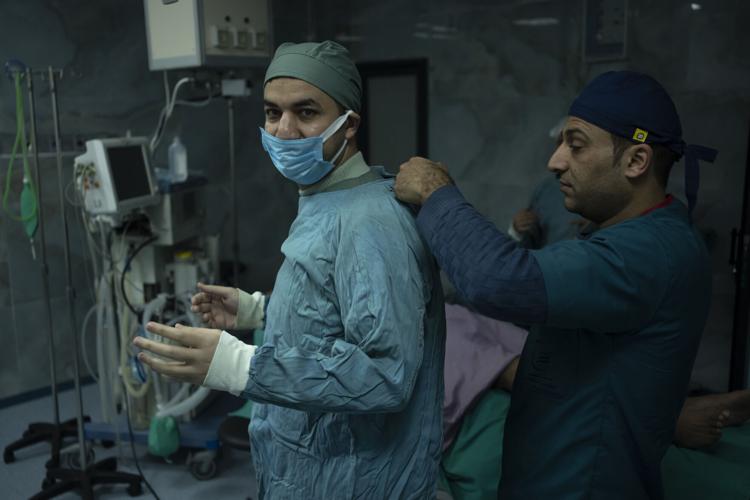
Dr. Suhaib Alhamss, director of the Kuwaiti Hospital in Gaza's southern town of Rafah, gets ready Thursday to perform surgery.
His hospital, donated and funded by Kuwait's government, is one of two in the city of Rafah. With just four intensive care beds before the war, it now receives some 1,500 wounded patients each day and at least 50 people dead on arrival — adults and children with shrapnel-shattered limbs and pulped bodies, bone-exposing wounds and tattered flesh.
Nearly 24,000 Palestinians in Gaza have been killed in the war as of Saturday, according to the Health Ministry in Hamas-run Gaza. The count does not distinguish between civilians and militants.
Israel, which mounted its blistering air and ground campaign in response to Hamas' Oct. 7 attack on southern Israel that saw 1,200 people killed and 250 others abducted, holds the group responsible for civilian deaths by embedding militants in buildings used by non-combatants.

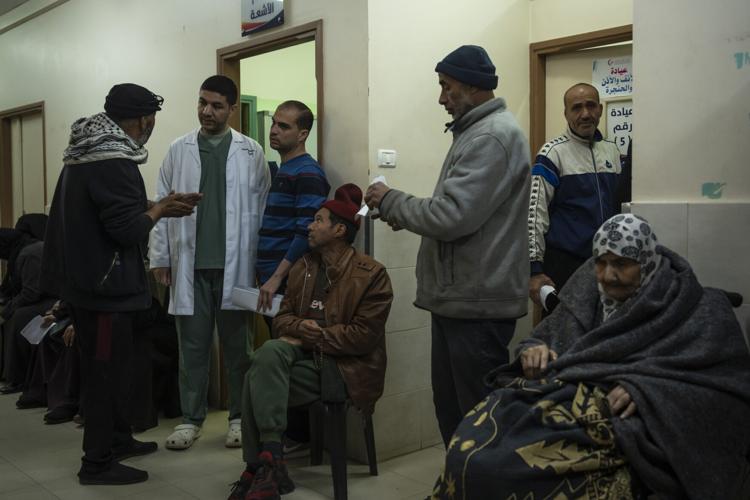
Dr. Suhaib Alhamss, director of the Kuwaiti Hospital in Gaza's southern town of Rafah, speaks with patients Thursday outside the X-ray department.
To make room for the daily rush of war-wounded, Alhamss has crammed a few dozen extra beds into the intensive care unit. He cleared out the pharmacy, which was largely empty since Israel's siege deprived the hospital of IV lines and most medicines. Still, patients sprawl on the floors.
"The situation is completely out of control," he said.
A urologist by training and a father of three, Alhamss watched aghast as his city and hospital transformed over the course of the war.
With its low-rise concrete buildings and trash-strewn alleys teeming with unemployed men, Rafah, the strip's southernmost city, long has been a squalid place straddling the Egyptian frontier. Notorious as a smuggling capital during the Israeli-Egyptian blockade, it contains Gaza's only border crossing that doesn't lead into Israel.

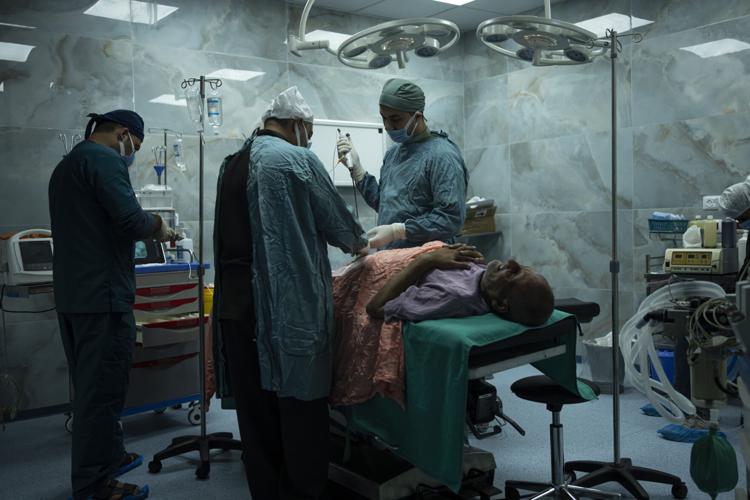
Dr. Suhaib Alhamss, director of the Kuwaiti Hospital in Gaza's southern town of Rafah, performs surgery Thursday on a patient.
Now it's the flashpoint in one of the world's worst humanitarian crises. Apartment towers have been blasted into flat, smoldering ruins. Israel's evacuation orders and expanding offensive swelled Rafah's population from 280,000 to 1.4 million, leaving hundreds of thousands of displaced Palestinians jammed into flimsy tents smothering the streets.
Most people spend hours each day in search of food, waiting in motionless lines outside aid distribution centers and sometimes plodding miles on foot to carry back canned beans and rice.
The faces he sees around the city changed, too, as Israel presses on with its goal of destroying Hamas.
Fear and strain crease the features of his colleagues, Alhamss says. Blood and dust smear the faces of the incoming wounded, while waxy gray skin and eyes circled by darkening rings are marks of the dying.

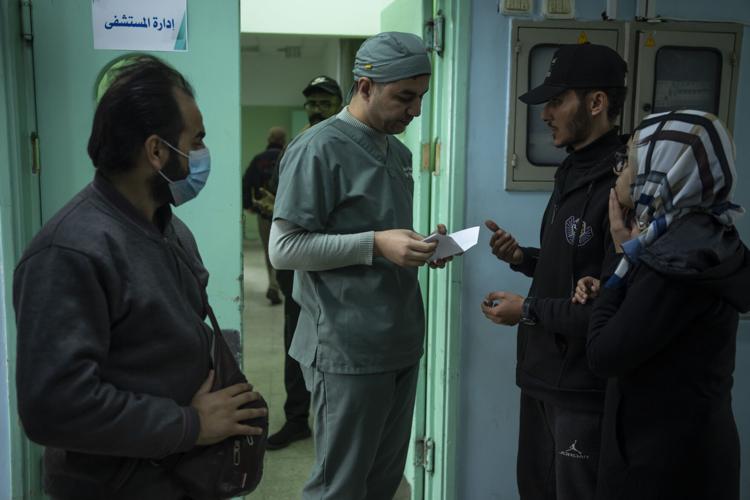
Dr. Suhaib Alhamss, director of the Kuwaiti Hospital in Gaza's southern town of Rafah, speaks with patients Thursday outside the hospital's administrative department.
"You can see the exhaustion, the nervousness, the hunger on everyone's faces," Alhamss said. "It's a strange place now. It's not the city I know."
Aid trucks have trickled through the Rafah border crossing with Egypt but it's nowhere near enough to meet the besieged enclave's surging needs, humanitarian officials say. In the absence of vital equipment, medical staff applied their ingenuity to new ends. Alhamss dresses patients' wounds with burial shrouds.
"Each day I have people who die before my eyes because I don't have medicine or burn ointment or supplies to help them," he said.

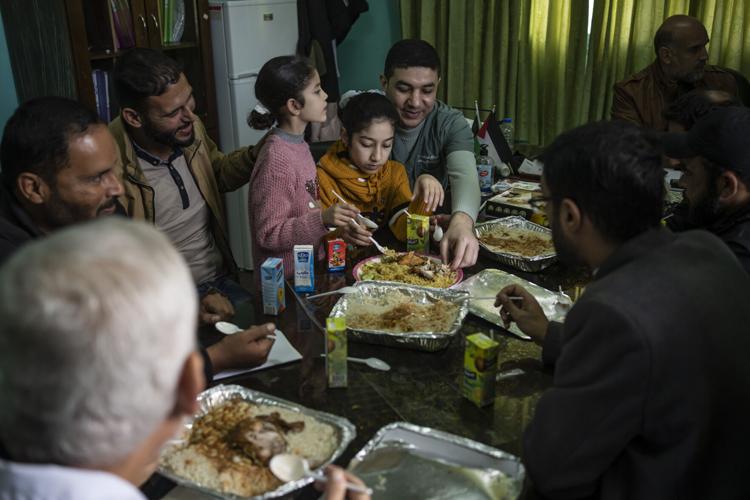
Dr. Suhaib Alhamss, director of the Kuwaiti Hospital in Gaza's southern town of Rafah, takes a break to eat with his young daughters Thursday during their weekly visit to the hospital.
He is too overwhelmed to dwell on all that he's seen, but some images spring up unbidden: the stare of a young boy who survived a strike that killed his entire family, a newborn rescued from his dead mother's womb.
"I think, how will they go on? They have no one left in this world," Alhamss said. His thoughts turn to his own children — 12-year-old Jenna, 8-year-old Hala and 7-year-old Hudhayfa — sheltering at their grandmother's Rafah apartment. He sees them once a week, on Thursdays, when they come to the hospital to give him a hug.
"I am terrified for them," he said.

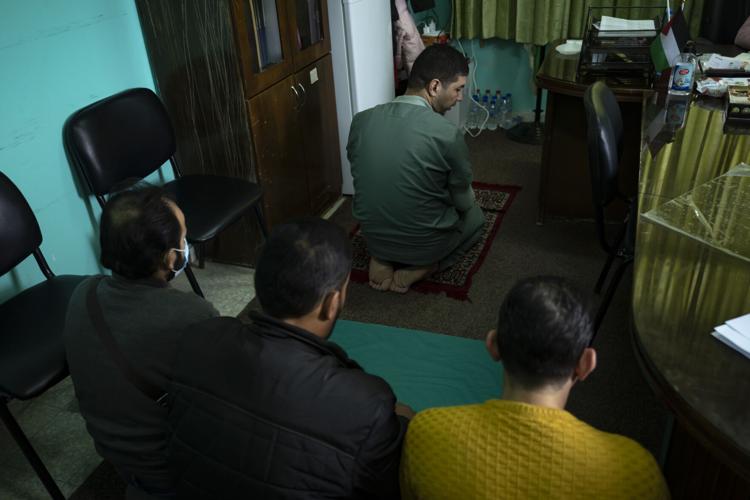
Dr. Suhaib Alhamss, director of the Kuwaiti Hospital in Gaza's southern town of Rafah, kneels in Islamic prayer Thursday in his hospital office.
Alhamss knows fellow doctors and nurses who were killed in their homes or on the way to work by artillery, missiles, exploding drones — so many kinds of incoming fire. He has lost dozens of his medical students at the Islamic University of Gaza where he teaches, ambitious men and women "with so much life left to live," he said.
Grief is a luxury he cannot afford. When asked how he felt, he answered with a simple, "It's God's will."
"We all will die in the end, why be afraid of it?" Alhamss asked. "We have no choice but to try to live in dignity, to help those we can."
Israel-Hamas war at 100 days

Police officers evacuate a woman and a child Oct. 7 from a site hit by a rocket fired from the Gaza Strip in Ashkelon, southern Israel.

Palestinians wave their national flag Oct. 7 and celebrate by a destroyed Israeli tank at the southern Gaza Strip fence east of Khan Younis.

Fire and smoke rise Oct. 8 following an Israeli airstrike in Gaza City.

Israelis evacuate a site struck by a rocket fired Oct. 9 from the Gaza Strip in Ashkelon, southern Israel.

An Israeli firefighter kneels to compose himself Oct. 9 after he and his colleagues extinguished cars set on fire by a rocket fired from the Gaza Strip in Ashkelon, Israel.

Palestinians inspect the rubble of the Yassin Mosque on Oct. 9 after it was hit by an Israeli airstrike at Shati refugee camp in Gaza City.

An Israeli soldier walks Oct. 11 by a house destroyed in fighting with Hamas militants in kibbutz Be'eri.

Antonio Macías' mother cries over her son's body covered with the Israeli flag Oct. 15 at Pardes Haim cemetery in Kfar Saba, near Tel Aviv, Israel. Macias was killed by Hamas militants Oct. 7 while attending a music festival in southern Israel.

Mourners gather around the five coffins of the Kotz family during their funeral Oct. 17 in Gan Yavne, Israel. The family was killed by Hamas militants on Oct. 7 at their house in Kibbutz Kfar Azza near the border with the Gaza Strip.

Rockets are fired from the Gaza Strip toward Israel over destroyed buildings Oct. 19 following Israeli airstrikes on Gaza City, central Gaza Strip.

An Israeli soldier hugs his partner Oct. 20 near the border with the Gaza Strip, southern Israel.

Palestinians walk Oct. 20 by buildings destroyed in an Israeli bombardment on al-Zahra, on the outskirts of Gaza City.

Palestinians evacuate a building hit Oct. 22 in an Israeli bombardment of the Gaza Strip in Rafah.

Palestinians inspect the rubble of destroyed buildings Oct. 26 following Israeli airstrikes on the town of Khan Younis, southern Gaza Strip.

Israeli security forces on Nov. 1 inspect charred vehicles burned in the Oct. 7 cross-border attack by Hamas militants outside the town of Netivot, southern Israel.

Kenzi al Madhoun, a 4-year-old wounded in an Israeli bombardment, lies Nov. 1 at Al Aqsa Hospital in Deir al Balah City, Gaza Strip.

An Israeli soldier stands in an apartment Nov. 8 during a ground operation in the Gaza Strip.

Palestinians flee Nov. 11 to the southern Gaza Strip on Salah al-Din Street in Bureij, Gaza Strip.

Palestinians wounded in an Israeli bombardment of the Gaza Strip wait for treatment Nov. 15 at a hospital in Khan Younis.

Palestinians displaced by the Israeli bombardment of the Gaza Strip seek cover from a winter rainfall Nov. 19 at a U.N. tent camp in the southern town of Khan Younis, Gaza Strip. Hundreds of thousands of Palestinians fled their homes in northern Gaza as Israel moved ahead with a ground offensive against the ruling Hamas militant group.

Palestinians flee to northern Gaza as Israeli tanks block the Salah al-Din road Nov. 24 in the central Gaza Strip, as a temporary cease-fire begins.

A Red Cross vehicle carrying Israeli hostages drives by Nov. 25 at the Gaza Strip crossing into Egypt in Rafah.

An Israeli soldier looks at Palestinians fleeing south Nov. 26, the third day of a temporary cease-fire between Hamas and Israel, at Salah al-Din road in central Gaza Strip.

Israelis embrace Nov. 28 next to photos of people killed and taken captive by Hamas during militants' Oct. 7 rampage through the Nova music festival in southern Israel, at the site of the event near kibbutz Re'im.

A Palestinian woman gestures Dec. 7 following Israeli airstrikes in Khan Younis refugee camp, southern Gaza Strip.

Israeli soldiers on Dec. 8 stand by a truck packed with bound and blindfolded Palestinian detainees rounded up for interrogation in northern Gaza during a search for Hamas fighters.

Palestinians mourn Dec. 20 outside a morgue in Khan Younis for relatives killed in the Israeli bombardment of the Gaza Strip.

Palestinians line up for a free meal Dec. 21 in Rafah, Gaza Strip. International aid agencies say Gaza is suffering from shortages of food, medicine and other essential supplies as a result of the war.

A makeshift tent camp Jan. 1 where Palestinians displaced by the Israeli bombardment of the Gaza Strip are staying in the Muwasi area.

With the U.S Capitol in the background, demonstrators rally Jan. 13 during the March on Washington for Gaza at Freedom Plaza in Washington. The protest was part of a global day of action ahead of the Israel-Hamas war's 100-day mark.