WASHINGTON — Among images of the bombed out homes and ravaged streets of Gaza, some stood out for the utter horror: Bloodied, abandoned infants.
Viewed millions of times online since the war began, these images are deepfakes created using artificial intelligence. If you look closely you can see clues: fingers that curl oddly, or eyes that shimmer with an unnatural light — all telltale signs of digital deception.
The outrage the images were created to provoke, however, is all too real.

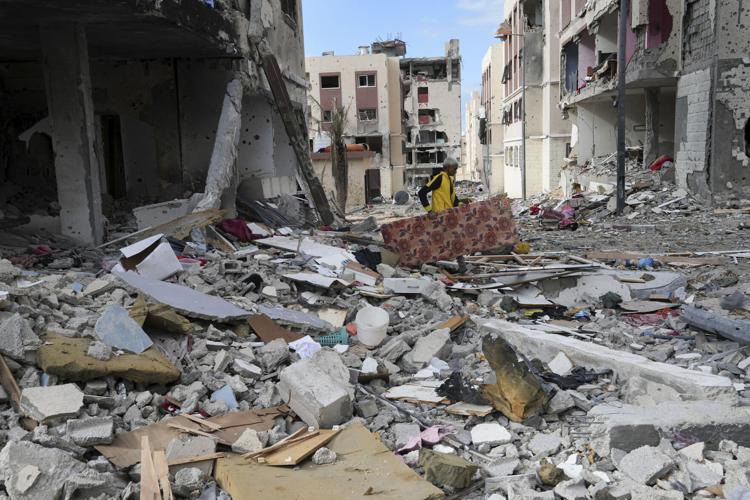
A Palestinian man collects his belongings Tuesday southeast of the Gaza City on the fifth day of the temporary ceasefire between Hamas and Israel.
Pictures from the Israel-Hamas war have vividly and painfully illustrated AI's potential as a propaganda tool, used to create lifelike images of carnage. Since the war began last month, digitally altered ones spread on social media have been used to make false claims about responsibility for casualties or to deceive people about atrocities that never happened.
People are also reading…
While most of the false claims circulating online about the war didn’t require AI to create and came from more conventional sources, technological advances are coming with increasing frequency and little oversight. That’s made the potential of AI to become another form of weapon starkly apparent, and offered a glimpse of what’s to come during future conflicts, elections and other big events.
“It’s going to get worse — a lot worse — before it gets better,” said Jean-Claude Goldenstein, CEO of CREOpoint, a tech company based in San Francisco and Paris that uses AI to assess the validity of online claims. The company has created a database of the most viral deepfakes to emerge from Gaza. “Pictures, video and audio: With generative AI it’s going to be an escalation you haven’t seen.”

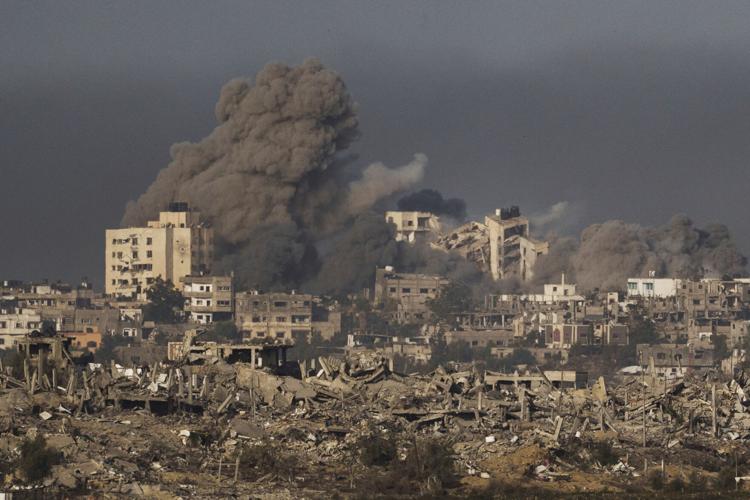
Smoke rises following an Israeli bombardment Nov. 23 in the Gaza Strip, as seen from southern Israel.
In some cases, photos from other conflicts or disasters have been repurposed and passed off as new. In others, generative AI programs have been used to create images from scratch, such as one of a baby crying amidst bombing wreckage that went viral in the conflict’s earliest days.
Other examples of AI-generated images include videos showing supposed Israeli missile strikes, or tanks rolling through ruined neighborhoods, or families combing through rubble for survivors.
In many cases, the fakes seem designed to evoke a strong emotional reaction by including the bodies of babies, children or families. In the bloody first days of the war, supporters of both Israel and Hamas alleged the other side had victimized children and babies; deepfake images of wailing infants offered photographic ‘evidence’ that was quickly held up as proof.
The propagandists who create such images are skilled at targeting people's deepest impulses and anxieties, said Imran Ahmed, CEO of the Center for Countering Digital Hate, a nonprofit that has tracked disinformation from the war. Whether it's a deepfake baby, or an actual image of an infant from another conflict, the emotional impact on the viewer is the same.

The more abhorrent the image, the more likely a user is to remember it and to share it, unwittingly spreading the disinformation further.
Similarly deceptive AI-generated content began to spread after Russia invaded Ukraine in 2022. One altered video appeared to show Ukrainian President Volodymyr Zelenskyy ordering Ukrainians to surrender. Such claims have continued to circulate as recently as last week, showing just how persistent even easily debunked misinformation can be.

Each new conflict, or election season, provides new opportunities for disinformation peddlers to demonstrate the latest AI advances. That has many AI experts and political scientists warning of the risks next year, when several countries hold major elections, including the U.S., India, Pakistan, Ukraine, Taiwan, Indonesia and Mexico.
The risk that AI and social media could be used to spread lies to U.S. voters has alarmed lawmakers from both parties in Washington. At a recent hearing on the dangers of deepfake technology, U.S. Rep. Gerry Connolly, Democrat of Virginia, said the U.S. must invest in funding the development of AI tools designed to counter other AI.

“We as a nation need to get this right,” Connolly said.
Around the world a number of startup tech firms are working on new programs that can sniff out deepfakes, affix watermarks to images to prove their origin, or scan text to verify any specious claims that may have been inserted by AI.
“The next wave of AI will be: How can we verify the content that is out there. How can you detect misinformation, how can you analyze text to determine if it is trustworthy?” said Maria Amelie, co-founder of Factiverse, a Norwegian company that has created an AI program that can scan content for inaccuracies or bias introduced by other AI programs.

Such programs would be of immediate interest to educators, journalists, financial analysts and others interested in rooting out falsehoods, plagiarism or fraud. Similar programs are being designed to sniff out doctored photos or video.
While this technology shows promise, those using AI to lie are often a step ahead, according to David Doermann, a computer scientist who led an effort at the Defense Advanced Research Projects Agency to respond to the national security threats posed by AI-manipulated images.
“Every time we release a tool that detects this, our adversaries can use AI to cover up that trace evidence,” said Doermann. “Detection and trying to pull this stuff down is no longer the solution. We need to have a much bigger solution.”
Misinformation about Israel-Hamas war floods social media; here are the facts
Claim: Black flag calls Muslims to action

CLAIM: A major mosque in Iran raised a black flag to call Muslims to war over Israel’s attacks on Gaza.
THE FACTS: The Imam Reza shrine, pictured above in 2008, said the flag was raised as a symbol of mourning for the lives lost in Israel’s strikes on Gaza. Experts on Islam and Iran confirmed the flag includes a passage from the Quran that is meant to comfort Muslims that their sacrifices will one day be rewarded.
Social media users are sharing the false claim alongside images and videos of the distinctive gold dome of the shrine — a major pilgrimage site for Shiite Muslims in Iran’s northeast that includes a mosque, library and other institutions — with a black banner flying on a flagpole.
“BREAKING: The Black Flag has been raised over Razavi Shrine in Mashhad, Khorasan province, Iran,” wrote one Facebook user who shared the image on Oct. 18, using an alternate name for the complex. “This is a call for war or vengeance.”
Others claimed the black flag and its Farsi inscription was meant to herald the coming of the Mahdi, the final leader believed to appear at the end of times to lead Muslim people.
But the black flag isn’t a call for war, and neither the flag’s text nor the shrine’s statement about the banner references the coming of the Mahdi or the end of time.
In fact, an announcement on the shrine’s English-language Facebook page on Oct. 17 specifically describes it as a “mourning flag” that was raised in response to the deadly blast that rocked a hospital in Hamas-controlled Gaza that day.
“In an unprecedented gesture and by the order of the custodian of Astan Quds Razavi, the black flag has been hoisted above the illuminated and pure Razavi dome, and drum beating will not be played tomorrow,” the post said, including #sorrow #mourning #sadness #grief and other hashtags.
Islamic and Iranian experts confirmed the flag includes a line from the Quran roughly translated as “help from Allah and an imminent victory” or “conquest from Allah and victory is near.”
That phrase isn’t traditionally used to declare war, but meant to bring comfort and hope to those struggling or engaged in battle that their sacrifice is not in vain and that Allah will grant them victory eventually, they said.
Hamid Dabashi, professor of Iranian Studies at Columbia University in New York, said the Quranic verse, in the context of the shrine’s Facebook post, means “solidarity” with the Palestinian cause and not an outright declaration of war against Israel.
“To me it says nothing more than the obvious: the ruling government in Iran supports Hamas and the Islamic Jihad,” he wrote in an email. “Nothing more, nothing less.”
The Middle East Media Research Institute, a Washington-based think tank founded by Israeli analysts, agreed, noting that Islamic militants tend to use a different passage from the Quran when declaring war.
The organization noted that statements from the Iran-backed Iraqi militias claiming responsibility for recent attacks on U.S. bases in Syria and Iraq open with this Quranic verse: “Permission (to fight) is given to those upon whom war is made because they are oppressed, and most surely Allah is well able to grant them victory.”
Claim: Kim Jong Un blames Biden for war

CLAIM: A video shows North Korean leader Kim Jong Un saying in a speech that he blames President Joe Biden for the latest Israel-Hamas war.
THE FACTS: The video is from 2020 and the version currently circulating online features incorrect English captions. The footage actually shows Kim celebrating the 75th anniversary of the founding of the Korean Workers’ Party; he doesn’t reference the conflict in the Middle East or Biden at any point.
In the misleading video circulating online, the English captions claim Kim says: “Under the Biden administration, conflicts erupt yearly. This year a war begins between Israel and Palestine.”
“I’m afraid that if the Biden admin does not cease to exist in the next election, World War 3 may begin,” the captions continue. “Who knows what next year’s war will be. I support Donald Trump for President in 2024. Good Luck to Mr. Trump.”
The video was shared on Instagram and TikTok, where one post garnered more than 223,000 likes.
However, the video is old and the captions are completely inaccurate.
Clips and images from the same speech can be seen in news reports from October 2020 about an event celebrating the 75th anniversary of the Korean Workers Party.
A transcript of the full speech translated to English by The National Committee on North Korea, a U.S.-based organization, does not mention anything about the Israel-Hamas war nor the 2024 U.S. presidential race.
Multiple Korean speakers and an expert who reviewed the portion of the speech circulating online also confirmed Kim says nothing of the sort in the footage.
Instead, Kim thanks his people and his military, saying: “The patriotic and heroic commitment shown by our People’s Army soldiers on the unexpected frontlines of epidemic prevention and natural disaster recovery this year is something that evokes tears of gratitude from everyone.”
Ji-Young Lee, a professor of Korean Studies at American University who confirmed the captions are inaccurate, noted that the surprise attack on Israel by Hamas militants did create concerns in South Korea about a similar assault from the North.
Claim: Turkish president threatens to intervene

CLAIM: Turkish President Recep Tayyip Erdogan has threatened to intervene in the latest Israel-Hamas war.
THE FACTS: The conservative Muslim president, pictured above in September, has said no such thing. A social media post he wrote recently about the ongoing conflict has been misquoted.
Social media users are sharing a quote they say is from Erdogan, in which the long serving leader warns his country will take decisive steps to end the conflict if the destruction of Hamas-controlled Gaza continues.
“Turkish President Erdogan has THREATENED to intervene in the Israeli war on Gaza: ‘I call on all humanity to take action to stop this unprecedented brutality in the Gaza Strip. If not, we will do it’,” wrote one user on X, the social media platform formerly known as Twitter, in a post that has been liked or shared more than 105,000 times.
But the posts are misquoting a comment Erdogan posted Oct. 17 on his personal account on X about the deadly conflict.
In the message, which was written in Turkish, the president did “invite all humanity” to help stop the “unprecedented brutality in Gaza,” as the posts claim.
But he doesn’t write “If not, we will do it” or other threatening phrases suggesting a direct military intervention by Turkey, according to native Turkish speakers and other experts who reviewed Erdogan’s social media posts for The Associated Press.
“President Erdogan did not threaten to intervene in the conflict,” Steven Cook, a Middle East expert at the Council on Foreign Relations, a Washington think tank, wrote in an email. “He was speaking generally about getting the world to put pressure on Israel to stop its military campaign.”
Elizabeth Shakman Hurd, a political science professor at Northwestern University who specializes in the Middle East, added that she hasn’t seen any indication that Erdogan has made such a threat elsewhere.
Turkish government spokespersons didn’t immediately respond to emails seeking comment, but Erdogan posted a lengthier statement on his personal account on X, also written in Turkish, in which he denounced Israel’s attacks on Gaza, criticized Western nations and media outlets and called for the international community to push for a ceasefire.
The official, English-language account for the Turkish president’s office echoed that sentiment in a post about a call between Erdogan and Egyptian President Abdel Fattah el-Sissi.
“Underscoring that forcing the Palestinians in Gaza to migrate from their homeland is unacceptable, President Erdoğan stressed that Türkiye will continue to make every effort in order for peace to be ensured and for humanitarian aid as well as healthcare services to be immediately delivered to Gaza,” the office wrote.
Claim: Israel confirms it bombed hospital

CLAIM: The Israeli military confirmed it bombed a hospital in Gaza in a social media post written in Arabic.
THE FACTS: A screenshot circulating online shows a Facebook post from an account posing as the Israeli military. No such post exists on the military's actual social media pages and its top Arabic-speaking spokesperson confirmed his office has issued no such statement.
In the wake of the Oct. 17 deadly blast at al-Ahli hospital in Gaza, social media users shared the screenshot, claiming it is from a member of the Israeli military's Arabic-speaking media relations team.
The user’s profile image bears the blue-and-white emblem of the spokesperson’s office, which features radio waves atop the Israeli military’s traditional symbol of an olive branch-wrapped sword.
The post, written in Arabic, suggests the Jewish nation said it bombed the hospital because the Gaza City medical facility lacked supplies and staff.
“Israeli official facebook post: ‘Due to the lack of medical equipment and the lack of medical staff, it was decided to bomb the Baptist Hospital in Gaza and give them euthanasia’,” wrote one user on X, the social media platform formerly known as Twitter, in a post translating the screenshot. Similar posts were also widely shared on TikTok and other social media platforms.
But the purported statement wasn’t penned by the Israeli military’s press office, its top Arabic-speaking spokesperson confirmed this week.
“Just to clarify: I did not issue any statement or comment regarding the Baptist Hospital in Gaza,” wrote Avichay Adraee, head of the Arab media branch of the Israeli military's Spokesperson’s Unit, in a post on X from Oct. 17, when the blast occurred. “All the news circulating in my name comes from the Hamas media outlets and is completely false.”
The office on Oct. 19 confirmed the post did not come from the military’s official Arabic page, saying in an emailed statement: “The IDF has made it very clear that there was no IDF strike on the hospital."
What’s more, the Israeli military’s press office doesn’t use its own logo on its actual social media accounts, unlike the fake account.
The unit’s separate Facebook pages in English and Hebrew, as well as its X account written in Farsi, for example, all use the military’s main symbol. That gold-colored emblem features the olive branch-wrapped sword with the Star of David in the background.
Meanwhile Adraee’s social media accounts, which are the main channel for the Israeli military’s messages in Arabic, feature his profile picture and a maroonlogo consisting of five swords with flames in the background as its cover photo.
The original fake account and post on Facebook also appear to have been deleted as of Oct. 19. Spokespersons for Meta, the parent company of Facebook, didn’t reply to an email seeking comment.
There were conflicting accusations of who was responsible for the hospital blast, with Hamas officials in Gaza blaming an Israeli airstrike and Israel saying it was caused by a an errant rocket launched by Palestinian militants. U.S. and French intelligence services also concluded it was likely caused by a misfired rocket. An AP analysis of video, photos and satellite imagery, as well as consultation with experts, showed the cause was likely a rocket launched from Palestinian territory that misfired in the air and crashed to the ground. However, a definitive conclusion could not be reached.
Claim: Qatar’s emir threatens to cut off world’s natural gas supply

CLAIM: A video shows Qatar’s emir threatening to cut off the world’s natural gas supply if Israel doesn’t stop bombing Gaza.
THE FACTS: Qatar’s ruling emir, Sheikh Tamim bin Hamad Al Thani, seen above in 2022, says no such thing in the widely circulating clip, which is more than 6 years old. A spokesperson for the Qatari government also confirmed that neither the emir nor any other government official has threatened to cut off exports in response to the conflict.
Many online are sharing the video of the Persian Gulf nation’s ruler, falsely claiming it shows him saying in Arabic that he’s willing to halt the distribution of its gas reserves to achieve his desired end to the latest Israel-Hamas war.
“BREAKING: Qatar is threatening to create a global gas shortage in support of Palestine,” wrote one user who posted the video on X, the social media platform formerly known as Twitter. “If the bombing of Gaza doesn’t stop, we will stop gas supply of the world.”
But Sheikh Tamim bin Hamad Al Thani says nothing of the sort in the video. The 7-second clip is actually a tiny snippet from his opening speech at the Doha Forum in 2017.
Marc Owen Jones, a professor of Middle East studies at Hamad bin Khalifa University in Doha, the capital of Qatar, confirmed that the emir touches briefly on Palestinians in the widely shared clip, but doesn’t make any threats related to the current conflict.
Instead the emir, in his remarks, urged the international community to take more steps to address the region’s refugee crisis, news outlets reported at the time.
“The exact translation is: ‘The issue of Palestine, I’ll begin by saying it’s a case of a people uprooted from their lands, and displaced from their nation’,” Jones wrote in an email.
Qatar’s government on Oct. 16 confirmed the clip dates to 2017 and is being misrepresented.
“This is yet another case of an online disinformation against Qatar — such a statement has never been made and never would be,” wrote the country’s International Media Office in an email. “Qatar does not politicize its LNG supplies or any economic investment.”
Qatar is one of the world’s top natural gas producers. It controlled the third-largest natural gas reserves and was the second largest exporter of liquified natural gas, or LNG, in 2021, according to the U.S. Energy Information Administration.
What’s more, the country has been working in recent years to use its sizable resources to build ties with other nations, not antagonize them, according to experts.
Patrick De Haan, head of petroleum analysis at GasBuddy, a Boston-based company that tracks gas prices nationwide, pointed to a deal Qatar’s state energy company just announced to supply French energy company TotalEnergies with 3.5 million tons of natural gas annually for the next 27 years.
“Qatar has been securing investment since Russia’s invasion of Ukraine pushed Europe to find new sources of natural gas and quickly,” he wrote in an email. “They’re making deals left and right.”
Claim: BBC reports Ukraine provided weapons to Hamas

CLAIM: A video shows a BBC News report confirming Ukraine provided weapons to Hamas.
Pictured above, Hamas masked gunmen display their military skills during a rally to commemorate the 27th anniversary of the Hamas militant group, in Gaza City, on Dec. 14, 2014.
THE FACTS: The widely shared video clip is fabricated, officials with the BBC and Bellingcat, an investigative news website that is cited in the video as the source, confirm.
The clip, which includes the BBC’s distinctive block-text logo, purports to show a story from the outlet about a recent report from Bellingcat on Ukraine providing arms to Hamas.
“Bellingcat: Ukrainian military offensive failure and HAMAS attack linked,” reads the text over the video, which has more than 2,500 comments and 110,000 views on the messaging service Telegram. “The Palestinians purchased firearms, ammunition, drones and other weapons.”
But neither the BBC nor Bellingcat has reported any evidence to support the notion that Ukraine funneled arms to Hamas.
“We’ve reached no such conclusions or made any such claims,” Bellingcat wrote Oct. 10 in a post on X that included screengrabs of the fake report. “We’d like to stress that this is a fabrication and should be treated accordingly.”
Eliot Higgins, the Amsterdam-based organization’s founder, noted in a separate post on X that the claims have been amplified by Russian social media users.
Nassim Nicholas Taleb, a New York University professor briefly shown near the end of the video, also disputed the clip’s suggestion that he’s said the U.S. might leave NATO if the arms claims prove true.
“Entirely fake. Never said that,” the distinguished professor of risk engineering wrote in an email.
Spokespersons for the BBC didn’t respond to emails seeking comment, but Shayan Sardarizadeh, a reporter with the organization’s fact checking unit, confirmed in a post on X that the video is not real.
Ukrainian officials have similarly dismissed the notion that its country’s arms have somehow found their way to Hamas. The country’s military intelligence agency, in an Oct. 9 post on its official Facebook page, accused Russia of plotting a disinformation campaign around these claims.
Experts say there is also no evidence of Hamas making any claims about receiving arms from Ukraine, nor would it make sense for Kyiv to provide them.
“I see no reason Ukraine would do this,” said Michael O’Hanlon, director of foreign policy research at the Brookings Institution, a Washington think tank. “Starting with the fact that Kiev is in the business of obtaining weapons and not giving them away.”
Claim: Video shows actor in fake blood for propaganda

CLAIM: Video of a young actor being filmed lying in a pool of fake blood shows propaganda being created for use in the Israel-Hamas war.
THE FACTS: The video is behind-the-scenes footage from the making of “Empty Place,” a short film focused on the story of Ahmad Manasra, a Palestinian who was arrested at age 13 in 2015 in relation to the stabbing of two Israelis.
Pictured, Manasra’s mother Wafa Manasra kisses him goodbye during his March 21, 2019, funeral in the West Bank village of Wad Fokin.
Social media users on both sides of the latest Israel-Hamas war are sharing the video, each falsely alleging that it’s proof the other group is creating propaganda about their own.
In the clip, a young actor lies on a sidewalk covered in fake blood, his right leg bent backward, as a film crew works around him. Other actors mill about dressed as soldiers and in garb worn by many Orthodox Jewish men.
“See how Israelis are making fake videos saying that Palestine Freedom Fighters killed children,” reads one tweet that had received more than 5,600 likes and more than 4,400 shares as of Oct. 11.
An Instagram post claimed the opposite, stating: “These terrorists are dressing up as JEWISH soldiers to create fake videos about Israeli soldiers! Faking Propaganda!”
But neither allegation is correct. The video shows footage from the making of the 2022 short film directed by Awni Eshtaiwe, a filmmaker based in the West Bank. The scene being shot begins about 1 minute and 10 seconds into the approximately 2 minute film.
Mohamad Awawdeh, a cinematographer listed in the film’s credits as a camera assistant, posted the behind-the-scenes footage to TikTok in April 2022, around the time the film was released. A caption on the post, written in Arabic, explains that the scene being filmed in the video shows Manasra being attacked. Awawdeh posted the same footage to Instagram on June 30.
Claim: Hamas fighters storm sports field to attack Israelis

CLAIM: A video shows Hamas fighters parachuting onto a sports field before attacking Israeli citizens during the group’s surprise Oct. 7 attack on Israel.
Pictured, Palestinians wave their national flag and celebrate by a destroyed Israeli tank Oct. 7, 2023, at the Gaza Strip fence east of Khan Younis after Hamas carried out an unprecedented, multi-front attack on Israel.
THE FACTS: While Hamas did employ paragliders to get some fighters across the border between Gaza and southern Israel, the footage of the sports field shows parachute jumpers in Cairo and has been online since at least September.
The clip shows people strapped to multi-colored parachutes descending onto a crowded sports field complex filled with children and families, many in red sports jerseys.
“Hamas paraglided amongst Israeli citizens and proceeded to massacre them,” text on the video clip reads. One post of the misleading footage on TikTok was viewed more than 38,000 times.
But this footage has been online since at least Sept. 27, when it was posted to TikTok with the location tag “Egypt.”
Details of the video also point to Egypt as the location — a person is wearing a blue shirt that reads “El Nasr SC” on the back, the name of a sporting club in northeastern Cairo.
Images of the club on Google Maps match the scene of the video — as well as several other clips of the event from the same TikTok user — with both showing a bright blue fence around a sporting ground next to a paved area with green and blue plastic seats.
The parachuters land on a larger soccer pitch surrounded by tall field lights. The field matches photos posted to the club’s Facebook page and footage of its soccer team’s matches, including a distinctive red building with a blue fence on top at one end that can be seen in the TikTok clip at around 19 seconds.
Other TikTok users shared footage of a parachuting similar scene around the same time, with “El Nasr” in the caption in Arabic.
The crowd of onlookers in the clip circulating online also doesn’t seem distressed by the arrival of the parachuters, as one might expect if they were an invading force. In fact, many women and children are seen running towards them, phones in hand taking videos and photos of the aerial display.
Claim: Putin warns US to ‘stay away’ from war

’CLAIM: Two videos show Russian President Vladimir Putin warning the U.S. to “stay away” from the latest Israel-Hamas war.
THE FACTS: Both videos circulating online are months-old clips of Putin, seen here on Oct. 24, 2023, in Moscow, speaking about the Russia-Ukraine war, not the conflict in the Middle East, which have been miscaptioned in English.
Both videos show Putin speaking in Russian, with false English captions saying he was warning the U.S. to refrain from helping the Jewish state.
“America wants to Destroy israel as we destroy ukraine In past,” the captions on one video state. “I am warning America. Russia will help palestine and america can do nothing.” One TikTok post that shared the clip had received approximately 11,600 views as of Oct. 9.
A caption on another video of Putin, filmed in a different location, similarly reads: “I am warning america to stay Away from palestine israel war.”
But the two clips long predate the latest Israel-Hamas war and make no mention of Israel at all.
The first shows Putin at a meeting of Russia’s Human Rights Council in December 2022, where, amid discussions about the war in Ukraine, he responded to a question about the country’s potential use of nuclear weapons, as the AP reported at the time. The footage was featured by multiple other newsoutlets with similar translations.
In the second, Putin is speaking at a February 2023 event marking the 80th anniversary of the World War II Soviet victory over Nazi German forces in the battle of Stalingrad. In his remarks, he compared this threat to Germany’s then-recent decision to supply Ukraine with tanks, the AP reported at the time. Several media outlets also featured the footage in similar reports.
Kremlin spokesman Dmitry Peskov told reporters on Oct. 9 that Russia is “extremely concerned” by the “spiral of violence” in Israel. Mikhail Bogdanov, Russia’s deputy foreign minister and former ambassador to Israel and Egypt, told the state Tass agency Oct. 7 that Moscow has been in touch with “all parties (of the conflict), including Arab countries” and was urging for “an immediate cease-fire and peace.”