JERUSALEM — Chants of “Now! Now! Now!” ring out at nearly every protest in Israel imploring the government to do everything possible to win the immediate release of dozens of hostages held by Hamas.
But a small group of hostages’ families is pushing a different message: Let the army first finish the job of defeating the militant group, even if that delays the return of their loved ones.
These families argue that the price to be paid in any hostage deal — the release of large numbers of Palestinian militants held by Israel — would endanger the country in the future.
“When you release terrorists, they will return to murder. That’s how it has always been,” said Tzvika Mor, whose son Eitan, 23, was abducted four months ago from the Nova music festival, where he was working as a security guard.
“How can you stand in front of people and say, ‘I want my son back, and I don’t care about you?’” Mor told The Associated Press by phone. “Instead of us only worrying about our son, we are concerned for the whole country.”
People are also reading…

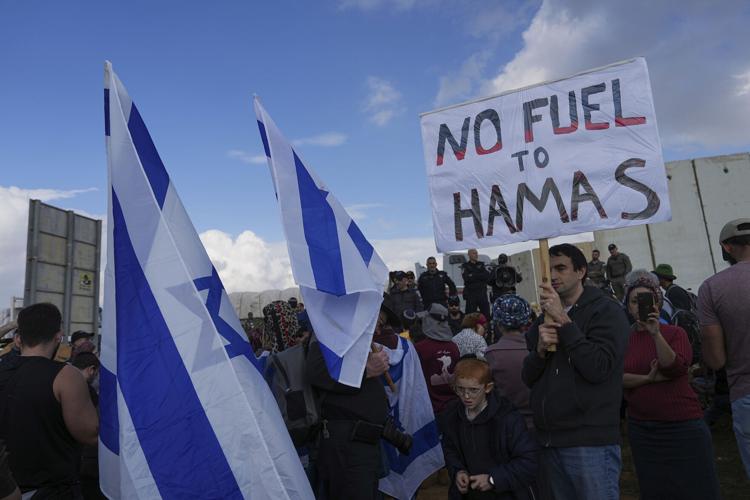
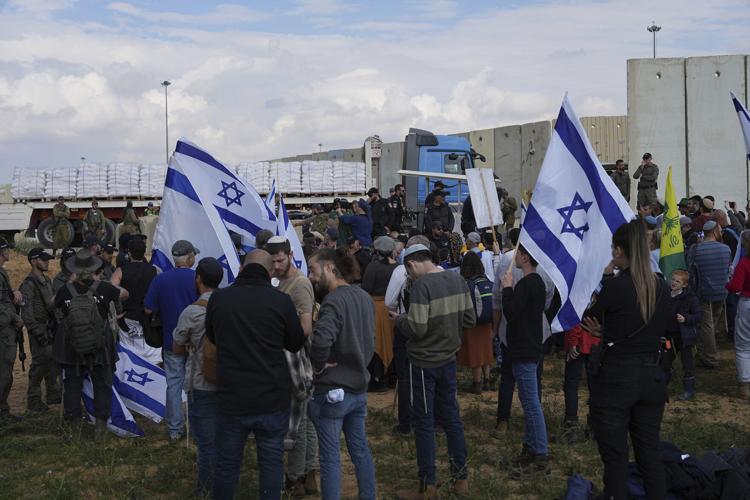
Israeli activists try to block trucks carrying humanitarian aid into the Gaza Strip Jan. 29 at the Kerem Shalom border crossing between Israel and Gaza in southern Israel.
Most of the hostages’ relatives sharply disagree with Mor, saying only a deal can free the captives and that their chances of survival are increasingly dim given the dangerous conditions in Gaza. Those fears were heightened late Wednesday when Israeli Prime Minister Benjamin Netanyahu rejected the latest Hamas demands for a hostage deal as delusional and instead vowed to pursue war until “total victory.”
The hostages’ plight has captured the Israeli public’s attention since they were seized during the Oct. 7 attack by Hamas militants on southern Israel that sparked the war.
Protests calling on the government to reach a deal with Hamas have grown in size and intensity as the crisis dragged on. Fearing that time is running out to bring them home safely, protesters have grown increasingly vocal — in some cases grabbing microphones and letting out blood-curdling screams.
Mor said he knows his opinion is “different from what’s acceptable” and is even viewed as unnatural. In December, Alon Nimrodi, the father of hostage Tamir Nimrodi, told Mor during a live show on Israel’s Channel 11, “just because you gave up on your son, doesn’t mean I will give up on mine,” causing Mor to break down in tears.

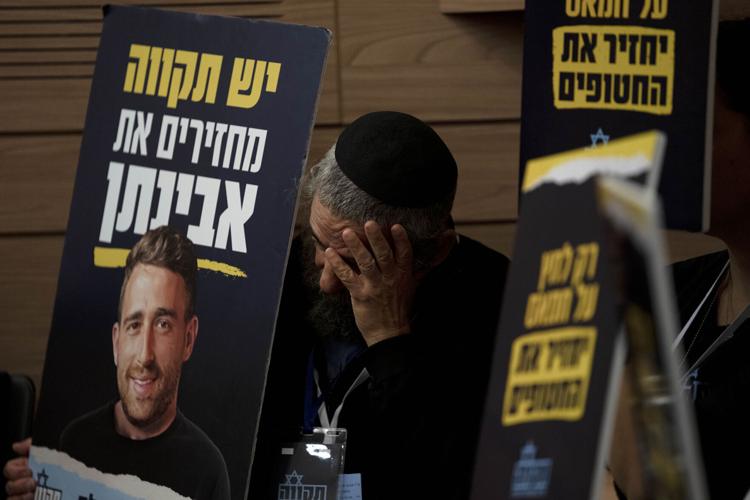
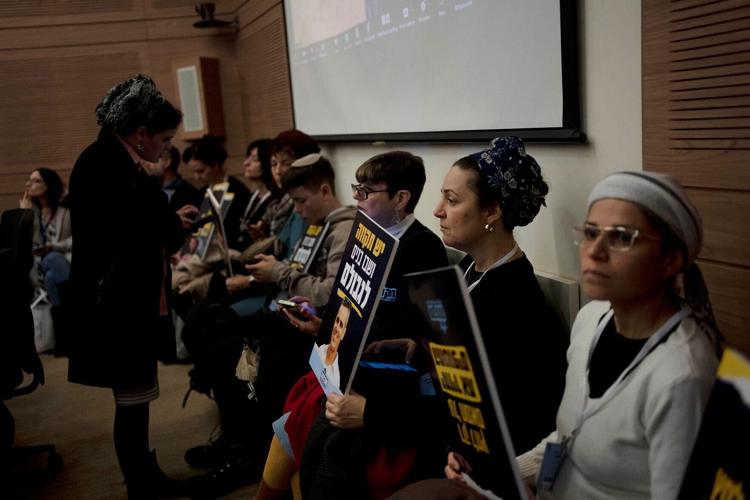
Relatives and supporters of Israelis held hostage by Hamas attend a committee hearing Monday at the Knesset, Israel's parliament, in Jerusalem.
The Mor family and two other hostages’ families founded the Tikva Forum, a loosely organized group whose public members are mostly religious and right-wing. They share the belief that military pressure, not an immediate cease-fire or hostage release deal, is the best way to bring their loved ones home.
Mor said his critics can’t understand how he could put his ideology above the natural response to seek the safe return of loved ones. He and others in the forum say they are being rational and that their critics are being led by their emotions.
Militants took about 250 hostage during the Oct. 7 attack in which fighting also left about 1,200 people dead, mostly civilians. Israel’s ensuing war on Hamas in Gaza has killed more than 27,000 Palestinians, two-thirds of whom are women and children, according to local health officials in Gaza, where Hamas continues to hold sway in some areas.
During a weeklong cease-fire in November, about 100 hostages were released in exchange for 240 Palestinian prisoners, mostly women and children who were convicted of minor offenses.
In its latest demands, Hamas seeks the release of hundreds of Palestinian prisoners, including those convicted of killing Israelis during the long-running conflict, in exchange for freeing all the hostages.

Israeli police prevent activists from blocking trucks carrying humanitarian aid Jan. 29 into the Gaza Strip at the Kerem Shalom border crossing between Israel and Gaza in southern Israel.
That’s unacceptable to the Tikva Forum, whose views hew closely to Netanyahu’s.
“Surrendering to the delusional demands of Hamas that we have heard not only won’t lead to the release of the hostages, it will invite another massacre,” Netanyahu told reporters Wednesday.
Netanyahu’s words were devastating for the vast majority of hostages’ families.
“I’m extremely scared that if you continue along this path … there won’t be any more hostages to release,” said 72-year-old Adina Moshe, who was among the hostages freed in November, referring to Netanyahu.
As Hamas leaders arrived in Cairo on Thursday for another round of talks, Mor was in the United States arguing Israel’s case for continued military pressure.
Mor lives in Kiryat Arba, a Jewish settlement that is known for its far-right ideology and that is next to Hebron, the largest Palestinian city in the Israeli-occupied West Bank.

Relatives and supporters of Israelis held hostage by Hamas attend a committee hearing Monday at the Knesset, Israel’s parliament, in Jerusalem.
Mor said other hostages’ families are associated with the Tikva Forum, not just its three founding families, and that they share the belief that continued military pressure is key to releasing the captives. He said many members do not want to be publicly identified because they are worried that Hamas could make conditions worse for their loved ones.
Ditza Or is a founding member of the Tikva Forum. Her son Avinatan was last seen being marched away from the music festival by Hamas militants as his girlfriend, Noa Argamani, screamed “don’t kill me!” Several weeks ago, Hamas released a video showing Argamani alive, but there has been no word of her fate since.
Avinatan’s uncle, Shimon Or, said he believes that Avinatan would be proud of his family’s stance.
Negotiations must be made from a place of strength, he said. “They are identifying our weaknesses and in another few years they’ll attack us again,” he said, referring to Hamas.
Liran Berman fears for the worst if Israel stays on its current course. His 26-year-old brothers, twins Gali and Ziv Berman, were abducted from Kibbutz Kfar Aza.
“We see that when there’s a deal, hostages return, and in between, when there isn’t, only bodies come back,” said Berman. “Only through a deal we will get my brothers back.”
Today in history: Feb. 9
1942: Joint Chiefs of Staff

In 1942, the U.S. Joint Chiefs of Staff held its first formal meeting to coordinate military strategy during World War II.
1943: Battle of Guadalcanal

In 1943, the World War II battle of Guadalcanal in the southwest Pacific ended with an Allied victory over Japanese forces.
1950: Joseph McCarthy

In 1950, in a speech in Wheeling, West Virginia, Republican Sen. Joseph McCarthy of Wisconsin charged that the State Department was riddled with Communists.
1962: Jamaica

In 1962, an agreement was signed to make Jamaica an independent nation within the British Commonwealth later in the year.
1964: The Beatles

In 1964, the Beatles made their first live American television appearance on “The Ed Sullivan Show,” broadcast from New York on CBS.
1971: Earthquake

In 1971, a magnitude 6.6 earthquake in California’s San Fernando Valley claimed 65 lives.
1984: Yuri V. Andropov

In 1984, Soviet leader Yuri V. Andropov, 69, died 15 months after succeeding Leonid Brezhnev; he was followed by Konstantin U. Chernenko.
1986: Halley's Comet

In 1986, Halley’s Comet visited the solar system for the first time since 1910. (Its next return will be in 2061).
2002: Princess Margaret

In 2002, Britain’s Princess Margaret, sister of Queen Elizabeth II, died in London at age 71.
2009: Alex Rodriguez

In 2009, New York Yankees third baseman Alex Rodriguez admitted to taking performance-enhancing drugs, telling ESPN he’d used banned substances while with the Texas Rangers for three years.
2020: Parasite

In 2020, “Parasite,” from South Korea, won the best picture Oscar, becoming the first foreign-language film to take home the biggest honor in film.
2021: Impeachment

In 2021, the Senate moved ahead with a second impeachment trial of former President Donald Trump, rejecting arguments that the chamber could not proceed because Trump was no longer in office.
2022: Kamila Valieva

In 2022, it was revealed that Kamila Valieva, the 15-year-old Russian figure skating superstar who had just led her team to an Olympic gold medal, tested positive for a banned heart medication before the Beijing Games.