CAIRO — Israel faces a growing risk of damaging its peace with neighboring Egypt as its military pushes the offensive against Hamas further south in the Gaza Strip. Already, the two sides are in a dispute over a narrow strip of land between Egypt and Gaza.
Israeli leaders say that to complete their destruction of Hamas, they must eventually widen their offensive to Gaza’s southernmost town, Rafah, and take control of the Philadelphi Corridor, a tiny buffer zone on the border with Egypt that is demilitarized under the two countries’ 1979 peace accord.

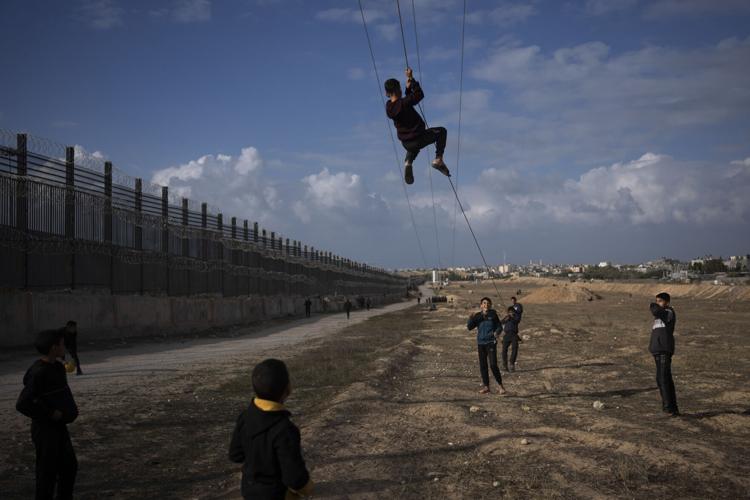
Palestinians displaced by the Israeli bombardment of the northern Gaza Strip play next to the border with Egypt on Jan. 14 in Rafah, southern Gaza. An increasingly public spat over the narrow strip of land between Israel and Egypt is fraying relations between the two nations.
In a news conference last week, Israeli Prime Minister Benjamin Netanyahu said Hamas continues to smuggle weapons under the border – a claim Egypt vehemently denies — and that the war cannot end “until we close this breach,” referring to the corridor.
People are also reading…
That brought a sharp warning from Egypt that deploying Israeli troops in the zone, known in Egypt as the Salaheddin Corridor, will violate the peace deal.
“Any Israeli move in this direction will lead to a serious threat to Egyptian-Israeli relations,” Diaa Rashwan, head of Egypt’s State Information Service, said Monday.
Egypt fears that an Israeli attack on Rafah will push a massive wave of Palestinians fleeing across the border into its Sinai Peninsula.

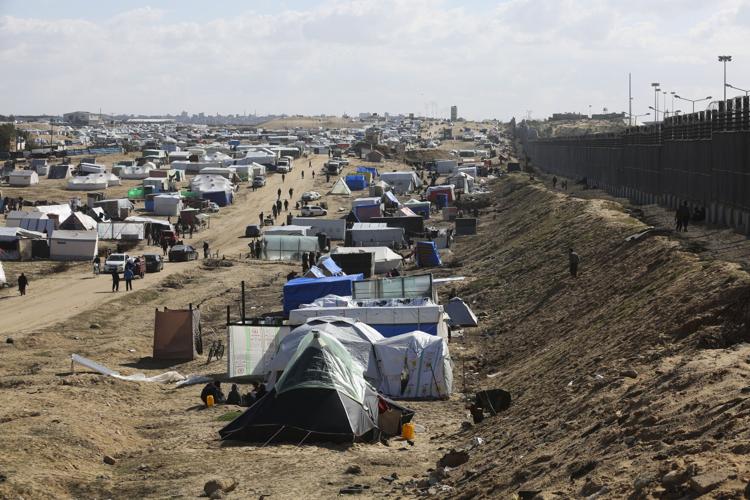
Palestinians displaced by the Israel air and ground offensive on the Gaza Striptake shelter Wednesday near the border fence with Egypt in Rafah.
More than 1 million Palestinians — nearly half of Gaza’s population of 2.3 million — are crowded into Rafah and its surroundings on the border, most driven there after fleeing Israeli bombardment and ground offensives elsewhere in Gaza.
If Israeli troops assault Rafah, they have nowhere to flee. Palestinians have broken through before: In 2008, early in the blockade imposed on Gaza by Israel and Egypt after the Hamas takeover, Hamas blew open the border wall. Thousands of people stormed into Egypt.
Egypt told the Israelis that before any ground assault on Rafah, Israel must let Palestinians return to northern Gaza, a senior Egyptian military official involved in coordination between the two countries said.
Israel says it has largely driven Hamas out of northern Gaza but is likely to resist allowing Palestinians back in the near term. Israel’s bombardment and ground assault have reduced much of the north to rubble, leaving many without homes.

The dispute puts Israel in a bind. If it stops its offensive without taking Rafah, it falls short on its top war goal of crushing Hamas. If its military pushes to the border, it risks undermining its peace deal with Egypt — a foundation of stability in the Mideast for decades — and upsetting its closest ally, the United States.
Israel and the U.S. are already divided over Gaza's post-war future. The Israeli military is working to create an informal buffer zone about a half-mile wide inside Gaza along the border with Israel to prevent militants from attacking nearby communities. The U.S. says it opposes any attempt by Israel to shrink Gaza’s territory.
Israel vows to expunge the militants from the entire Gaza Strip and has done so by a strategy of systematic destruction, at a huge cost in civilian lives. Starting in north Gaza, it leveled large swaths of the urban landscape, saying it was eliminating Hamas tunnels and infrastructure while battling militants. It is working its way down the territory, doing the same in central Gaza and the southern city of Khan Younis.

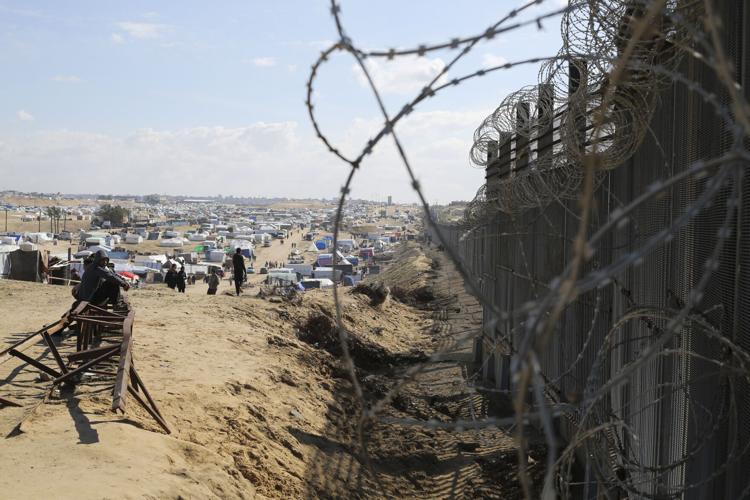
Palestinians displaced by the Israel air and ground offensive on the Gaza Strip sit next to the border fence with Egypt on Wednesday in Rafah.
Netanyahu has said Israel intends to keep open-ended security control over Gaza to ensure Hamas cannot repeat its Oct. 7 attacks that triggered Israel’s assault. He has been vague on what form that would take but said ensuring control over the Philadelphi Corridor is crucial.
“There are a few options on how we can close it, we are checking all of them, and we haven’t made a decision, except for one thing: It must be closed,” he said.
Egypt warned Israel and the U.S. that any military operations in the zone “could tear apart our peace,” a second Egyptian official said. “We will not tolerate such a move.” The official spoke on condition of anonymity because he was not authorized to talk to the press.
The corridor is a narrow strip — about 100 yards wide in parts — running the 8.6-mile length of the Gaza side of the border with Egypt. It includes the Rafah crossing into Egypt, Gaza's sole outlet not controlled by Israel.
The corridor is part of a larger demilitarized zone along both sides of the entire Israel-Egypt border. Under the peace accord, each side is allowed to deploy only a tiny number of troops or border guards in the zone. At the time of the accord, Israeli troops controlled Gaza, until Israel withdrew its forces and settlers in 2005.
Hamas has had free rein of the border since its 2007 takeover.
Smuggling tunnels were dug under the Gaza-Egypt border to get around the Israeli-Egyptian blockade. Some of the tunnels were massive, large enough for vehicles. Hamas brought in weapons and supplies, and Gaza residents smuggled in commercial goods, from livestock to construction materials.
That changed over the past decade, as Egypt battled Islamic militants in the Sinai. The Egyptian military cracked down on the tunnels and destroyed hundreds of them, saying they were being used to funnel weapons into the Sinai.
Israel-Hamas war at 100 days

Police officers evacuate a woman and a child Oct. 7 from a site hit by a rocket fired from the Gaza Strip in Ashkelon, southern Israel.

Palestinians wave their national flag Oct. 7 and celebrate by a destroyed Israeli tank at the southern Gaza Strip fence east of Khan Younis.

Fire and smoke rise Oct. 8 following an Israeli airstrike in Gaza City.

Israelis evacuate a site struck by a rocket fired Oct. 9 from the Gaza Strip in Ashkelon, southern Israel.

An Israeli firefighter kneels to compose himself Oct. 9 after he and his colleagues extinguished cars set on fire by a rocket fired from the Gaza Strip in Ashkelon, Israel.

Palestinians inspect the rubble of the Yassin Mosque on Oct. 9 after it was hit by an Israeli airstrike at Shati refugee camp in Gaza City.

An Israeli soldier walks Oct. 11 by a house destroyed in fighting with Hamas militants in kibbutz Be'eri.

Antonio Macías' mother cries over her son's body covered with the Israeli flag Oct. 15 at Pardes Haim cemetery in Kfar Saba, near Tel Aviv, Israel. Macias was killed by Hamas militants Oct. 7 while attending a music festival in southern Israel.

Mourners gather around the five coffins of the Kotz family during their funeral Oct. 17 in Gan Yavne, Israel. The family was killed by Hamas militants on Oct. 7 at their house in Kibbutz Kfar Azza near the border with the Gaza Strip.

Rockets are fired from the Gaza Strip toward Israel over destroyed buildings Oct. 19 following Israeli airstrikes on Gaza City, central Gaza Strip.

An Israeli soldier hugs his partner Oct. 20 near the border with the Gaza Strip, southern Israel.

Palestinians walk Oct. 20 by buildings destroyed in an Israeli bombardment on al-Zahra, on the outskirts of Gaza City.

Palestinians evacuate a building hit Oct. 22 in an Israeli bombardment of the Gaza Strip in Rafah.

Palestinians inspect the rubble of destroyed buildings Oct. 26 following Israeli airstrikes on the town of Khan Younis, southern Gaza Strip.

Israeli security forces on Nov. 1 inspect charred vehicles burned in the Oct. 7 cross-border attack by Hamas militants outside the town of Netivot, southern Israel.

Kenzi al Madhoun, a 4-year-old wounded in an Israeli bombardment, lies Nov. 1 at Al Aqsa Hospital in Deir al Balah City, Gaza Strip.

An Israeli soldier stands in an apartment Nov. 8 during a ground operation in the Gaza Strip.

Palestinians flee Nov. 11 to the southern Gaza Strip on Salah al-Din Street in Bureij, Gaza Strip.

Palestinians wounded in an Israeli bombardment of the Gaza Strip wait for treatment Nov. 15 at a hospital in Khan Younis.

Palestinians displaced by the Israeli bombardment of the Gaza Strip seek cover from a winter rainfall Nov. 19 at a U.N. tent camp in the southern town of Khan Younis, Gaza Strip. Hundreds of thousands of Palestinians fled their homes in northern Gaza as Israel moved ahead with a ground offensive against the ruling Hamas militant group.

Palestinians flee to northern Gaza as Israeli tanks block the Salah al-Din road Nov. 24 in the central Gaza Strip, as a temporary cease-fire begins.

A Red Cross vehicle carrying Israeli hostages drives by Nov. 25 at the Gaza Strip crossing into Egypt in Rafah.

An Israeli soldier looks at Palestinians fleeing south Nov. 26, the third day of a temporary cease-fire between Hamas and Israel, at Salah al-Din road in central Gaza Strip.

Israelis embrace Nov. 28 next to photos of people killed and taken captive by Hamas during militants' Oct. 7 rampage through the Nova music festival in southern Israel, at the site of the event near kibbutz Re'im.

A Palestinian woman gestures Dec. 7 following Israeli airstrikes in Khan Younis refugee camp, southern Gaza Strip.

Israeli soldiers on Dec. 8 stand by a truck packed with bound and blindfolded Palestinian detainees rounded up for interrogation in northern Gaza during a search for Hamas fighters.

Palestinians mourn Dec. 20 outside a morgue in Khan Younis for relatives killed in the Israeli bombardment of the Gaza Strip.

Palestinians line up for a free meal Dec. 21 in Rafah, Gaza Strip. International aid agencies say Gaza is suffering from shortages of food, medicine and other essential supplies as a result of the war.

A makeshift tent camp Jan. 1 where Palestinians displaced by the Israeli bombardment of the Gaza Strip are staying in the Muwasi area.

With the U.S Capitol in the background, demonstrators rally Jan. 13 during the March on Washington for Gaza at Freedom Plaza in Washington. The protest was part of a global day of action ahead of the Israel-Hamas war's 100-day mark.