The Trump administration is trying to slash access to lawyers who defend the rights of Americans with disabilities, advocates say.
Most of the lawyers work either for the Department of Justice or for disability rights agencies that Congress set up in every state decades ago. Many of the Justice Department lawyers quit in 2025 after being reassigned to other duties, their supporters say. And Trump budget officials proposed deep cuts to federal grants supporting the state-based legal groups.
Federal laws and court decisions say people with disabilities may attend school, work jobs and go to restaurants, movie theaters and other public places, and they can file legal challenges when those rights are denied.
The federally funded attorneys quietly work to ensure the U.S. lives up to promises made by the Americans with Disabilities Act and other laws, said Alison Barkoff, a health law professor at George Washington University.
People are also reading…
The attorneys’ goals include ensuring that people with disabilities have the services they need to live in their own homes, instead of having to move into nursing homes or other types of institutions, Barkoff said.
The state-based disability rights groups are known as “protection and advocacy” organizations. Most of them are nonprofit groups.
Congress approved the federally financed system in the 1970s. But President Donald Trump proposed cutting the system’s federal funding from $148 million to $69 million for fiscal year 2026, according to the National Disability Rights Network, which represents the state-based groups.
White House officials declined to comment on why the Trump administration proposed the deep cuts.
Life-changing treatment, equipment
Isaac Schreier’s family can attest to the value of the state-based legal groups.
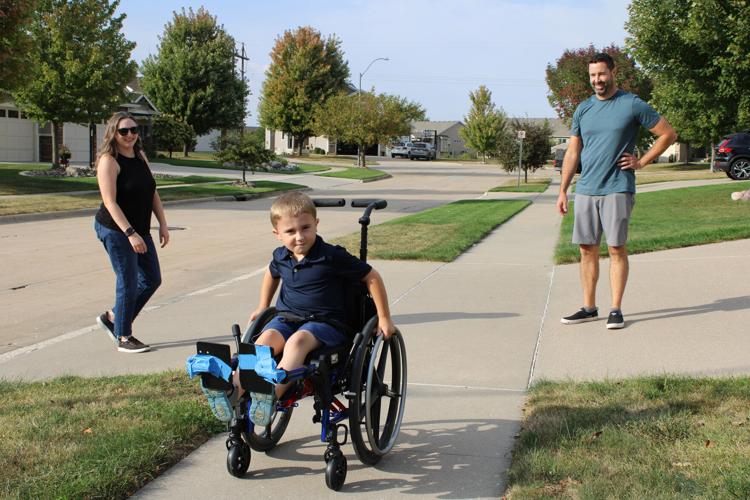
Isaac, 7, lives in Ankeny, Iowa. He has a rare condition called osteogenesis imperfecta, also known as brittle bone disease. The condition has caused about 60 bone fractures, including in his limbs, spine and skull. It can cause intense pain and leave him unable to walk.
At times, Isaac’s disability is practically invisible, said his father, Jake Schreier. Unless he has recently suffered a broken leg bone, he walks well.

Isaac Schreier of Ankeny, Iowa, shows how he uses his specialized wheelchair to get around when he has broken bones from a condition called osteogenesis imperfecta. His parents, Maria and Jake Schreier, received legal assistance from the nonprofit group Disability Rights Iowa after the private company managing Isaac's Medicaid benefits refused to pay for the wheelchair.
Isaac’s doctor said he needed a special wheelchair that could be adjusted to put him in different positions depending on which bones were broken. But the private insurer that manages his Medicaid coverage declined to pay for the $3,500 wheelchair.
“They required proof that it was a permanent and long-standing condition,” Schreier said. “We were very frustrated.”
Schreier appealed the denial but lost. A nurse then recommended he reach out to Disability Rights Iowa, a federally funded protection and advocacy group.
The group linked Schreier with two of its attorneys, who filed a new appeal. The lawyers wrote a detailed letter explaining why Isaac was legally entitled to the new wheelchair, and they cited specific Iowa codes and court precedents.
The insurer wound up paying for Isaac’s special wheelchair.
Increased institutionalization
David Hutt, deputy executive director for legal services at the National Disability Rights Network, noted that state-based advocacy groups have legal authority to go into state institutions and privately owned nursing homes where people with disabilities live, to check conditions and treatment.
More Americans could wind up living in such settings if Trump succeeds in his quest to institutionalize people with mental illness who are living on the streets, Hutt said.

Isaac Schreier of Ankeny, Iowa, uses his specialized wheelchair to get around when he has broken bones from a condition called osteogenesis imperfecta.
At the same time, states are facing cuts in federal contributions to Medicaid. In response, they may be tempted to reduce Medicaid coverage of community care programs, many of which are considered optional under federal law, Hutt said. If that happens, “you’re going to get increased institutionalization, which actually costs more,” he said.
Disability rights organizations often have stepped in when states failed to provide care and services that people with disabilities are entitled to. So have lawyers from the Justice Department’s civil rights division.
But since Trump returned to office, many of the Justice Department’s most experienced disability rights lawyers have taken buyouts or been reassigned to other areas, said Jennifer Mathis, a former top administrator at the Justice Department under Biden.
The overall civil rights division is down to about 300 people, fewer than half the number it had under Biden, Mathis said.
The civil rights division’s new director, Harmeet Dhillon, told conservative commentator Glenn Beck in April that more than 100 attorneys had left the division, but that they didn’t support Trump’s priorities.
In a statement to KFF Health News, Dhillon said the division continues to be “a vocal and active advocate for Americans with disabilities.”
Dhillon noted the department recently sued Uber over complaints that the ride-hailing service was turning away customers with service dogs or wheelchairs; has secured agreements with Arkansas and North Carolina to improve treatment of imprisoned people with disabilities; and is investigating large bus companies over allegations of failing to provide proper accommodations for people with disabilities.
KFF Health News is a national newsroom that produces in-depth journalism about health issues and is one of the core operating programs of KFF — the independent source for health policy research, polling and journalism.