WASHINGTON — The U.S. and Israeli strikes on Iran raised concerns among Democrats and others about diminishing American stockpiles of certain weapons, illustrating a long-standing production problem that some experts say could present challenges if another conflict emerges.
President Donald Trump posted last week on social media that several defense contractors agreed to quadruple production of weapons "as rapidly as possible," though he did not offer details.
Questions about the nation's weapons stockpiles grew as the U.S. campaign against Iran escalates. Missile defense systems are under the most strain, experts said, with Patriot and Terminal High Altitude Area Defense, or THAAD, interceptors in high demand in Ukraine and Israel, respectively.
"I'm not particularly worried about us actually running out during this conflict," said Ryan Brobst, a scholar focused on U.S. defense strategy at the Foundation for Defense of Democracies. "It's about deterring China and Russia the day after this conflict is over."
People are also reading…
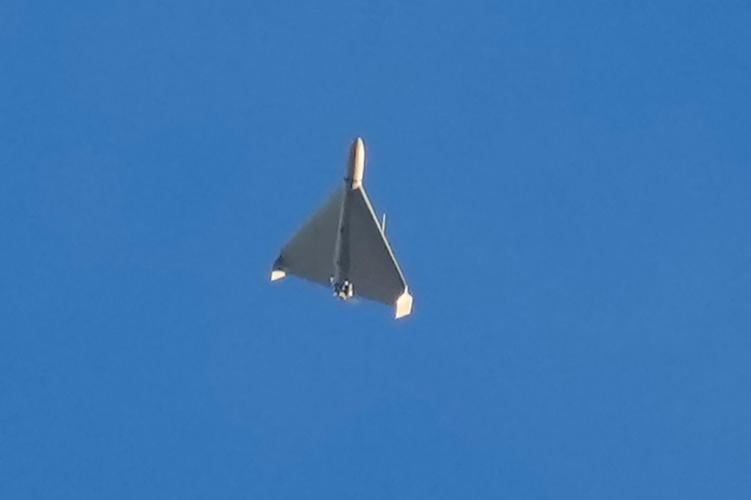
The U.S. uses both systems to take down Iranian missiles but U.S. officials said they struggled to stop drones launched by the Islamic Republic and would bring in an American anti-drone system proven to work against Russian drones in Ukraine. The Merops system also is cheaper than firing a missile that costs hundreds of thousands of dollars at a drone that costs less than $50,000.

An Iranian Shahed exploding drone launched by Russia flies through the sky Oct. 17, 2022, seconds before it struck buildings in Kyiv, Ukraine.
Pentagon says the military has 'everything it needs'
Sean Parnell, the Pentagon's chief spokesman, said the U.S. military "has everything it needs to execute any mission at the time and place of the President's choosing and on any timeline."
Defense contractor Lockheed Martin posted on social media late Friday that it agreed to "quadruple critical munitions production" and "began this work months ago." Trump and Lockheed did not offer a timetable of when the production increases would reach their target.

Some Democratic lawmakers questioned the long-term effect to the U.S. and its allies.
"We've been told again and again and again one reason that we can't provide interceptors for the Patriot system or other munitions for Ukraine is that they're in short supply," Sen. Richard Blumenthal, D-Conn., told CNN.
Sen. Mark Warner, D-Va., told reporters that U.S. supplies are dwindling after the military fought the Houthi rebels in Yemen and engaged in recent conflicts under the Republican administration.
"Our munitions are low. That's public knowledge," Warner said. "It will require additional funding, funding where we have other domestic needs as well."

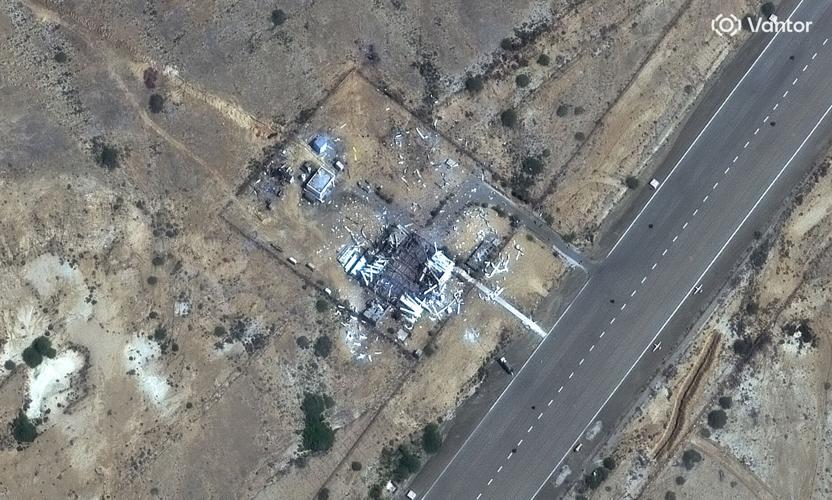
Damaged buildings are seen March 1 at the Konarak drone base in Iran.
Already in high demand
Supplies of defense interceptors are the most taxed, said Brobst, deputy director of the Center on Military and Political Power at the Foundation for Defense of Democracies, a Washington think tank.
The THAAD system is designed for defeating medium-range ballistic missiles, while the Patriot system is for taking down short-range ballistic missiles and crewed aircraft. About 25% of the THAAD stockpile was estimated to be used defending Israel from Iran's ballistic missiles in the 12-day war with Iran last summer, Brobst said.
"These were already in very high demand and we had not procured enough before the conflict," Brobst said. "And now we've probably used, between the two of them, probably several hundred more."
The exact number of U.S. THAAD and Patriot systems is classified.

Demand for interceptors likely fell as the U.S. and its allies took out Iran's weapons' capabilities, Brobst said. Gen. Dan Caine, chairman of the Joint Chiefs of Staff, told reporters last week that the number of ballistic missiles Iran fired was down by 86% from the war's first day.
Other munitions in demand include cruise missiles and precision-guided missiles, known as "standoff" weapons, Brobst said. Their stockpiles are likely healthier, and their use probably peaked at the beginning of the war as U.S. forces hit Iran's early warning systems, air defenses and other targets.
Defense Secretary Pete Hegseth said as much — that American forces used more "standoff munitions at the start, but no longer need to." He told reporters that they would use "500-pound, 1,000-pound and 2,000-pound GPS- and laser-guided, precision gravity bombs."
The U.S. has a healthy supply of those types of weapons, which are cheaper but require aircraft to fly closer to their targets, Brobst said.

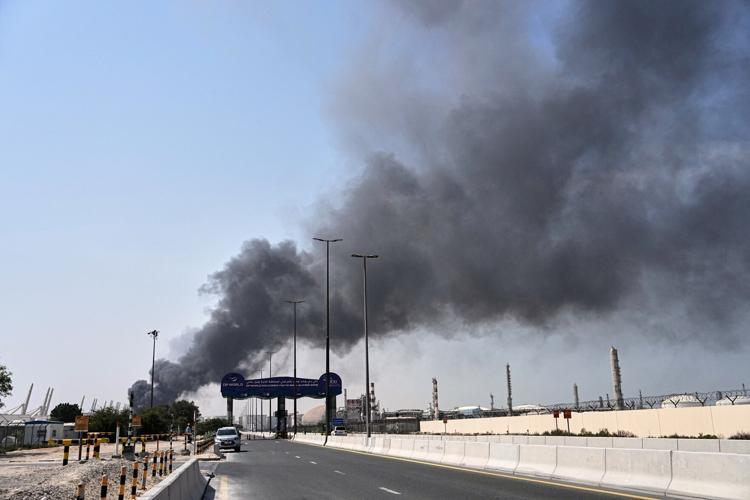
Smoke rises after an Iranian drone attack March 1 in the port area of Dubai, United Arab Emirates.
Root cause of the stockpile concerns
Brobst said the problem of not having enough advanced munitions, particularly interceptors, was around well before the war in Iran, though "this has definitely not made it get any better by using up these munitions."
"Successive administrations over multiple decades did not procure sufficient quantities of these interceptors, and when that happens, companies don't have an incentive to expand their production capacity," Brobst said, adding it takes "significant time" to ramp up production.
The administration in recent months promised to boost defense spending and speed up production, while calling on the Pentagon to call out defense contractors that underperform and insufficiently invest in building manufacturing.
Katherine Thompson, a former deputy senior adviser at the Pentagon during this Trump administration, said then-President Joe Biden diminished some of the stockpile of interceptors by sending them to Ukraine.
Riki Ellison, chairman of the Missile Defense Advocacy Alliance, said the U.S. military could shift interceptors from one part of the world to another or get them from allies if needed.
Photos show US-Israeli strikes and Iran's response

Large fire and plume of smoke is visible after, according to the authorities, debris of an Iranian intercepted drone hit the Fujairah oil facility, in Fujairah, United Arab Emirates, Tuesday, March 3, 2026. (AP Photo/Altaf Qadri)

The sun sets behind a plume of smoke rising after a U.S.–Israeli military strike in Tehran, Iran, Tuesday, March 3, 2026. (AP Photo/Vahid Salemi)

The sun sets behind a plume of smoke rising after a U.S.–Israeli military strike in Tehran, Iran, Tuesday, March 3, 2026. (AP Photo/Vahid Salemi)

An Iranian flag is placed among the ruins of a police station struck Monday during the U.S.–Israeli military campaign in Tehran, Iran, Tuesday, March 3, 2026. (AP Photo/Vahid Salemi)

Residents and officials attend the funeral of people killed in what Iranian officials said was an Israeli-U.S. strike Feb. 28 on a girls' elementary school in Minab, Iran, Tuesday, March 3, 2026. (Abbas Zakeri/Mehr News Agency via AP)

A woman throws rose petals on the coffins during funeral of mostly children killed in what Iranian officials said was an Israeli-U.S. strike Feb. 28 on a girls' elementary school in Minab, Iran, Tuesday, March 3, 2026. (Amirhossein Khorgooei/ISNA via AP)

Coffins holding the bodies of mostly children are prepared for the funeral of those killed in what Iranian officials said was an Israeli-U.S. strike Feb. 28 at a girls' elementary school in Minab, Iran, Tuesday, March 3, 2026. (Amirhossein Khorgooei/ISNA via AP)

A woman crosses almost deserted square with a billboard at rear showing a portrait of the late Iranian Supreme Leader Ayatollah Ali Khamenei, who was killed in the U.S.–Israeli military campaign, in Tehran, Iran, Tuesday, March 3, 2026. (AP Photo/Vahid Salemi)

Large fire and plume of smoke is visible after, according to the authorities, debris of an Iranian intercepted drone hit the Fujairah oil facility, in Fujairah, United Arab Emirates, Tuesday, March 3, 2026. (AP Photo/Altaf Qadri)

Smoke rises on the skyline after an explosion in Tehran, Iran, Saturday, Feb. 28, 2026.(AP Photo)

People watch as smoke rises on the skyline after an explosion in Tehran, Iran, Saturday, Feb. 28, 2026.(AP Photo)

Paramedics evacuate wounded people from the site of a deadly Iranian missile strike in Beit Shemesh, Israel Sunday, March 1, 2026. (AP Photo/Leo Correa)

A black plume of smoke rises from a warehouse at the industrial area of Sharjah City in the United Arab Emirates following reports of Iranian strikes in Dubai, United Arab Emirates, Sunday, March 1, 2026. (AP Photo/Altaf Qadri)

A man walks away after watching as a black plume of smoke rises from a warehouse in the industrial area of Sharjah City, United Arab Emirates, Sunday, March 1, 2026, following reports of Iranian strikes in Dubai. (AP Photo/Altaf Qadri)

Israeli security forces inspect a damaged road after a missile launched from Iran struck Jerusalem, Sunday, March 1, 2026.(AP Photo/Mahmoud Illean)

A man holds an Iranian flag as he looks at the damaged façade of Gandhi Hospital, which was hit Sunday when a strike also struck a state TV communications tower and nearby buildings across the street during the ongoing joint U.S.–Israeli military campaign in Tehran, Iran, Tuesday, March 2, 2026. (AP Photo/Vahid Salemi)

Clerics and other government supporters mourn in a gathering after state TV officially announced the death of Iranian Supreme Leader Ayatollah Ali Khamenei, in Tehran, Iran, Sunday, March 1, 2026. (AP Photo/Vahid Salemi)

Government supporters gather in mourning after state TV officially announced the death of Iranian Supreme Leader Ayatollah Ali Khamenei, in Tehran, Iran, Sunday, March 1, 2026. (AP Photo/Vahid Salemi)

Rescue workers and military personnel survey the scene of a direct hit a day after an Iranian missile struck in Tel Aviv, Israel, Sunday, March 1, 2026. (AP Photo/Oded Balilty)

A plume of smoke rises after a strike in Tehran, Iran, Sunday, March 1, 2026. (AP Photo/Vahid Salemi)

Leah Guttmann holds her son, Teddy, as other people take shelter in an underground parking garage while air-raid sirens warn of incoming missiles launched by Iran toward Tel Aviv, Israel, Sunday, March 1, 2026. (AP Photo/Ohad Zwigenberg)

Rescue workers and military personnel operate at the scene where several people were killed in an Iranian missile strike in Beit Shemesh, Israel Sunday, March 1, 2026. (AP Photo/Leo Correa)

An Israeli rescue personal carries a child after missiles attack from Iran hit in Tel Aviv, Israel, Saturday, Feb. 28, 2026. (AP Photo/Ohad Zwigenberg)

An explosion is seen as an Iranian missile directly hits a building in Tel Aviv, Israel, Saturday, Feb. 28, 2026. (AP Photo/Tomer Neuberg)

Rescue workers bandage a wounded man and provide first aid at the site of a direct hit from an Iranian missile strike in Tel Aviv, Israel, Saturday, Feb. 28, 2026. (AP Photo/Tomer Neuberg)

Firefighters try to extinguish flames in a building after a direct hit by an Iranian missile strike in Tel Aviv, Israel, Saturday, Feb. 28, 2026. (AP Photo/Tomer Neuberg)

Officers from Israel's Home Front Command search through the rubble of a damaged apartment building after an Iranian missile strike, in Tel Aviv, Israel, early Sunday, March 1, 2026. (AP Photo/Ohad Zwigenberg)

Officers from Israel's Home Front Command search through the rubble of a damaged apartment building after an Iranian missile strike in Tel Aviv, Israel, early Sunday, March 1, 2026. (AP Photo/Ohad Zwigenberg)

Government supporters mourn during a gathering after state TV officially announced the death of Iranian Supreme Leader Ayatollah Ali Khamenei, shown in the poster, in Tehran, Iran, Sunday, March 1, 2026. (AP Photo/Vahid Salemi)

Firemen and rescue workers inspect the site of an explosion at the Fairmont The Palm Hotel in Dubai, United Arab Emirates, Saturday, Feb. 28, 2026. (AP Photo/Altaf Qadri)

This image provided by Airbus shows the strike on Iranian Supreme Leader's compound on Saturday, Feb. 28, 2026 in Iran. (Pléiades Neo (c) Airbus DS 2026 via AP)

This image from video provided by U.S. Central Command shows a missile being launched from a U.S. Navy ship in support of Operation Epic Fury on Saturday, Feb. 28, 2026. (U.S. Central Command via AP)

Rescue workers and residents search through the rubble in the aftermath of what Iranian officials said was an Israeli-U.S. strike on a girls' elementary school in Minab, Iran, Saturday, Feb. 28, 2026. (Abbas Zakeri/Mehr News Agency via AP)

A man hold a children's backpack as rescue workers and residents search through the rubble in the aftermath of what Iranian officials said was an Israeli-U.S. strike on a girls' elementary school in Minab, Iran, Saturday, Feb. 28, 2026. (Abbas Zakeri/Mehr News Agency via AP)

Traces of an air defense missile interception are seen, left, over Jerusalem's Old City, Saturday, Feb. 28, 2026. (AP Photo/Mahmoud Illean)

An incoming projectile explodes over the water as Israel issues a nationwide alert following its strikes on Iran, in Haifa Bay, northern Israel, Saturday, Feb. 28, 2026. (AP Photo/Leo Correa)

People rush to take shelter as warning sirens sound following missile fired towards Israel, in Tel Aviv, Israel, Saturday, Feb. 28, 2026. (AP Photo/Ohad Zwigenberg)

People take shelter in an underground metro station as air raid sirens warn of incoming strikes by Iran, in Ramat Gan, Israel, Saturday, Feb. 28, 2026. (AP Photo/Oded Balilty)

The flare of a projectile is seen over the skyline of Dubai, United Arab Emirates, Saturday, Feb. 28, 2026. (AP Photo/Fatima Shbair)