JERUSALEM — Satellite images, expert analysis, a U.S. official and public information released by the U.S. and Israeli militaries suggest an explosion that killed scores of Iranian students at a school was likely caused by U.S. airstrikes that also hit an adjacent compound associated with the regime's Revolutionary Guard.
The United Nations and human rights monitors criticized the Feb. 28 strike, which had the highest reported civilian death toll since the war began. More than 165 people were killed, mostly children, in the blast during school hours at Shajareh Tayyebeh Elementary School, according to Iranian state media.

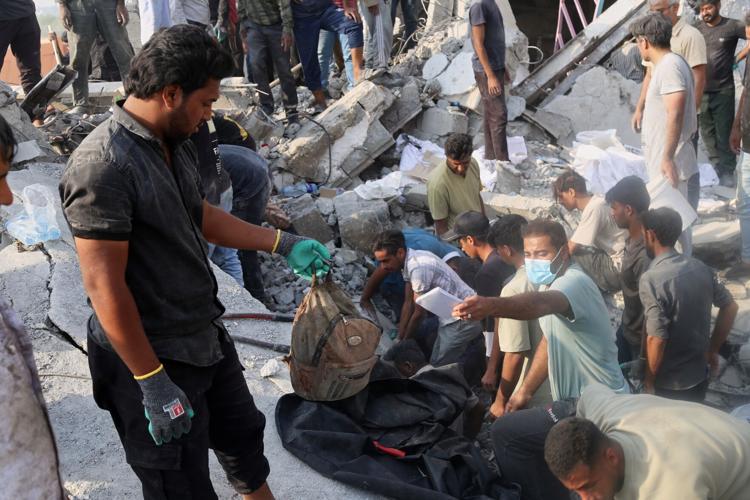
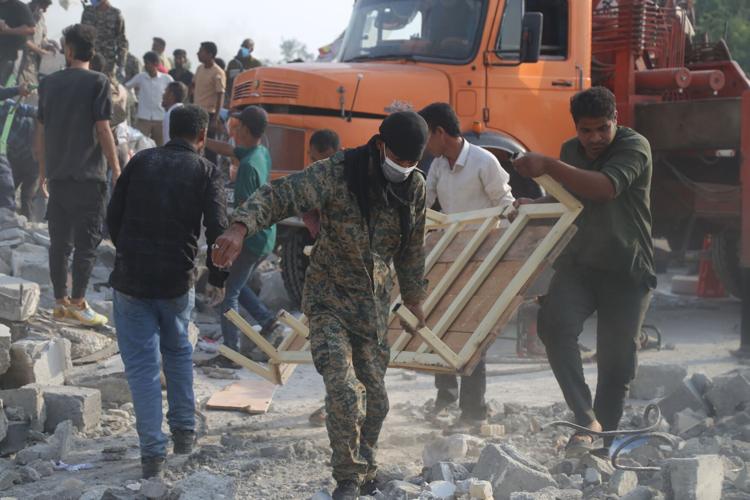
A man hold a children's backpack Feb. 28 as rescue workers and residents search through rubble after what Iranian officials said was an Israeli-U.S. strike on a girls' elementary school in Minab, Iran.
Satellite images taken Wednesday and reviewed by the The Associated Press show most of the school in the city of Minab, about 680 miles southeast of Tehran, reduced to rubble, a crescent shape punched into its roof. Experts say the tight pattern of the damage visible on the satellite photos is consistent with a targeted airstrike.
People are also reading…
Iran blamed Israel and the United States for the blast. Neither country accepted responsibility.
Asked about the strike at a Pentagon press briefing Wednesday, Defense Secretary Pete Hegseth said, "All I can say is that we're investigating that. We, of course, never target civilian targets. But we're taking a look and investigating that."

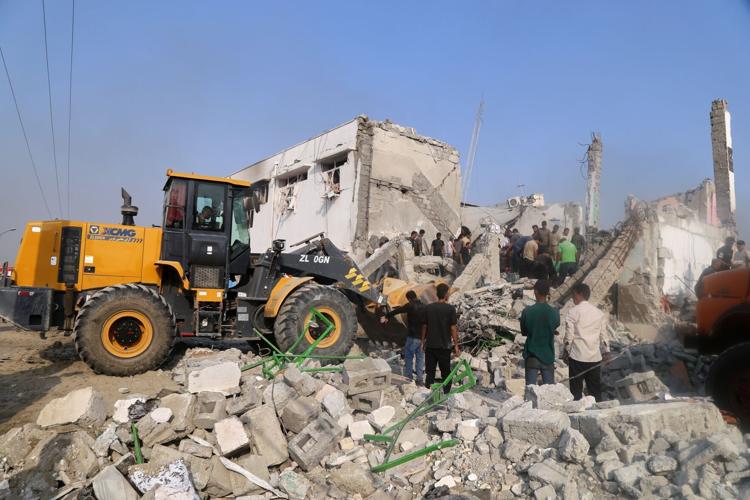
Rescue workers and residents search through the rubble Feb. 28 after what Iranian officials said was an Israeli-U.S. strike on a girls' elementary school in Minab, Iran.
Several factors point to a U.S. strike
One is the launching of an assessment of the incident by the U.S. military. According to the Pentagon's instructions on processes for mitigating civilian harm, an assessment is launched after a group of investigators make an initial determination that the U.S. military may bear culpability. A U.S. official, speaking on condition of anonymity, told the AP the strike was likely American.
Another is the location of the school — next to a base of the Revolutionary Guard in Hormozgan Province and close to a barracks for its naval brigade. The U.S. military focused on naval targets and acknowledged strikes in the province, including one in the vicinity of the school.
Israel, which denied conducting the strike, focused on areas of Iran closer to Israel and hasn't reported conducting any strikes south of Isfahan, 500 miles away. U.S. warships in the Arabian Sea are within range of the school.
The White House is facing criticism for posting a video montage mixing footage from the Iran war with films and cartoons.
When asked by the AP about its findings, U.S. military Central Command spokesperson Capt. Tim Hawkins said, "It would be inappropriate to comment given the incident is under investigation."
White House press secretary Karoline Leavitt told reporters Friday that she had no updates on the investigation and did not directly answer a question about whether Trump was satisfied with the pace of the probe.
"My assumption is that probably there were some activities recently there and they detected and tracked them, but … they weren't aware or didn't have an up-to-date database that a girls' school was there and they bombed it," said Farzin Nadimi, a senior fellow at the Washington Institute for Near East Policy who studies Iran's military.
Satellite images show damage

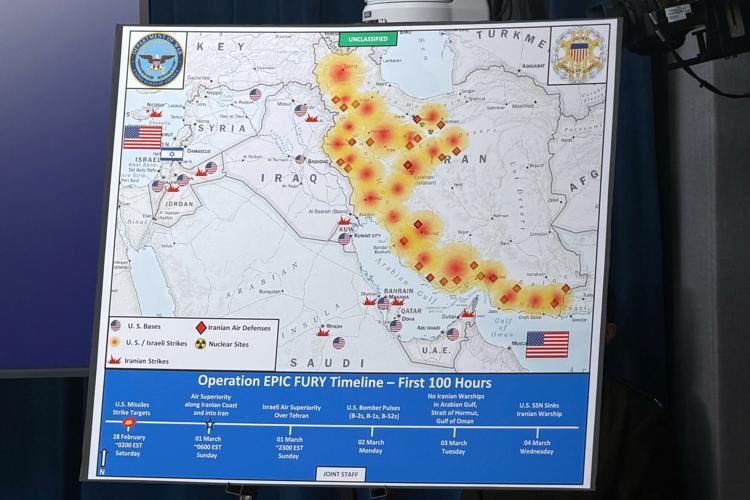
A Department of Defense map titled "Operation EPIC FURY Timeline - First 100 Hours" is displayed Wednesday during a news conference at the Pentagon in Washington.
The school is adjacent to a walled compound labeled on maps as the Seyyed Al-Shohada Cultural Complex of the Guard, which included a pharmacy, gym and sports field.
Satellite photos show blasts also struck at least five buildings in the Guard compound, leaving the area pocked with craters, charred holes in roofs and piles of rubble.
Iranian online map applications show a living quarters for the Assef Brigades about 165 yards from the school, in the Revolutionary Guard compound. The 16th Assef Coastal Missile Group is part of the Guard's navy, Nadimi said. The 1st Naval District, which the Assef Brigades belong to, is responsible for the Strait of Hormuz, the narrow mouth of the Persian Gulf through which a fifth of all oil and natural gas traded passes and a particular point of conflict in the war.
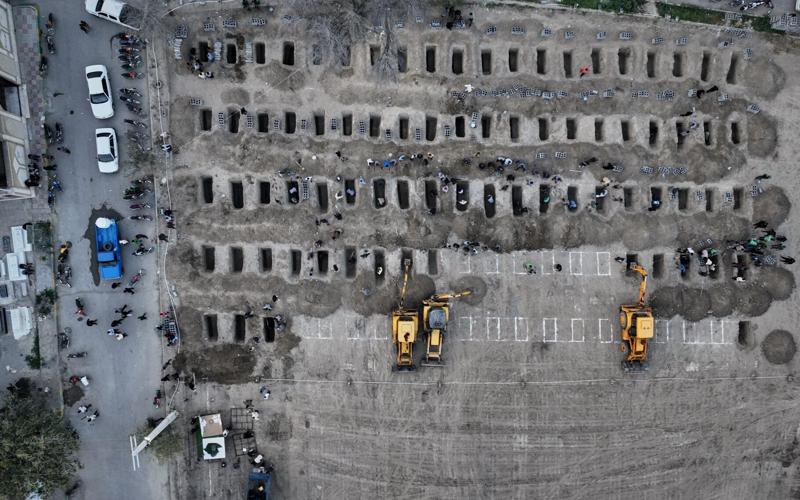
After the strike, video from Iran's state broadcaster verified by the Associated Press using satellite imagery showed dozens of fresh graves dug at a nearby cemetery. Nadimi said it is likely the school taught daughters of Guard personnel.

Graves are prepared Monday for the victims, mostly children, of a Feb. 28 strike at a girls' elementary school in Minab, Iran.
The strike drew wide condemnation from international human rights groups amid reports that airstrikes also hit other schools in Iran.
Targeting schools would be a clear violation of international laws governing armed conflict, said Elise Baker, a senior staff lawyer at the Atlantic Council, a Washington-based nonprofit think tank.

Rescue workers and residents remove rubble Feb. 28 after a strike on a girls' elementary school in Minab, Iran.
Pattern of damage suggests targeted strike
Three experts told the AP the satellite imagery and videos strongly suggest multiple munitions hit the compound. Complicating any assessment is the lack of images of bomb fragments. No independent agency reached the site during the war to investigate.
There are no craters or evidence of bombs hitting in the surrounding neighborhood, suggesting a great degree of accuracy, said Corey Scher, a researcher who uses satellite imagery and radar data to study landscape changes in armed conflict zones. He said the school and the other buildings struck in the compound showed damage consistent with the use of air-to-surface munitions.
Sean Moorhouse, a former British Army officer and explosive ordnance disposal expert, said the available satellite imagery was insufficient to determine exactly what type of munitions were used in the strike, but said the visible damage was consistent with what would be expected from multiple 2,000-pound high-explosive warheads. He said the multiple precise impacts would undercut any suggestion that a malfunctioning Iranian missile hit the school.
Photos show US-Israeli strikes and Iran's response

Large fire and plume of smoke is visible after, according to the authorities, debris of an Iranian intercepted drone hit the Fujairah oil facility, in Fujairah, United Arab Emirates, Tuesday, March 3, 2026. (AP Photo/Altaf Qadri)

The sun sets behind a plume of smoke rising after a U.S.–Israeli military strike in Tehran, Iran, Tuesday, March 3, 2026. (AP Photo/Vahid Salemi)

The sun sets behind a plume of smoke rising after a U.S.–Israeli military strike in Tehran, Iran, Tuesday, March 3, 2026. (AP Photo/Vahid Salemi)

An Iranian flag is placed among the ruins of a police station struck Monday during the U.S.–Israeli military campaign in Tehran, Iran, Tuesday, March 3, 2026. (AP Photo/Vahid Salemi)

Residents and officials attend the funeral of people killed in what Iranian officials said was an Israeli-U.S. strike Feb. 28 on a girls' elementary school in Minab, Iran, Tuesday, March 3, 2026. (Abbas Zakeri/Mehr News Agency via AP)

A woman throws rose petals on the coffins during funeral of mostly children killed in what Iranian officials said was an Israeli-U.S. strike Feb. 28 on a girls' elementary school in Minab, Iran, Tuesday, March 3, 2026. (Amirhossein Khorgooei/ISNA via AP)

Coffins holding the bodies of mostly children are prepared for the funeral of those killed in what Iranian officials said was an Israeli-U.S. strike Feb. 28 at a girls' elementary school in Minab, Iran, Tuesday, March 3, 2026. (Amirhossein Khorgooei/ISNA via AP)

A woman crosses almost deserted square with a billboard at rear showing a portrait of the late Iranian Supreme Leader Ayatollah Ali Khamenei, who was killed in the U.S.–Israeli military campaign, in Tehran, Iran, Tuesday, March 3, 2026. (AP Photo/Vahid Salemi)

Large fire and plume of smoke is visible after, according to the authorities, debris of an Iranian intercepted drone hit the Fujairah oil facility, in Fujairah, United Arab Emirates, Tuesday, March 3, 2026. (AP Photo/Altaf Qadri)

Smoke rises on the skyline after an explosion in Tehran, Iran, Saturday, Feb. 28, 2026.(AP Photo)

People watch as smoke rises on the skyline after an explosion in Tehran, Iran, Saturday, Feb. 28, 2026.(AP Photo)

Paramedics evacuate wounded people from the site of a deadly Iranian missile strike in Beit Shemesh, Israel Sunday, March 1, 2026. (AP Photo/Leo Correa)

A black plume of smoke rises from a warehouse at the industrial area of Sharjah City in the United Arab Emirates following reports of Iranian strikes in Dubai, United Arab Emirates, Sunday, March 1, 2026. (AP Photo/Altaf Qadri)

A man walks away after watching as a black plume of smoke rises from a warehouse in the industrial area of Sharjah City, United Arab Emirates, Sunday, March 1, 2026, following reports of Iranian strikes in Dubai. (AP Photo/Altaf Qadri)

Israeli security forces inspect a damaged road after a missile launched from Iran struck Jerusalem, Sunday, March 1, 2026.(AP Photo/Mahmoud Illean)

A man holds an Iranian flag as he looks at the damaged façade of Gandhi Hospital, which was hit Sunday when a strike also struck a state TV communications tower and nearby buildings across the street during the ongoing joint U.S.–Israeli military campaign in Tehran, Iran, Tuesday, March 2, 2026. (AP Photo/Vahid Salemi)

Clerics and other government supporters mourn in a gathering after state TV officially announced the death of Iranian Supreme Leader Ayatollah Ali Khamenei, in Tehran, Iran, Sunday, March 1, 2026. (AP Photo/Vahid Salemi)

Government supporters gather in mourning after state TV officially announced the death of Iranian Supreme Leader Ayatollah Ali Khamenei, in Tehran, Iran, Sunday, March 1, 2026. (AP Photo/Vahid Salemi)

Rescue workers and military personnel survey the scene of a direct hit a day after an Iranian missile struck in Tel Aviv, Israel, Sunday, March 1, 2026. (AP Photo/Oded Balilty)

A plume of smoke rises after a strike in Tehran, Iran, Sunday, March 1, 2026. (AP Photo/Vahid Salemi)

Leah Guttmann holds her son, Teddy, as other people take shelter in an underground parking garage while air-raid sirens warn of incoming missiles launched by Iran toward Tel Aviv, Israel, Sunday, March 1, 2026. (AP Photo/Ohad Zwigenberg)

Rescue workers and military personnel operate at the scene where several people were killed in an Iranian missile strike in Beit Shemesh, Israel Sunday, March 1, 2026. (AP Photo/Leo Correa)

An Israeli rescue personal carries a child after missiles attack from Iran hit in Tel Aviv, Israel, Saturday, Feb. 28, 2026. (AP Photo/Ohad Zwigenberg)

An explosion is seen as an Iranian missile directly hits a building in Tel Aviv, Israel, Saturday, Feb. 28, 2026. (AP Photo/Tomer Neuberg)

Rescue workers bandage a wounded man and provide first aid at the site of a direct hit from an Iranian missile strike in Tel Aviv, Israel, Saturday, Feb. 28, 2026. (AP Photo/Tomer Neuberg)

Firefighters try to extinguish flames in a building after a direct hit by an Iranian missile strike in Tel Aviv, Israel, Saturday, Feb. 28, 2026. (AP Photo/Tomer Neuberg)

Officers from Israel's Home Front Command search through the rubble of a damaged apartment building after an Iranian missile strike, in Tel Aviv, Israel, early Sunday, March 1, 2026. (AP Photo/Ohad Zwigenberg)

Officers from Israel's Home Front Command search through the rubble of a damaged apartment building after an Iranian missile strike in Tel Aviv, Israel, early Sunday, March 1, 2026. (AP Photo/Ohad Zwigenberg)

Government supporters mourn during a gathering after state TV officially announced the death of Iranian Supreme Leader Ayatollah Ali Khamenei, shown in the poster, in Tehran, Iran, Sunday, March 1, 2026. (AP Photo/Vahid Salemi)

Firemen and rescue workers inspect the site of an explosion at the Fairmont The Palm Hotel in Dubai, United Arab Emirates, Saturday, Feb. 28, 2026. (AP Photo/Altaf Qadri)

This image provided by Airbus shows the strike on Iranian Supreme Leader's compound on Saturday, Feb. 28, 2026 in Iran. (Pléiades Neo (c) Airbus DS 2026 via AP)

This image from video provided by U.S. Central Command shows a missile being launched from a U.S. Navy ship in support of Operation Epic Fury on Saturday, Feb. 28, 2026. (U.S. Central Command via AP)

Rescue workers and residents search through the rubble in the aftermath of what Iranian officials said was an Israeli-U.S. strike on a girls' elementary school in Minab, Iran, Saturday, Feb. 28, 2026. (Abbas Zakeri/Mehr News Agency via AP)

A man hold a children's backpack as rescue workers and residents search through the rubble in the aftermath of what Iranian officials said was an Israeli-U.S. strike on a girls' elementary school in Minab, Iran, Saturday, Feb. 28, 2026. (Abbas Zakeri/Mehr News Agency via AP)

Traces of an air defense missile interception are seen, left, over Jerusalem's Old City, Saturday, Feb. 28, 2026. (AP Photo/Mahmoud Illean)

An incoming projectile explodes over the water as Israel issues a nationwide alert following its strikes on Iran, in Haifa Bay, northern Israel, Saturday, Feb. 28, 2026. (AP Photo/Leo Correa)

People rush to take shelter as warning sirens sound following missile fired towards Israel, in Tel Aviv, Israel, Saturday, Feb. 28, 2026. (AP Photo/Ohad Zwigenberg)

People take shelter in an underground metro station as air raid sirens warn of incoming strikes by Iran, in Ramat Gan, Israel, Saturday, Feb. 28, 2026. (AP Photo/Oded Balilty)

The flare of a projectile is seen over the skyline of Dubai, United Arab Emirates, Saturday, Feb. 28, 2026. (AP Photo/Fatima Shbair)