WASHINGTON — The Senate passed legislation Monday to reopen the government, bringing the longest shutdown in history closer to an end as a small group of Democrats ratified a deal with Republicans despite searing criticism from within their party.

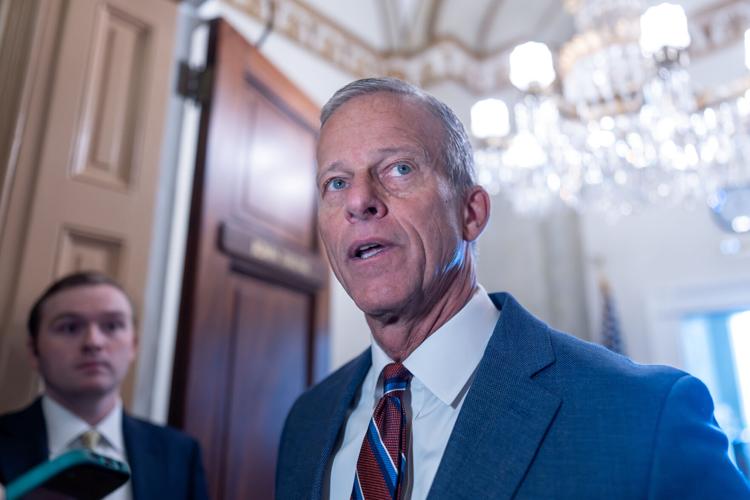
Senate Majority Leader John Thune, R-S.D., speaks to reporters Monday as he arrives at his office after a weekend vote to move forward with a stopgap funding bill to reopen the government at the Capitol in Washington.
The 41-day shutdown could last a few more days as members of the House, which has been on recess since mid-September, return to Washington to vote on the legislation. President Donald Trump has signaled support for the bill, saying Monday that “we’re going to be opening up our country very quickly.”
The final Senate vote, 60-40, broke a grueling stalemate that lasted more than six weeks as Democrats demanded that Republicans negotiate with them to extend health care tax credits that expire Jan. 1. The Republicans never did, and five moderate Democrats eventually switched their votes as federal food aid was delayed, airport delays worsened and hundreds of thousands of federal workers continued to go unpaid.
People are also reading…
House Speaker Mike Johnson urged lawmakers to start returning to Washington “right now" given shutdown-related travel delays. “We have to do this as quickly as possible," said Johnson, who has kept the House out of session since mid-September, when the House passed a bill to continue government funding.
After weeks of negotiations, a group of three former governors — New Hampshire Sen. Jeanne Shaheen, New Hampshire Sen. Maggie Hassan and Independent Sen. Angus King of Maine — agreed to vote to advance three bipartisan annual spending bills and extend the rest of government funding until late January. Republicans promised to hold a vote to extend the health care subsidies by mid-December, but there was no guarantee of success.

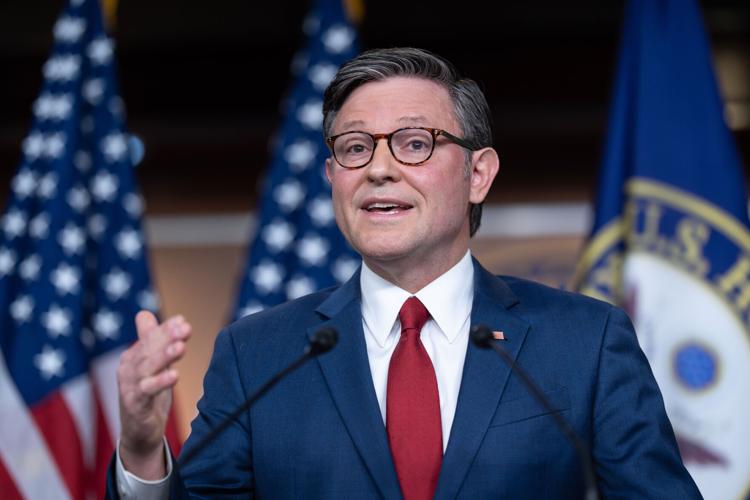
House Speaker Mike Johnson, R-La., makes a statement to reporters Monday at the Capitol in Washington.
Shaheen said Monday that “this was the option on the table” after Republicans refused to budge.
“We had reached a point where I think a number of us believed that the shutdown had been very effective in raising the concern about health care," she said, and the promise for a future vote “gives us an opportunity to continue to address that going forward."
The legislation includes a reversal of the mass firings of federal workers by the Trump administration since the shutdown began on Oct. 1. It also protects federal workers against further layoffs through January and guarantees they are paid once the shutdown is over.
In addition to Shaheen, King and Hassan, Democratic Sen. Tim Kaine of Virginia, home to tens of thousands of federal workers, also voted Sunday in favor of moving forward on the agreement. Illinois Sen. Dick Durbin, the No. 2 Democrat, Pennsylvania Sen. John Fetterman and Nevada Sens. Catherine Cortez Masto and Jacky Rosen also voted yes. All other Democrats, including Senate Democratic leader Chuck Schumer of New York, voted against it.
The moderates expected a larger number of Democrats to vote with them as 10 to 12 Democratic senators had been part of the negotiations. But in the end, only five switched their votes — the exact number that Republicans needed. King, Cortez Masto and Fetterman had already been voting to open the government since Oct. 1.
Schumer, who received blowback from his party in March when he voted to keep the government open, said he could not “in good faith” support it after meeting with his caucus for more than two hours on Sunday.
“We will not give up the fight,” Schumer said, adding that Democrats have now “sounded the alarm” on health care.

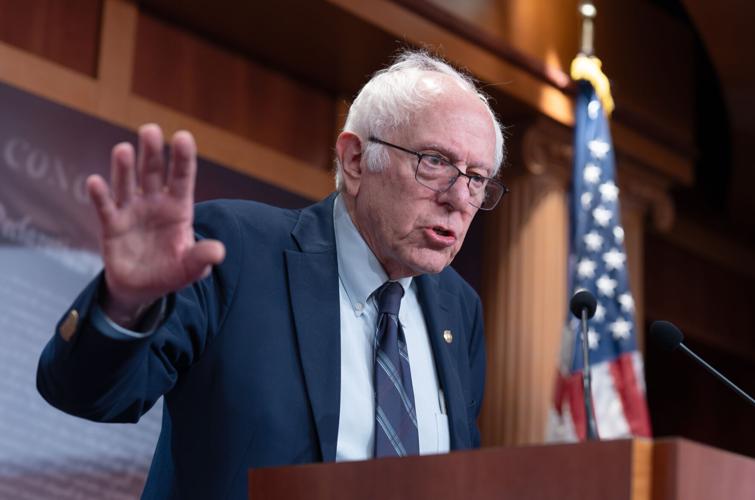
Sen. Bernie Sanders, I-Vt., speaks to reporters Wednesday at the Capitol in Washington.
Independent Sen. Bernie Sanders of Vermont, who caucuses with the Democrats, said giving up the fight was a “horrific mistake.” Sen. Chris Murphy, D-Conn., agreed, saying that voters who overwhelmingly supported Democrats in last week's elections were urging them to "hold firm.”
House Democrats swiftly criticized the Senate.
Texas Rep. Greg Casar, the chairman of the Congressional Progressive Caucus, said a deal that doesn’t reduce health care costs is a “betrayal” of millions of Americans who are counting on Democrats to fight.
Others gave Schumer a nod of support. House Democratic leader Hakeem Jeffries criticized Schumer in March after his vote to keep the government open. But he praised the Senate Democratic leader Monday and expressed support for his leadership throughout the shutdown.
“The American people know we are on the right side of this fight,” Jeffries said Monday, pointing to last Tuesday's election results.
It’s unclear whether the two parties would be able to find common ground on the health care subsidies before a promised December vote in the Senate. House Speaker Mike Johnson, R-La., said he will not commit to bringing it up in his chamber.
On Monday, Johnson said House Republicans have always been open to voting to reform what he called the “unaffordable care act” but again did not say if they would vote on the subsidies.
Some Republicans have said they are open to extending the COVID-19-era tax credits as premiums could skyrocket for millions of people, but they also want new limits on who can receive the subsidies. Some argue that the tax dollars for the plans should be routed through individuals.
Senate Appropriations Committee Chairwoman Susan Collins said Monday that she's supportive of extending the tax credits with changes, like new income caps. Some Democrats have signaled they could be open to that idea.
“We do need to act by the end of the year, and that is exactly what the majority leader has promised,” Collins said.
Other Republicans, including Trump, have used the debate to renew their yearslong criticism of the law and called for it to be scrapped or overhauled.
In a possible preview, the Senate voted 47-53 along party lines Monday not to extend the subsidies for a year. Majority Republicans allowed the vote as part of a separate deal with Democrats to speed up votes and send the legislation to the House.
Monthlong government shutdown in photos: Disruptions, delays and divisions

Volunteer Betty McNeely, right, helps a man bag food items Oct. 28 at Project Feed, an emergency food pantry in Portland, Maine. With no endgame in sight, the U.S. government shutdown is expected to roll on for the unforeseeable future, injecting more uncertainty into an already precarious economy.

Brock Brooks, a disable Marine Corps veteran, cries Oct. 30 while describing the impending SNAP shutdowns while waiting in line to enter the food pantry service at Calvary Episcopal Church in Louisville, Ky. Funding for the Supplemental Nutrition Assistance Program, or SNAP, lapsed Saturday.

Volunteers prepare emergency food packages Oct. 28 at the Tarrant Area Food Bank in Fort Worth, Texas.

Tammy Norton, a furloughed federal employee of 16 years who currently works for the Internal Revenue Service, reacts with emotion Oct. 28 as she talks about running through her limited savings to support her family during the government shutdown, at a food distribution center for federal employees affected by the government shutdown in Dania Beach, Fla. The monthlong government shutdown halted routine federal operations, furloughed about 750,000 federal employees and left others working without pay.

Volunteer Joel Hernandez helps load a vehicle Oct. 27 during a food distribution targeting federal employee households affected by the federal shutdown as well as SNAP recipients in San Antonio.

A food and supplies bank is set up Oct. 17 at Harry Reid International Airport in Las Vegas, Nv.

House Minority Leader Hakeem Jeffries, D-N.Y., disputes a reporter's question Oct. 24 as he enters his office at the Capitol in Washington on day 24 of the government shutdown.

The Capitol is seen at nightfall Oct. 22, day 22 of a government shutdown, in Washington.

Sen. John Barrasso, R-Wyo., the Senate GOP whip, left, and Speaker of the House Mike Johnson, R-La., arrive for a news conference with top Republicans on the government shutdown Oct. 1 at the Capitol in Washington.

Air Traffic Controllers stand Oct. 28 outside Detroit Metropolitan Wayne County Airport in Romulus, Mich., distributing leaflets explaining how the federal government shutdown is affecting air travel. Airports have been scrambling with flight disruptions.

Travelers sit together and wait Oct. 2 at the Baltimore/Washington International Thurgood Marshall Airport in Baltimore.

TSA agent Sashene McLean, holding her 1-year-old daughter, comes from work to collect a donation of produce, meat and yogurt Oct. 28 at a food distribution center in Dania Beach, Fla., organized to assist federal employees missing paychecks during the government shutdown.

Senate Majority Leader John Thune, R-S.D., speaks to reporters Sept. 30 at the U.S. Capitol in Washington as the U.S. government was on the brink of the first federal government shutdown in almost seven years.

Speaker of the House Mike Johnson, R-La., and GOP leaders, from left, Rep. Lisa McClain, R-Mich., and Majority Whip Tom Emmer, R-Minn., blame the government shutdown on Democrats during an Oct. 2 news conference at the Capitol in Washington. Americans, meanwhile, are divided on who’s to blame.

Senate Minority Leader Chuck Schumer, D-N.Y., attends a Sept. 30 news conference about the government shutdown on Capitol Hill in Washington. Democrats seek an extension of expiring tax credits that helped millions of people afford health insurance, while Republicans say they won’t negotiate until the government is reopened.