WASHINGTON — President Donald Trump largely sidestepped diplomatic coordination as he made the decision to launch strikes on Iran with Israel. Now with the war's economic and geopolitical consequences unfurling rapidly, he's cajoling allies and other global powers to help mop up the mess.
Trump says he asked about a half-dozen other countries to send warships to reopen the vital Strait of Hormuz, a consequential waterway through which one-fifth of the world's traded oil flows. So far, none committed.
Trump even indicated he would use his long-planned trip to China to pressure Beijing to help with a new coalition meant to get oil tanker traffic moving through the strait — a notion his treasury secretary later downplayed.
"We strongly encourage other nations whose economies depend on the strait far more than ours … we want them to come and help us with the strait," Trump said at the White House on Monday, listing Japan, China, South Korea and several countries in Europe as examples. Trump claims the shipping channel is not something the United States needs because of its own access to oil.
People are also reading…

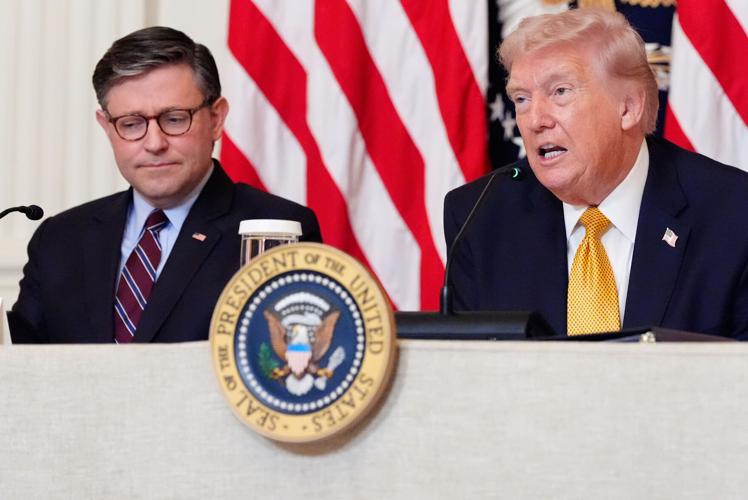
U.S. President Donald Trump, right, speaks Monday during a board meeting of the John F. Kennedy Memorial Center For The Performing Arts in the East Room of the White House in Washington, as House Speaker Mike Johnson looks on.
But with oil prices soaring and the Middle East rattled by violence, there's little inclination from other countries to heed Trump's call.
China is noncommittal. France is a maybe on escorting ships, when "circumstances permit." Britain is unlikely to dispatch a warship.
In Trump's view, this lack of appetite for helping to secure the strait confirms his suspicions about the benefits of working with other countries, because "if we ever needed help, they won't be there for us."
"I've always felt that was a weakness of NATO," Trump said Monday. "We were going to protect them, but I always said when in need, they won't protect us."
Not long after, Trump insisted the U.S. didn't need help from anybody because "we're the strongest nation in the world."
Europeans have been critical of the U.S. and Israel for failing to provide clarity on their objectives in the war.

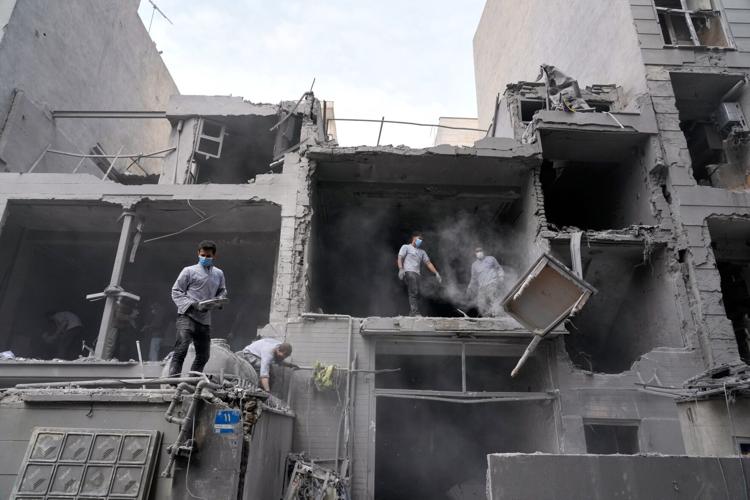
Volunteers clean debris Sunday from a residential building damaged when a nearby police station was hit Friday in a U.S.-Israeli strike in Tehran, Iran.
Ahead of a meeting in Brussels, the European Union's foreign policy chief Kaja Kallas said the bloc's foreign ministers would discuss possibly extending a naval mission that protects ships in the Red Sea to the Strait of Hormuz, without giving any details.
Italian Foreign Minister Antonio Tajani told reporters in Brussels that his country favors strengthening anti-piracy and defensive missions in the Red Sea, but said he didn't believe in expanding their roles to the Strait of Hormuz.
Prime Minister Keir Starmer of Britain, which is not an EU member, told reporters that Britain and allies were working on a plan to reopen the strait. Starmer said Britain might deploy mine-hunting U.K. drones already in the region, but insisted it "will not be drawn into the wider war." He suggested the U.K. is unlikely to dispatch a warship.

Japan and Australia both said Monday that they were not asked to help protect the strait and had no plans to do so.
Separately, Trump indicated in a Sunday interview with the Financial Times that "we'd like to know" before he leaves for a late-March summit in Beijing whether China will help secure the strait because of its reliance on Middle Eastern oil, adding: "We may delay."
A Foreign Ministry spokesperson in Beijing, Lin Jian, did not respond directly to questions about Trump's call for outside help in the strait. He noted the impact on goods and energy trade and repeated his government's call for an end to the fighting.
At the White House on Monday, Trump was asked what his aides told him about how long gas prices will remain high. Trump dismissed the question.
"I don't need advisers to tell me that," he said. "I know what it is."

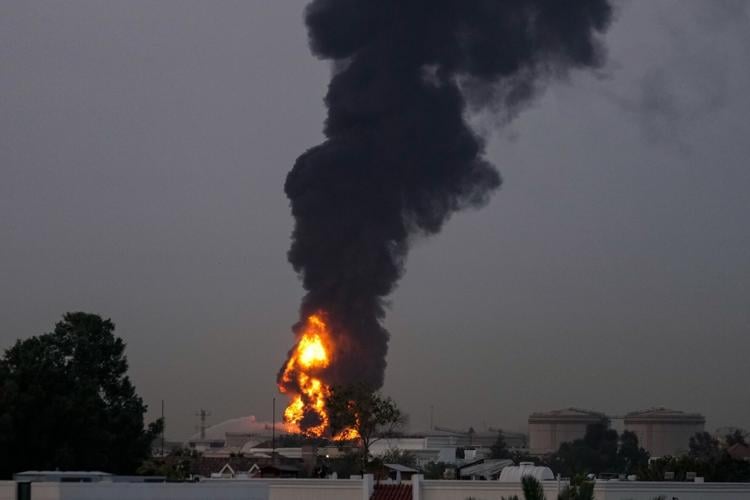
Fire and smoke rises Monday after a drone strike near Dubai International Airport, United Arab Emirates.
War rages on
Meanwhile, the war in the Middle East raged on multiple fronts on Monday as the U.S. and Israel pummeled military targets in Iran's capital, Israel stepped up its campaign against Iran-backed militants in Lebanon and Iran retaliated with a drone strike that temporarily shut Dubai's airport, a crucial hub for travelers.
Iranian strikes on commercial ships in and around the Strait of Hormuz, and even just the threat of those attacks, slowed shipping there to a trickle. That dramatically increased the price of oil and put pressure on Washington to do something to ease the pain for consumers and the global economy.
Brent crude, the international standard, remained over $100 a barrel on Monday.
Two Indian-flagged ships and a Pakistani-flagged one crossed the strait this weekend, according to authorities and a marine-tracking website.

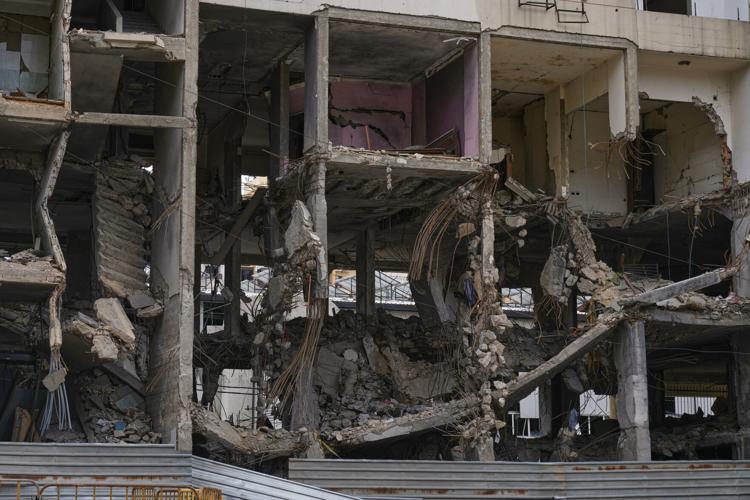
A building damaged in an Israeli airstrike is seen Monday in Dahiyeh, Beirut's southern suburbs.
Iranian Foreign Minister Abbas Araghchi said of the strait, "From our perspective it is open" — just not for the United States, Israel and its allies. On social media, Araghchi also rejected as "delusional" claims that Iran wants a negotiated end to the war. He said it seeks neither "truce nor talks."
Since the United States and Israel attacked Iran more than two weeks ago, Tehran regularly fired drones and missiles at Israel, American bases in the region, and Gulf Arab countries' energy infrastructure.