NEW YORK — Workers all over the country responded with anger and confusion Friday as they grappled with the Trump administration's aggressive effort to shrink the size of the federal workforce by ordering agencies to lay off probationary employees who have yet to qualify for civil service protections.
As layoff notices began to go out this week, federal employees from Michigan to Florida were left reeling from being told their services were no longer needed.
Many of those affected said they already accepted the administration's deferred resignation offer, under which they were supposed to be paid until Sept. 30 if they agreed to quit. Friday evening, the Office of Personnel Management said some employees may have received termination notices in error and that buyouts agreements would be honored.
"This has been slash and burn," said Nicholas Detter, who was working in Kansas as a natural resource specialist, helping farmers reduce soil and water erosion, until he was fired by email Thursday night.
People are also reading…
"None of this has been done thoughtfully or carefully," he said.

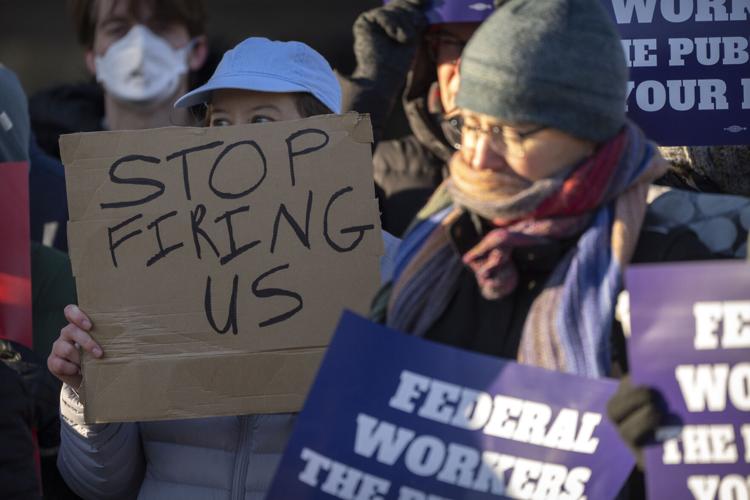
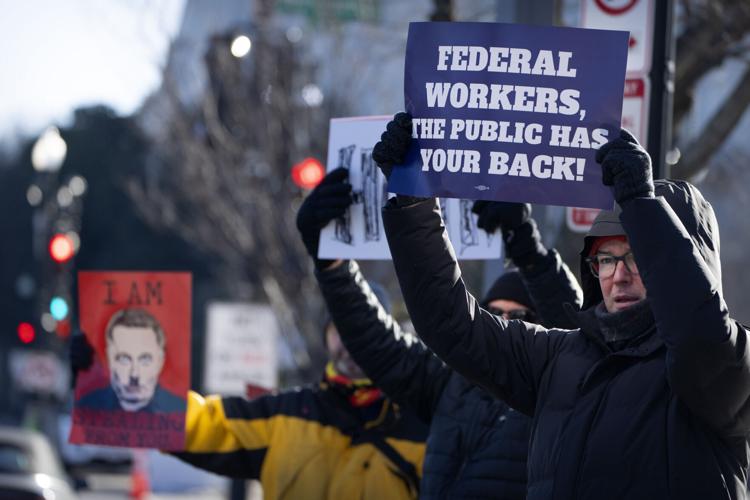
Demonstrators rally Friday in support of federal workers outside of the Department of Health and Human Services in Washington.
The White House and Office of Personnel Management declined to say Friday how many probationary workers, who generally have less than a year on the job, so far were dismissed. According to data maintained by OPM, 220,000 workers had less than a year on the job as of March 2024.
OPM gave agencies until 8 p.m. Tuesday to issue layoff notices, according to a person familiar with the plan who requested anonymity.
The new administration's sweeping efforts to reduce the size of the federal workforce are led by billionaire Elon Musk and his Department of Government Efficiency. Trump, in an executive order Tuesday, told agency leaders to plan for "large-scale reductions" after their initial attempt to downsize the workforce — the voluntary buyout — was accepted by only 75,000 workers.
At the Department of Veterans Affairs, the firings included researchers working on cancer treatment, opioid addiction, prosthetics and burn pit exposure, U.S. Sen. Patty Murray, a Democrat, said Thursday.
Dozens were fired from the Education Department, including special education specialists and student aid officials, according to a union that represents agency workers.
At the Centers for Disease Control and Prevention, nearly 1,300 probationary employees — roughly one-tenth of the agency's total workforce — are being forced out. The Atlanta-based agency's leadership was notified of the decision Friday morning, according to a federal official who was at the meeting and requested anonymity.
Department of Health and Human Services officials expected most of the agency's roughly 5,200 probationary employees to be fired Friday, according to an audio recording of a National Institutes of Health department meeting.

Elon Musk walks down the stairs Thursday from the Eisenhower Executive Office Building on the White House campus in Washington.
The new Agriculture Secretary Brooke Rollins said Friday that her agency invited Musk's DOGE team with "open arms" and layoffs "will be forthcoming."
"Clearly, it's a new day," Rollins said at the White House. "I think the American people spoke on November 5th, that they believe that government was too big."
Andrew Lennox, a 10-year Marine veteran, was part of a new supervisor training program at the Veterans Affairs Medical Center in Ann Arbor, Michigan. He said he received an email Thursday evening informing him that he would be terminated.
"In order to help veterans, you just fired a veteran," said Lennox, 35, a former USMC infantryman who was deployed to Iraq, Afghanistan and Syria.
In a post on its website, the VA announced the dismissal of more than 1,000 employees, saying the personnel moves "will save the department more than $98 million per year" and be better equipped to help vets.
David Rice, a disabled Army paratrooper who was on probation since joining the U.S. Department of Energy in September, also learned Thursday night that he lost his job.
"It's just been chaos," said Rice, 50, who just bought a house in Melbourne, Florida, after he got the job.
Rice said he agrees with the goal of making the government more efficient, but objects to the random, scattershot approach.

Demonstrators rally Friday in support of federal workers outside of the Department of Health and Human Services in Washington.
Detter, 25, who had worked for the Agriculture Department's Natural Resources Conservation Service, said he accepted the buyout. But late Thursday night, he received an email saying he was laid off effective immediately, even though he received "completely positive" job evaluations.
"You're just kind of a pawn in a much bigger struggle that Elon Musk — in particular, I feel like — is his kind of battle he's decided to take on to shrink the government," Detter said.
Detter said two of the four employees in the Kansas county where he worked were laid off even though they were already struggling with their workload helping farmers in a program created in the wake of the 1930s Dust Bowl to help keep America's farmland healthy and productive.

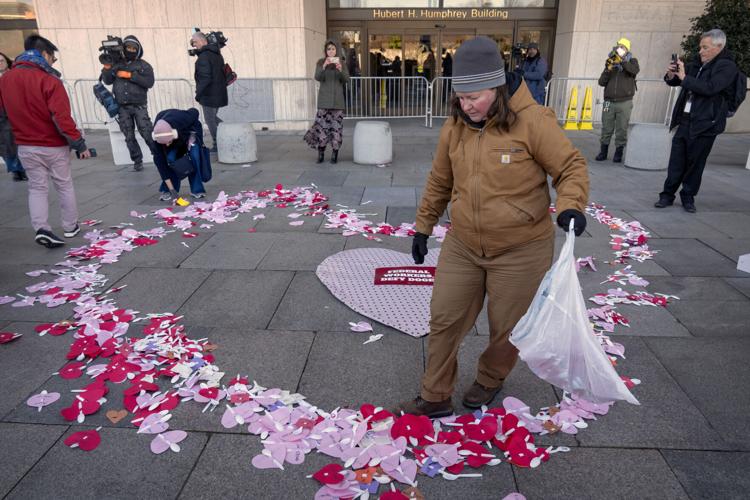
Demonstrators rallying in support of federal workers spread Valentine's Day themed messages for them Friday outside of the Department of Health and Human Services in Washington.
Unions filed a lawsuit Thursday challenging what they call unlawful terminations.
On Friday evening, the advocacy group Democracy Forward filed a complaint with the Office of Special Counsel, the federal agency dedicated to protecting whistleblowers, asking for an investigation into whether the mass firings violated federal personnel practices and asking that they be halted while the inquiry is conducted.
The layoffs are unlikely to yield significant deficit savings. The government spends about $270 billion annually compensating civilian federal workers, according to the Congressional Budget Office, with about 60% going to workers at the departments of Defense, Homeland Security and Veterans Affairs.
Even if the government cut all of those workers, it would still run a deficit of over $1 trillion.