By the end of the century, rising sea levels could push powerful seasonal waves into Easter Island’s 15 iconic moai statues, according to a new study published in the Journal of Cultural Heritage. About 50 other cultural sites in the area are also at risk from flooding.

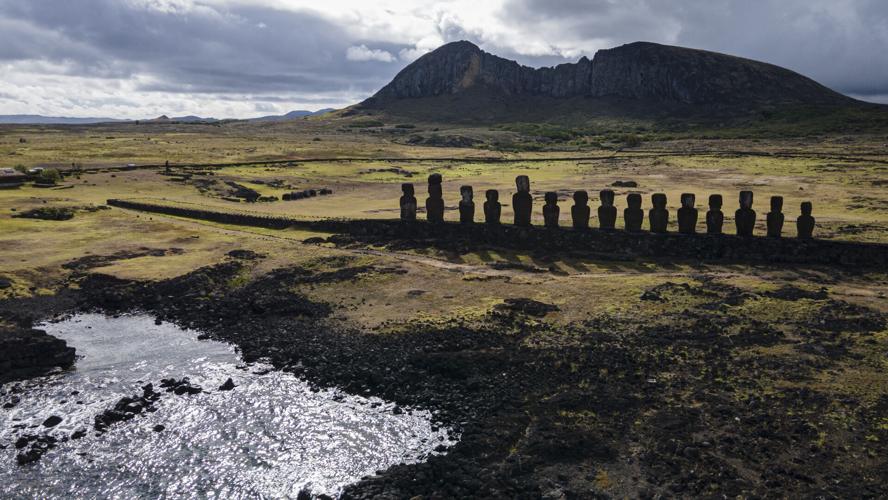
Moai statues stand on Ahu Tongariki near the Rano Raraku volcano, top, Nov. 27, 2022, on Rapa Nui, or Easter Island, Chile.
“Sea level rise is real,” said Noah Paoa, lead author of the study and a doctoral student at the University of Hawaii at Manoa’s School of Ocean and Earth Science and Technology. “It’s not a distant threat.”
Paoa, who is from Easter Island — known to its Indigenous people as Rapa Nui — and his colleagues built a high-resolution “digital twin” of the island’s eastern coastline and ran computer models to simulate future wave impacts under various sea-level rise scenarios. They then overlaid the results with maps of cultural sites to pinpoint which places could be inundated in the coming decades.
People are also reading…
The findings show waves could reach Ahu Tongariki, the largest ceremonial platform on the island, as early as 2080. The site, home to the 15 towering moai, draws tens of thousands of visitors each year and is a cornerstone of the island’s tourism economy.

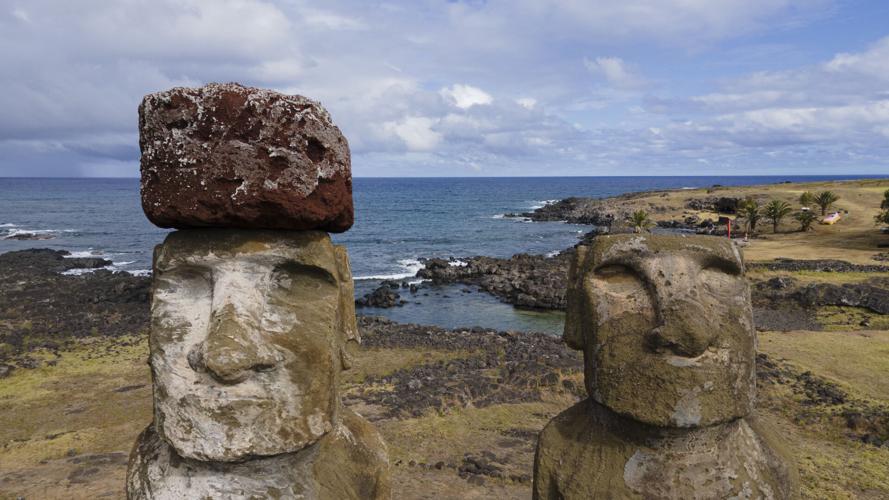
Moai statues are seen Nov. 27, 2022, on Ahu Tongariki, Rapa Nui, or Easter Island, Chile.
Beyond its economic value, the ahu is deeply woven into Rapa Nui’s cultural identity. It lies within Rapa Nui National Park, which encompasses much of the island and is recognized as a UNESCO World Heritage site.
The roughly 900 moai statues across the island were built by the Rapa Nui people between the 10th and 16th centuries to honor important ancestors and chiefs.
The threat isn't unprecedented. In 1960, the largest earthquake ever recorded — a magnitude 9.5 off the coast of Chile — sent a tsunami surging across the Pacific. It struck Rapa Nui and swept the already-toppled moai further inland, which damaged some of their features. The monument was restored in the 1990s.
While the study focuses on Rapa Nui, its conclusions echo a wider reality: cultural heritage sites worldwide are increasingly endangered by rising seas. A UNESCO report published last month found that about 50 World Heritage sites are highly exposed to coastal flooding.
In an email to The Associated Press, a UNESCO spokesperson said climate change is the biggest threat to UNESCO’s World Heritage marine sites. “In the Mediterranean and Africa, nearly three-quarters of coastal low-lying sites are now exposed to erosion and flooding due to accelerated sea level rise.”
Possible defenses for Ahu Tongariki range from armoring the coastline and building breakwaters to relocating the monuments.
Paoa hopes that the findings will bring these conversations about now, rather than after irreversible damage.
“It’s best to look ahead and be proactive instead of reactive to the potential threats,” he said.
See photos of a Swiss glacier melting in the heat of climate change

Matthias Huss, of the Federal Institute of Technology in Zurich and glacier monitoring group GLAMOS, arrives at the Rhone Glacier on June 10, 2025, near Goms, Switzerland.

Matthias Huss, of the Federal Institute of Technology in Zurich and glacier monitoring group GLAMOS, arrives June 10, 2025, at the Rhone Glacier near Goms, Switzerland.

Matthias Huss, of the Federal Institute of Technology in Zurich and glacier monitoring group GLAMOS, drills holes into the Rhone Glacier on June 10, 2025, near Goms, Switzerland.

Matthias Huss, of the Federal Institute of Technology in Zurich and glacier monitoring group GLAMOS, stands June 10, 2025, at the Rhone Glacier that is partially covered with sheets near Goms, Switzerland.

Matthias Huss, of the Federal Institute of Technology in Zurich and glacier monitoring group GLAMOS, and Monica Ursina Jaeger arrive June 10, 2025, at the Rhone glacier near Goms, Switzerland.

Matthias Huss, of the Federal Institute of Technology in Zurich and glacier monitoring group GLAMOS, and Monica Ursina Jaeger arrive June 10, 2025, at the Rhone Glacier near Goms, Switzerland.

Matthias Huss, of the Federal Institute of Technology in Zurich and glacier monitoring group GLAMOS, right, drills holes into the Rhone Glacier on June 10, 2025, near Goms, Switzerland.

Matthias Huss, of the Federal Institute of Technology in Zurich and glacier monitoring group GLAMOS, drills holes into the Rhone Glacier on June 10, 2025, near Goms, Switzerland.

Matthias Huss, of the Federal Institute of Technology in Zurich and glacier monitoring group GLAMOS, and Monica Ursina Jaeger take measurements June 10, 2025, at the Rhone Glacier near Goms, Switzerland.

Matthias Huss, of the Federal Institute of Technology in Zurich and glacier monitoring group GLAMOS, and Monica Ursina Jaeger prepare a camera June 10, 2025, at the Rhone Glacier near Goms, Switzerland.

Water drips June 10, 2025, from a melting chunk of ice that originated from the Rhone Glacier near Goms, Switzerland.

Workers prepare sheets June 10, 2025, to cover the Rhone Glacier near Goms, Switzerland.

Water flows June 10, 2025, from the melting Rhone Glacier near Goms, Switzerland.

The sun shines June 10, 2025, over the melting Rhone Glacier near Goms, Switzerland.

A lake of meltwater that formed on the tongue of the Rhone Glacier is seen June 10, 2025, near Goms, Switzerland.

The aftermath of the Birch Glacier collapse is visible June 11, 2025, in Blatten, Switzerland.

The aftermath of the Birch Glacier collapse is visible June 11, 2025, in Blatten, Switzerland.

The aftermath of the Birch Glacier collapse is visible June 11, 2025, in Blatten, Switzerland.