

CAPE CANAVERAL, Fla. — An asteroid that NASA used for target practice a few years ago was nudged into a slightly different route around the sun, findings that could help divert a future incoming killer space rock, scientists reported.
It's the first time a celestial body's orbit around the sun was deliberately changed. The asteroid that NASA's Dart spacecraft slammed into was never a threat to Earth.
"This study marks a notable step forward in our ability to prevent future asteroid impacts on Earth," the international research team wrote in Science Advances.

An impact plume emerges from the asteroid Dimorphos, left, after the Dart spacecraft collided with it Sept. 26, 2022, orbiting the larger asteroid Didymos.
The changes were slight — reductions of just one-tenth of a second and one-half of a mile to a solar lap spanning two years and hundreds of millions of miles, according to the scientists.
"Even though this seems small, a tiny deflection … can add up over decades and make the difference between a potentially hazardous asteroid hitting or missing the Earth in the future," lead author Rahil Makadia of the University of Illinois Urbana-Champaign said in an email.
People are also reading…
For any save-the-planet tests, "the key isn't delivering a huge shove at the last minute. The key is delivering a tiny shove many years in advance," he added.
Launched in 2021 on the world's first planetary defense exercise, the Dart spacecraft deliberately plowed into Dimorphos, which orbits a bigger asteroid, Didymos, as they circle the sun together. The space agency quickly determined that the 2022 strike trimmed the smaller asteroid's orbit around its bigger companion.
However, it took until now for scientists to confirm, based on observations from around the world, that the impact cut the duo's travel time around the sun by 0.15 seconds. With each solar orbit lasting 769 days, that's a real-time slowdown of just over 10 micrometers per second, shrinking the asteroids' 300-million-mile orbit by 2,360 feet.

The researchers said all the boulders and other debris flung off Dimorphos in the crash provided as much push to Dimorphos as the spacecraft itself — a doubling of momentum. Last summer, a U.S.-Italian team estimated that 35 million pounds of rock and dust were ejected.
The good news is that even with the change in the asteroids' course, Earth remains safely out of their way for the foreseeable future. That's why this rubble-packed system was picked for the mission, said Steven Chesley of NASA's Jet Propulsion Laboratory, who took part in the study.
"While it is just a single experiment, it is nonetheless an important data point that will be relevant to any future asteroid deflection missions," he said in an email.
Scientists expect to learn even more about the impact's aftermath when the European Space Agency's Hera spacecraft reaches the asteroids in November. Dimorphos is 525 feet in diameter. Fast-spinning Didymos is 2,560 feet across with, according to the latest study, 200 times more mass than its sidekick.
Unlike Dart, Hera will not strike but will tag along for months of surveying. A pair of small experimental probes will attempt to land.
Incredible NASA photos of the sun

Every child, at least once in their life, has been admonished to not stare at the sun for so long lest they go blind. But does looking at the sun really cause blindness, or is that just an old wives’ tale? Turns out, it’s a bit of both. The retina most certainly can be damaged by staring straight at the sun, but it would take several minutes of uninterrupted focus for that to happen.
In order to cause permanent injury to the eye, the retina would need to heat up by 50 degrees Fahrenheit. And at the brightest point of the day, when sun-induced eye damage is most likely, the average person can only look at the sun long enough to experience a 39-degree Fahrenheit increase in corneal temperature. After that, our natural defenses take over and our sensitive eyes begin to water and burn, which typically causes us to blink and look away before long-term harm can be done.
Fortunately, there are better and easier ways to get a good look at the sun. We can, for example, peruse NASA’s online gallery of sun photos. Over the last 100 years alone, the agency has taken thousands of photographs of the star. In the following slides, Stacker has rounded up 10 incredible photos of the sun from space taken by the agency. These images are a much clearer and safer way of getting a good look at the glowing ball of gas at the center of our solar system.
You may also like: 50 images of the universe from the Hubble Space Telescope


This photo captures the transit of Venus—or the moment in which the planet passes in front of our sun—an event that happens only four times every 243 years. The next Venus transit will happen in 2117, which means no one currently alive is likely to see it ever again.

When solar material enters the sun’s atmosphere or the corona, it is often expelled out in what is called a coronal mass ejection (or CME). These CMEs, which are most easily understood as bubbles of electrified gas, cause the auroras that we see at the north and south poles

Occasionally, the sun will form solar prominences or looped rings of plasma (hot gas) that extend from the star’s surface into its corona. These prominences take a day to form, and can last for several months, but eventually burst—like the one pictured above—when they become unstable, causing a solar flare.

Sunspots, like the ones shown in this image, are areas where the magnetic field is significantly higher than anywhere else on the sun. Because of the way these sunspots affect pressure on the star (their increased magnetic pressure decreases the atmospheric pressure of the corona) they are incredibly volatile and often create dramatic solar flares.

This photo from NASA shows how the magnetic poles created by various active regions on the sun can link up, or connect, to make swirling and looping patterns across the star’s surface.
You may also like: Most imported endangered animals to America

Essentially the same thing as solar prominences—magnetic loops of hot gas that extend out and away from the sun—filaments are viewed from the top rather than the side. If this particular filament were stretched out, it would be 533,000 miles long, which, according to NASA, is longer than 67 Earths laid side-by-side.

This picture captures a coronal hole or a spot on the sun where the star’s magnetic field is open to space. Solar wind, which contains all types of gasses, escapes through these holes, causing geomagnetic storms (aka auroras) near Earth.
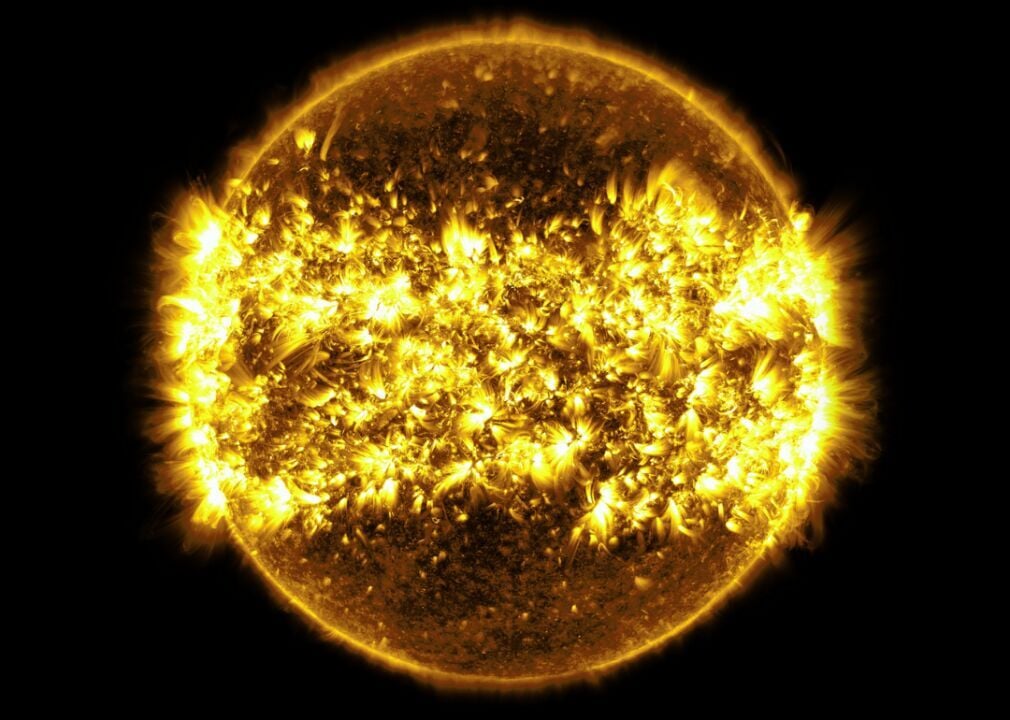
This composite image covers the space of time between Jan. 2, 2015, and Jan. 28, 2016, and shows which regions of the sun were most active during that span.

A still from a recording done by an orbiting Transition Region and Coronal Explorer (known as TRACE) telescope, this image shows a series of coronal loops extending over the sun’s surface. Coronal loops, which are large amounts of hot plasma that follow the curved lines of magnetic fields, generally arc between pairs of sunspots.

Finally, this composite photograph shows the International Space Station as it transits the sun, moving at a speed of about 5 miles per second.
You may also like: Space discoveries from the year you were born


