

WASHINGTON — The Perseids are back to dazzle the sky with bursts of light and color.

In this long exposure photo, a streak appears in the sky during the annual Perseid meteor shower at the Guadarrama mountains Aug. 12, 2016, near Madrid.
The annual meteor shower, active since July, will peak before dawn Monday. It's one of the brightest and most easily viewed showers of the year, producing “bright blue meteors — and lots of them," said University of Warwick astronomer Don Pollacco.
More than 50 meteors per hour are expected, according to the American Meteor Society. The shower lasts through Sept. 1.
Here’s what to know about the Perseids and other meteor showers.
What is a meteor shower?
Multiple meteor showers occur annually and you don’t need special equipment to see them.
Most meteor showers originate from the debris of comets. The source of the Perseids is the comet 109P/Swift-Tuttle.
People are also reading…
When rocks from space enter Earth’s atmosphere, the resistance from the air makes them very hot. This causes the air to glow around them and briefly leaves a fiery tail behind them — the end of a “shooting star.”
The glowing pockets of air around fast-moving space rocks, ranging from the size of a dust particle to a boulder, may be visible in the night sky.
The Perseids result from “bigger particles than a lot of other showers,” said NASA’s Bill Cooke, giving them the appearance of “bright fireballs” — easier to spot than many others.
How to view a meteor shower
Meteor showers are usually most visible between midnight and predawn hours.
It’s easier to see shooting stars under dark skies, away from city lights. Meteor showers also appear brightest on cloudless nights when the moon wanes smallest.
The Northern Hemisphere will have the best view of the Perseids. This year's peak coincides with a moon around 44% full.
When is the next meteor shower?
The meteor society keeps a list of upcoming large meteor showers, including the peak viewing days and moonlight conditions.
The next major meteor shower will be the Orionids, peaking in mid-October.
17 stunning photos of meteors to celebrate National Meteor Watch Day
METEOR JOSHUA TREE

Four Leonid meteors are seen streaking through the sky over Joshua Tree National Park, Calif., looking to the northwest in the Southern California desert in this approximately 15-minute time exposure ending at 3:20 a.m. PST (11:20 UT) Sunday, Nov. 18, 2001. Two are clearly visible at top left center; another is at at lower left center, another at top left. Short concentric lines in the sky are stars and planets; streaks on the ground are lights of a moving car. The Leonid shower occurs each November, when the Earth's orbit takes it through a trail of dust particles left by the Comet Tempel-Tuttle, which swings around the sun once every 33 years. (AP Photo/Reed Saxon)
METEOR

A meteor streaks through the sky over Joshua Tree National Monument in the Southern California desert, some of hundreds seen in the early morning hours of Sunday, Nov. 18, 2001. The meteor's fiery entry into Earth's atmosphere takes just about a second in this time exposure of one minute, causing slight blurring of the stars in the sky. (AP Photo/Reed Saxon)
LEONID METEOR

A Leonid meteor is seen streaking across the sky over snow-capped Mount Fuji, Japan's highest mountain, early Monday Nov. 19, 2001, in this about 7-minute long exposure photo. Star gazers braved cold temperatures at the foot of Mount Fuji to observe the shower of Leonid meteors. A cloud hangs over the mountain. (AP Photo/Itsuo Inouye)
METEORS
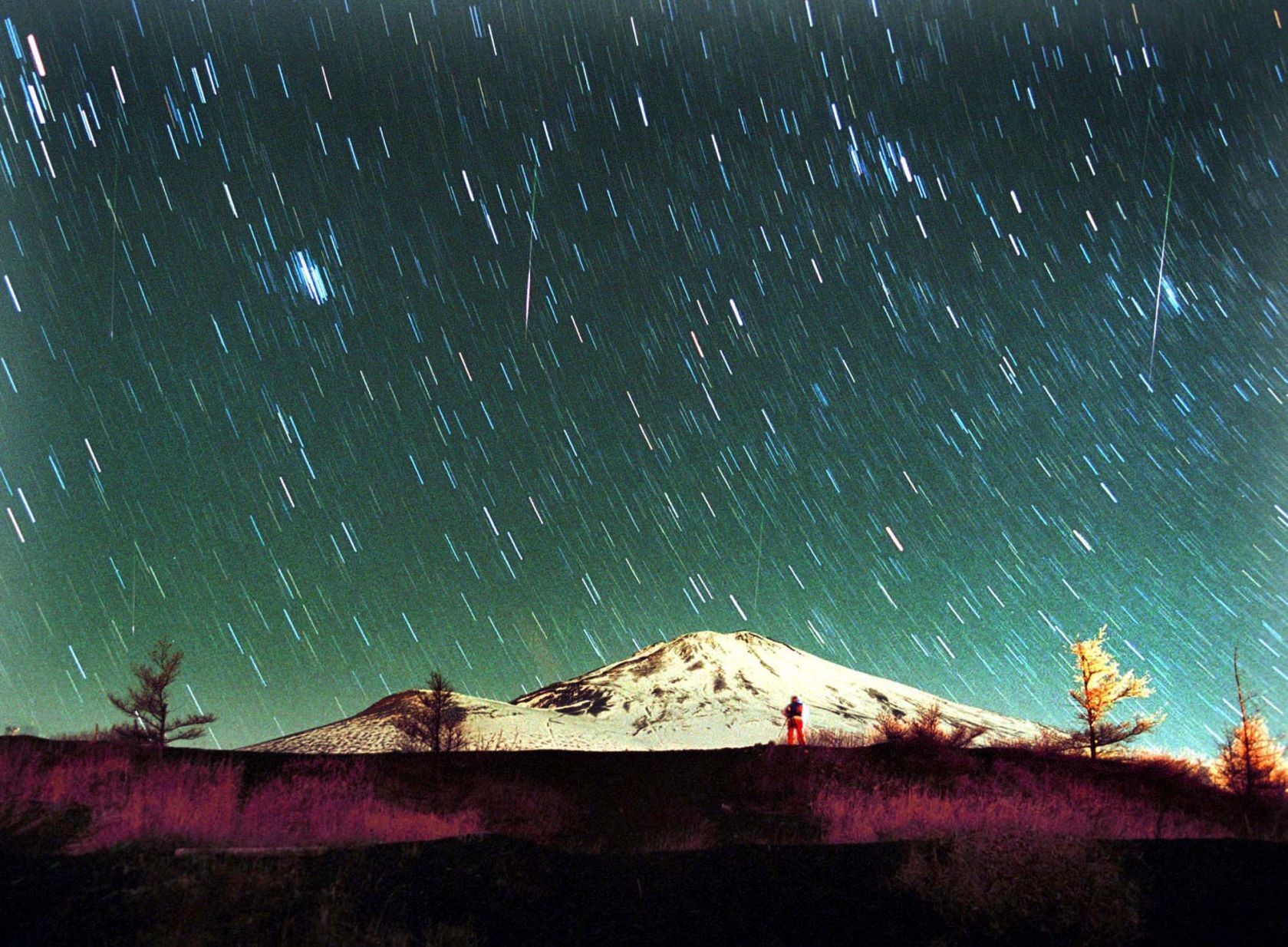
Leonid meteors are seen streaking across the sky over snow-capped Mount Fuji, Japan's highest mountain, early Monday Nov. 19, 2001, in this 7-minute exposure photo. Star gazers braved cold temperatures at the foot of Mount Fuji to observe the shower of Leonid meteors. (AP Photo/Itsuo Inouye)
Thailand Meteor Shower

The night sky over the ancient city of Ayutthaya, Thailand, is seen Wednesday, Nov. 18, 2009, as meteors from Leonid meteor shower appear. Forecasters define a meteor storm as 1,000 or more meteors per hour expected to streak across the sky during the shower's peak. (AP Photo/David Longstreath)
METEOR

A meteor streaks through the sky over Joshua trees and rocks at Joshua Tree National Park in Southern California's Mojave Desert in this 30-minute time exposure ending at 1:15 a.m. PST Tuesday, Nov. 17, 1998. Part of the most spectacular meteor shower in 33 years, the celestial fireworks were actually particles in a long tail of the comet Tempel-Tuttle striking the atmosphere. Stars moving through the sky as the Earth rotates are seen as a series of short lines across the frame. (AP Photo/Reed Saxon)
Spain Perseid Meteor Shower

Stars seen as streaks from a long camera exposure are seen behind Arnotegui Hermitage, in Obanos, northern Spain, Tuesday, Aug. 11, 2015. Some Catholics refer to the Perseids as the "tears of Saint Lawrence", since 10 August is the date of that saint's martyrdom. (AP Photo/Alvaro Barrientos)
GREECE PERSEID METEOR SHOWER

People look through telescopes to get a closer view of a spectacular meteor shower in the town of Ano Vrontou, northern Greece, Sunday 10 Aug. 2008. The phenomenon, known as the Perseid meteor shower, occurs at mid-August and is caused by falling debris from the Swift-Tuttle comet. (AP Photo/Nikolas Giakoumidis)
PERSEID METEOR SHOWER

A bright Perseid Meteor cuts across Orion's Belt at five a.m. Tuesday morning during the peak of the annual Perseid Meteor Shower Aug. 12,1997. This time exposure photo was taken from the dark desert site of Indian Cove campground in Joshua Tree National Park, fifty miles north of Palm Springs, Calif. The Perseid Meteor Shower is particularly spectacular this year as the Earth passes closer to the center of an old comet's tail. The show will continue thru the remainder of the week during the early morning hours. (AP Photo/Wally Pacholka)
Spain Perseid Meteor Shower

Stars seen as streaks from a long camera exposure are seen behind an ancient Hermitage, in Murillo del Fruto, northern Spain, Wednesday Aug. 12, 2015. Some Catholics refer to the Perseids as the "tears of Saint Lawrence", since 10 August is the date of that saint's martyrdom. (AP Photo/Alvaro Barrientos)
Spain Perseid Meteor Shower

In this long exposure photo, a streak appears in the sky during the annual Perseid meteor shower above a roadside silhouette of a Spanish fighting bull, conceived decades ago in Spain as highway billboards, in Villarejo de Salvanes, central Spain in the early hours of Monday Aug. 12, 2013. (AP Photo/Paul White)
Spain Perseid Meteor Shower

Stars seen as streaks from a long camera exposure are seen behind a Stations of The Cross, in Ujue, northern Spain, Wednesday, Aug.12, 2015. The meteor shower is expected to peak Wednesday night into Thursday morning. (AP Photo/Alvaro Barrientos)
Spain Perseid Meteor Shower

Stars, clouds and storm seen as streaks from a long camera exposure are seen behind a Stations of The Cross, in Ujue, northern Spain, Wednesday, Aug. 12, 2015. The meteor shower is expected to peak Wednesday night into Thursday morning. (AP Photo/Alvaro Barrientos)
Spain Perseid Meteor Shower

Stars seen as streaks from a long camera exposure are seen behind a silhouette of a Spanish fighting bull, conceived decades ago as highway billboards in Cordoba, Spain, Wednesday, Aug. 12, 2015. Some Catholics refer to the Perseids as the "tears of Saint Lawrence", since 10 August is the date of that saint's martyrdom. (AP Photo/Manu Fernandez)
Britain Perseid Meteor Shower

A general view of the stars above Sycamore Gap prior to the Perseid Meteor Shower above Hadrian's Wall near Bardon Mill, England, Wednesday, Aug. 12, 2015. The annual Perseid meteor shower reaches its peak on Wednesday night, but much of the UK is facing cloudy conditions. The best places to view the event is in northern England and Scotland. (AP Photo/Scott Heppell)
Spain Perseid Meteor Shower

In this photo taken with long exposure, stars and Perseid meteors streak across the sky during the annual Perseid meteor shower above a silhouette of a roadside billboard of a Spanish fighting bull in Reduena, Spain, Friday, Aug. 12, 2016. (AP Photo/Daniel Ochoa de Olza)
Bosnia Perseid Meteor Shower

Stars and meteor streaks are seen above the lake, near Tuzla, Bosnia, Saturday, Aug. 13, 2016. The annual Perseid meteor shower reaches its peak during month of August. (AP Photo/Amel Emric).


