DENVER — River basins around the world that were once regularly snowbound are increasingly seeing their snowpack shrink and climate change is to blame, a new study found.
"Many of the world's most populous basins are hovering on the precipice of rapid snow declines," concluded the study of snow amounts since 1981 in Wednesday's journal Nature.
That's because the study found a key threshold for the future of snowpacks in the Northern Hemisphere: 17.6 degrees Fahrenheit. In places where the winter temperature average is colder than that, the snowpack often survives because it's cold enough. Areas warmer than 17.6 degrees for a winter average tend to see their winter wonderland dreams melt — and it's happening fast.
"You're potentially in this regime of just really rapid and accelerating losses with warming," said lead author Alexander Gottlieb, an Earth systems scientist at Dartmouth College.
People are also reading…
Most past studies looked at snow cover, which is a simple measurement of whether the ground has snow or not. This latest research examined snowpack, a more encompassing measurement that includes depth and amount, at its general peak in March. Spring snowpack is critical for delivering a steady supply of drinking and irrigation water to billions of people, with bigger and earlier melts causing problems.

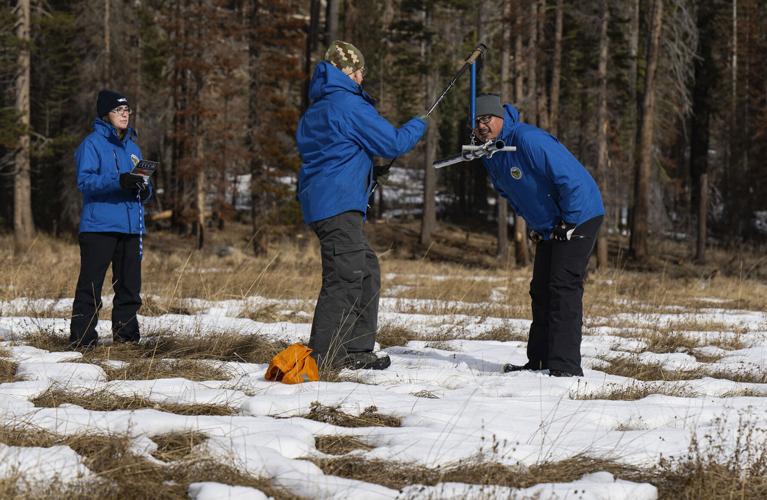
Sean de Guzman, right, snow survey manager at the California Department of Water Resources, conducts the first snow survey of the season Jan. 2 with his team at Phillips Station, Calif.
University of New Hampshire Earth systems scientist Elizabeth Burakowski, who wasn't part of the research, said the study shows "beyond a reasonable doubt that humans are responsible for the decline in snowpack in dozens of river basins across the Northern Hemisphere" and melting of the snow "will ratchet up with each degree."
"The study demonstrates that our snow future depends on the path we take to act on climate," Burakowski wrote in an email.
Gottlieb and Dartmouth climate scientist Justin Mankin examined 169 northern hemisphere river basins; they found a significant 40-year downward trend in 70 of them, an increasing trend in a dozen and no trend in the others.
In 23 of those shrinking snowpacks, Mankin and Gottlieb, using variations on standard scientific techniques, were able to show climate change clearly contributed to the melt.
Below that 17.6 degrees mark, it’s cold enough that the extra moisture in the air from climate change may result in more snow and increased snowpack. In eight river basins, all in chilly eastern Siberia, Gottlieb and Mankin found climate change helped build snowpack as precipitation increased but temperatures stayed cool enough to preserve it.

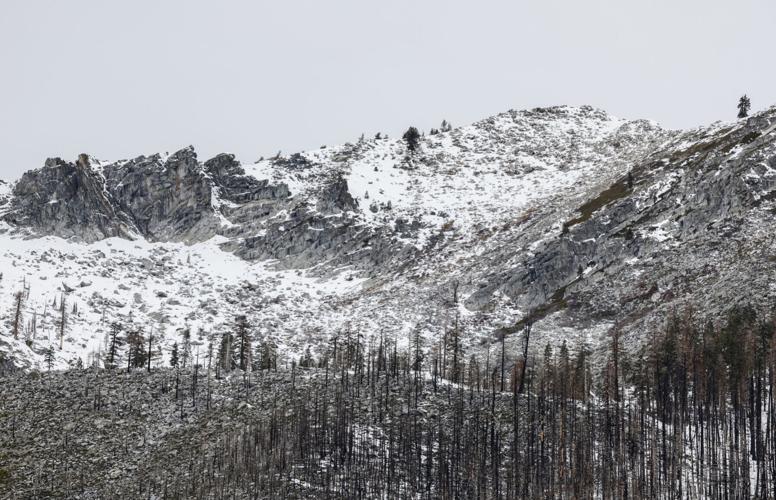
A mountain peak is dusted with snow near the meadow where the first snow survey of the year took place Jan. 2 in Phillips Station, Calif.
Europe and North America are getting some of the biggest spring snowpack losses, they found, including the Great Salt Lake, Merrimack, Connecticut, Susquehanna, Hudson, Delaware, Neva, Vistula, Dnieper, Don and Danube river basins.
A good example of shrinking snowpack is the upper reaches of the Colorado River basin in Colorado and parts of Wyoming, Gottlieb said. There, the winter temperature averages around 23 degrees, seemingly cold enough for snow because it's below freezing, but not really, he said.
"This is a place where we've started to see these kinds of accelerating losses start to emerge," Gottlieb said. "We see this really clear picture of anthropogenic forest snow loss over the last 40 years or so."

Gottlieb and Mankin documented fingerprints of human-caused warming by using the standard climate attribution method of comparing what happened in the past 40 years of a real warming world to thousands of computer model runs showing what would happen to these river basins on a fictional planet with no climate change.
Places chillier than 17.6 degrees account for 81% of the Northern Hemisphere snowpack, but they don't hold many people, only 570 million, Mankin said. More than 2 billion people live in areas where winter averages between 17.6 and 32 degrees, he said.
What's key, especially for water supply, is that "as warming accelerates, the snowpack change is going to accelerate much faster than it has," said Daniel Scott, a scientist at the University of Waterloo who wasn't involved in the study.

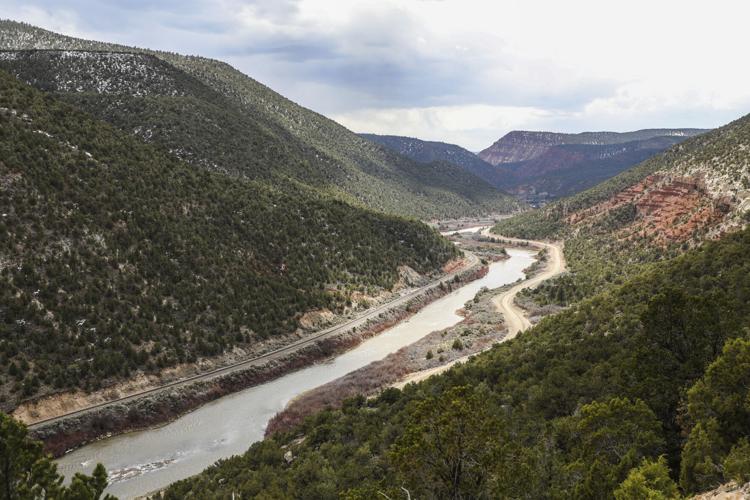
The Colorado River runs between lightly snow-covered mountains April 12 near Burns, Colo.
The ski industry — with sometimes stark visuals of manufactured snow for winter revelers to enjoy on an otherwise brown landscape — has long been an easy to understand example of an economy that will suffer from the lack of snow.
Many ski areas wait anxiously every year for Mother Nature to bring enough powder to start running their lifts. Others permanently closed after their seasons got too short.
Larger corporate-run mountains, such as Colorado's Aspen Snowmass, are able to operate consistently despite less snow and shorter winters.
"Opening and closing days remain constant due to snowmaking, which shows how important that is," said Auden Schendler, senior vice-president of sustainability at Aspen One, the parent company of Aspen Skiing Company.
They also invested in building new ski runs at higher elevations where snow is more reliable than at the base, insulating them from substantial economic loss — for now.
"That in no way reduces the urgency of the need to act with force and at scale," Schendler said. Aspen Snowmass is among a growing handful of ski areas that are embracing climate activism as the new industry standard, recognizing an urgent need to lobby for climate-friendly policies if they want to exist into the future.
From wildfires to floods, photos reveal intensity of climate change in 2023

Jestina Nyamukunguvengu walks near a pearl millet crop in Zimbabwe's arid Rushinga district, northeast of the capital Harare, Jan. 19, 2023. (AP Photo/Tsvangirayi Mukwazhi)

A tribal woman tries to catch small fish as her granddaughter dozes off on her back in a paddy field on the outskirts of Guwahati, northeastern Assam state, India, March 20, 2023. (AP Photo/Anupam Nath)

A train passes a railroad crossing between flooded fields in Nidderau-Eichen near Frankfurt, Germany, Jan. 16, 2023. (AP Photo/Michael Probst)

Birds fly over debris in the aftermath of Hurricane Otis in Acapulco, Mexico, Oct. 28, 2023. (AP Photo/Felix Marquez)

Fisherwomen and men pull in a net of fish off the coast of Chuao, Venezuela, June 7, 2023. (AP Photo/Matias Delacroix)

Yaad Ali, left, offers prayers as his wife Monuwara Begum cooks food in their flooded house in Sandahkhaiti, a floating island village in the Brahmaputra River in Morigaon district, Assam, India, Aug. 29, 2023. (AP Photo/Anupam Nath)

A woman sits next to baskets filled with fish as she works at a market on the shore of the Senegal River in Saint Louis, Senegal, Jan. 20, 2023. (AP Photo/Leo Correa)

People wait in the rain to receive free food distributed from volunteers outside a camp for people displaced from coastal areas in Sujawal, Pakistan's southern district in the Sindh province, June 15, 2023, as Cyclone Biparjoy was approaching. (AP Photo/Pervez Masih)

Jay Begay holds the caul fat from a sheep, Sept. 6, 2023, in the community of Rocky Ridge, Ariz., on the Navajo Nation. (AP Photo/John Locher)

Workers harvest cranberries at Golden Eagle Farms, in Pitt Meadows, British Columbia, Oct. 12, 2023. (Darryl Dyck/The Canadian Press via AP)

Men fish amid dead fish floating near the shore of the Salado River during a drought in Buenos Aires province, Argentina, Jan. 22, 2023. (AP Photo/Natacha Pisarenko)

Jorge Martinez works the fires at his taco stand at sunset on a hot day, July 19, 2023, in Mexicali, Mexico. (AP Photo/Gregory Bull)

A Kashmiri farmer walks back from saffron fields after a day of work in Pampore, south of Srinagar, Indian controlled Kashmir, Nov. 5, 2023. (AP Photo/Mukhtar Khan)

A worker hops over an irrigation canal as he applies fertilizer to a sugar cane field in Albion, Guyana, April 15, 2023. (AP Photo/Matias Delacroix)

Oumar Abdoulaye Sow sits at a water trough after giving water to his cows in the village of Fete Forrou, in the Matam region of Senegal, April 11, 2023. (AP Photo/Leo Correa)

Darren Platt, left, captain of the Agnes Sabine, and first-year deckhand Juan Zuniga, right, step over nets as they dock the boat for refueling, June 23, 2023, in Kodiak, Alaska. (AP Photo/Joshua A. Bickel)

Goats and sheep run toward a water point before undertaking a 24-kilometer (15-mile) journey to a new location in the Munkh-Khaan region of the Sukhbaatar district, in southeast Mongolia, May 14, 2023. (AP Photo/Manish Swarup)

Yaad Ali, left, and his son Musikur Alam, row a boat to collect drinking water in the floodwaters in Sandahkhaiti, a floating island village in the Brahmaputra River in Morigaon district, Assam, India, Aug. 30, 2023. (AP Photo/Anupam Nath)

People take items from a store in the aftermath of Hurricane Otis, in Acapulco, Mexico, Oct. 28, 2023. (AP Photo/Felix Marquez)

Jay Begay, left, and his mother Helen butcher a sheep at their home Wednesday, Sept. 6, 2023, in the community of Rocky Ridge, Ariz., on the Navajo Nation. (AP Photo/John Locher)

Children are seen through a car window during rain outside a camp set up in a school building for people displaced from coastal areas due to Cyclone Biparjoy approaching, in Badin, in Pakistan's southern district in the Sindh province, June 15, 2023. (AP Photo/Fareed Khan)

An Indigenous Wari' boy swims in the Komi Memem River, named Laje in non-Indigenous maps, at Wari' community in Guajara-Mirim, Rondonia state, Brazil, Thursday, July 13, 2023. (AP Photo/Andre Penner)

Joyce Ngui, left, fetches water in Athi River, Machakos county, Kenya, Oct. 17, 2023. (AP Photo/Brian Inganga)

A boy walks on plastic waste at the Badhwar Park beach on the Arabian Sea coast in Mumbai, India, June 5, 2023. (AP Photo/Rajanish Kakade)

A 40-year-old woman poses for a photo after an interview in Saint Louis, Senegal, Saturday, Jan. 21, 2023. The woman said she had to resort to prostitution last year after her fisherman husband left the city and cut contact. (AP Photo/Leo Correa)

People attend a burial ceremony for some of the people who died following heavy rains caused by Cyclone Freddy in Blantyre, southern Malawi, March 15, 2023. (AP Photo/Thoko Chikondi)

Rekha Devi, a farm worker, washes her face next to her temporary shelter on an under-construction overpass after her family evacuated the flooded banks of the Yamuna River in New Delhi, India, Aug. 9, 2023. (AP Photo/Altaf Qadri)

Neelam Tamar, suffering from heatstroke, recovers at the Lalitpur district hospital, in the Indian state of Uttar Pradesh, June 17, 2023. (AP Photo/Rajesh Kumar Singh)

Dilrukshan Kumara looks at the ocean as he stands by the remains of his family's home destroyed by erosion in Iranawila, Sri Lanka, June 15, 2023. (AP Photo/Eranga Jayawardena)

A woman carries a water jug as she walks back to her home after collecting drinking water from a mobile water tanker on World Water Day in a residential area in New Delhi, India, March 22, 2023. (AP Photo/Altaf Qadri)

Local residents watch a wildfire in Avantas village, near Alexandroupolis, Greece, Aug. 21, 2023. (AP Photo/Achilleas Chiras)

A woman carries her pet dogs as residents are evacuated on rubber boats through floodwaters in Zhuozhou in northern China's Hebei province, south of Beijing, Aug. 2, 2023. (AP Photo/Andy Wong)

A residential swimming pool hangs on a cliffside after a landslide in San Clemente, Calif., March 16, 2023. (AP Photo/Jae C. Hong)

A man talks on his phone as he looks through smoke from wildfires in Canada at the George Washington Bridge in Fort Lee, N.J., June 7, 2023. (AP Photo/Seth Wenig)

Children cool themselves with electric fans as they take a rest near the Forbidden City on a hot day in Beijing, June 25, 2023. (AP Photo/Andy Wong)

A woman, whose family members are trapped under rubble, wails after a landslide washed away houses in Raigad district, western Maharashtra state, India, July 20, 2023. (AP Photo/Rafiq Maqbool)

Wildfire destruction is visible Aug. 10, 2023, in Lahaina, Hawaii. (AP Photo/Rick Bowmer)

A person runs to avoid the flames of a wildfire in Gennadi village, on the Aegean Sea island of Rhodes, southeastern Greece, July 25, 2023. (AP Photo/Petros Giannakouris)

A girl touches her father's head as they are engulfed by mist from a public fountain on a hot day in Bucharest, Romania, July 13, 2023. (AP Photo/Andreea Alexandru)

Rescuers recover the body of a person killed during flooding in Derna, Libya, Sept. 15, 2023. (AP Photo/Ricardo Garcia Vilanova)

A skier moves along a lit pathway during the polar night in Longyearbyen, Norway, Jan. 6, 2023. (AP Photo/Daniel Cole)

The McDougall Creek wildfire burns on the mountainside above houses in West Kelowna, British Columbia, Aug. 18, 2023. (Darryl Dyck/The Canadian Press via AP)

Pamela and Patrick Cerruti empty coins from Pajaro Coin Laundry as floodwaters surround machines in the community of Pajaro in Monterey County, Calif., March 14, 2023. (AP Photo/Noah Berger)

A boat travels through a section of the Amazon River affected by drought in Amazonas state, near Manacapuru, Brazil, Sept. 27, 2023. (AP Photo/Edmar Barros)

A cameraman walks up to the Rhone Glacier near Goms, Switzerland, Friday, June 16, 2023. (AP Photo/Matthias Schrader)