


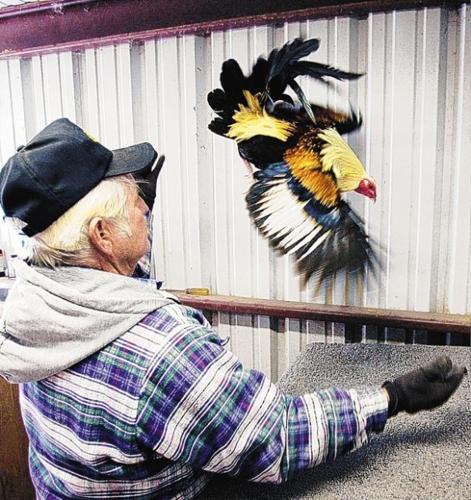
BLANKET, Texas — Too frail to walk much any more, the old man cruises around his small farm on a scooter, weaving his way through the chickens that cluck and crow in a shrill storm of barnyard noise.
He stops near one rooster, no ordinary chicken. Large and magnificent with white, red and brown plumage, it is bred to fight — and kill — in a bloodsport dating back centuries and illegal in most states.
"The Chicken Man," as some locals call him, is 83-year-old Mike Ratliff, who since 1968 has taught an estimated 8,000 cockfighters around the world how to breed and train game birds at his "School for Beginning Cockers." Worn down by age and illness, he's closing shop, causing animal-rights groups to cheer and Ratliff to lament the end of an era.
"I've been hooked on cockfighting since I was a little boy," Ratliff said, recalling how he watched at age 5 as new hatchlings pecked each other bloody. "There is no one to take my place."
People are also reading…
Ratliff and the Humane Society of the United States agree on one thing — that Ratliff's school was unique in the United States. His last class met in November when two sons of a former student from Guatemala came to this tiny hamlet of 402 people in West Texas.
Cockfighting is still practiced around the world. Roosters are usually fitted with razors and gaffes designed to slash and puncture in a bloody death struggle.
"So many people see this as a sport," said Heidi Brasher of the Houston Society for the Prevention of Cruelty to Animals. "We see it as animal cruelty. And the law sees it as animal cruelty."
Only 2 states allow it
Since voters in Oklahoma approved a ban on cockfighting in 2002, New Mexico and Louisiana are the only states that allow cockfights. But Texas permits people to raise fighters and teach breeding and training methods.
Experts say the sport flourishes despite its mostly outlaw status. Enthusiasts print magazines — The Feathered Warrior and The Gamecock are two examples — and trade tips on the Internet. Police bust up rings that flout the law.
While recently serving a warrant in a drug case in Luling, Texas, officers broke up a large cockfighting operation and seized about 400 chickens. The property included breeding and bird hospital areas, two fight rings and an announcer's platform that doubled as a concession stand with a cooler full of beer. "You don't make 'em fight," Ratliff said. "All you do is show 'em to each other and they get the fight on."
Ratliff became a champion bird fighter as an adult. Dozens of trophies gathering dust in his wood-paneled living room suggest he had few peers.
His students "the best"
He said his two-week classes taught breeding, training and a spirit of competition in a sport where cheaters sometimes try to poison competitors' birds. Students learned how to boost their birds' stamina and sharpen running and jumping instincts.
He charged $150 when he started, but declined to say what his final rates were. By the 1980s he was selling instructional videotapes.
Ratliff said he's traveled to countries where cockfighting is legal, including Mexico, teaching and winning cockfights.
"I've got students who are the best chicken men in the world," he said. "They dominate."
Some of his best students were women — he found them to have a tender, easy touch.
Dan Tucker of Fort Worth went to Ratliff's school in the early 1970s when Ratliff lived in Florida. He fights birds in Louisiana and New Mexico and still calls his old mentor for advice.
"I'll come to him with 150 questions," Tucker said, "and he'll go right down every one of them."
The Humane Society tried to shut Ratliff down from the start, but the law was on his side and local authorities weren't interested in pressuring him to stop. Ratliff discovered that his district attorney liked cockfighting. Ratliff moved his school from Texas to Florida and Alabama before settling back in Texas, far off the beaten path.
In Blanket, Main Street passes the post office, a few houses, a general store and little else. Ask for directions to Ratliff's farm and locals size up a stranger with a wink and a nod — "You must be in the chicken business" — before leading the way.
At the farm, about 100 birds and their blue plastic shelters are visible in the yard.
With a cold wind whipping at his face, Ratliff rides his scooter past the breeding pens and through the rows of birds kept apart by tethers on their legs. Let them run loose and it would be bloody mayhem once the fighting instinct takes over.
"God put them here for one purpose," he said, "and that's to fight."
Inside the cockhouse, the cool darkness is swamped by the clucking and crowing of about 20 roosters in small cages. Ratliff pulls one from the coop for its first training session — running and jumping on an old mattress. Later, he lets it spar with another chicken, protecting it with rubber "boots" on the birds' spurs.
The birds lunge at each other in a quick fury of wings and feathers before the men grab them with no harm done.
"It's part of the American spirit," Tucker said. "Fighting for your territory."
Denies criminal activity
Animal-rights activists consider Ratliff an outlaw promoting an illegal bloodsport. And they complain the sport and its underground channels promote illegal gambling and drugs.
Ratliff chafes at any suggestion of criminal activity. "I'm just a local country boy raising fighting chickens," he said. "You've got to be sensible and go where it's legal. I've always been for legal."
The law has squeezed those areas and boosted penalties.
"It is a relief that this so-called school has closed, but we are still dealing with the 'graduates' of this program who are engaging in their criminal conduct throughout the country," said Wayne Pacelle, president and CEO of The Humane Society of the United States.
Ratliff dismisses the Humane Society as "just a bunch of idiots" who don't understand cockfighting culture.
"The world is totally ignorant of the life of chicken people," Ratliff said. "The only way the Humane Society will stop cockfighting is to kill all the chickens and kill all the people with chickens. It's a way of life."
The ban has largely pushed the activity underground, making it difficult to detect. But cockfighting still takes place, Myers said, and the birds are raised in and transported through Southern Arizona.
Pima County sheriff's deputies raided a house on the Southwest Side Dec. 29 and seized more than 300 fighting roosters, 30 hens and cockfighting paraphernalia.
The bust came after deputies were called to a cockfight at another location earlier in the week, said Sgt. James Ogden, a Sheriff's Department spokes-man. They detained and questioned individuals at the cockfight and a man admitted to having fighting roosters at his home in the 2000 block of West Via Vista Bonita, near South Mission and West Los Reales roads.
Deputies raided his home after obtaining a search warrant, Ogden said.
Roosters are territorial, but organized cockfights differ from ones that occur naturally, Myers said.
"Those fights are to defend their roost, not to cause death or serious trauma to another bird," he said.
During cockfights, sickle-shaped razors are sometimes attached to the birds so they can tear into one another's flesh, he said.
"That's where the inhumane part comes in: The purpose is to have one bird brutally kill the other," Myers said.
● Dale Quinn, Arizona Daily Star


