

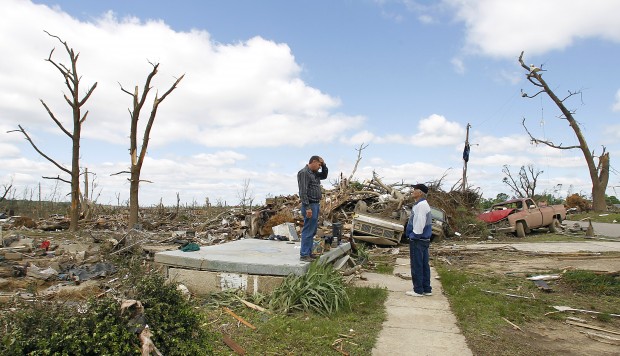
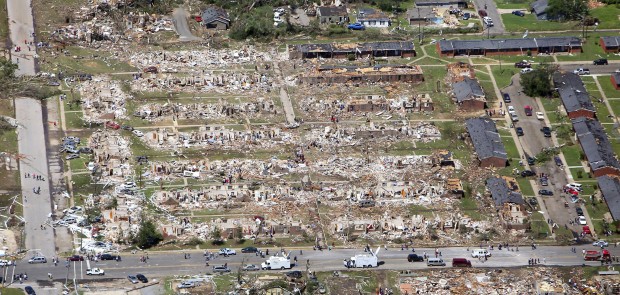
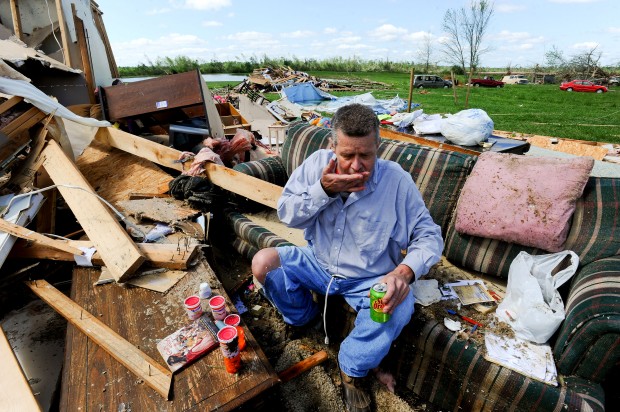
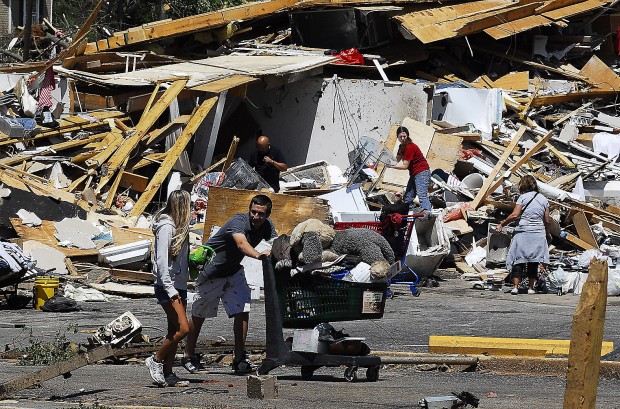
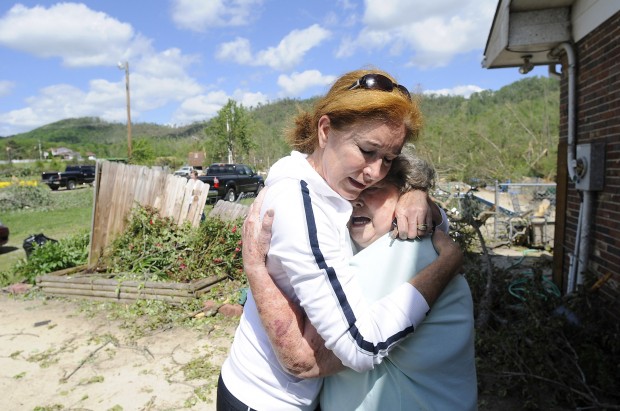
WASHINGTON - Some of the killer tornadoes that ripped across the South may have been among the largest and most powerful ever recorded, experts suggested, leaving a death toll that is approaching that of a tragic "super outbreak" of storms almost 40 years ago.
"There's a pretty good chance some of these were a mile wide, on the ground for tens of miles and had wind speeds over 200 mph," said Harold Brooks of the National Severe Storms Laboratory in Norman, Okla.
Wednesday was the deadliest day for tornadoes since a series of twisters killed more than 300 people in 11 states and Canada in 1974, Brooks added.
The death toll from Wednesday stood at 296 and is expected to rise. The worst day in recorded history for storm fatalities is March 18, 1925, with 747 deaths.
Alabama officials confirmed 210 deaths, while there were 33 in Mississippi, 33 in Tennessee, 14 in Georgia, five in Virginia and one in Kentucky.
People are also reading…
President Obama said he would visit Alabama today to view damage and meet with the governor and families devastated by the storms.
Obama has already expressed condolences by phone to Gov. Robert Bentley and approved his request for emergency federal assistance.
The National Weather Service's Storm Prediction Center in Oklahoma said it received 137 tornado reports into Wednesday night. The storms forced authorities in some places into makeshift command posts after their headquarters lost power or were damaged, and an Alabama nuclear plant was using backup generators to cool units that were shut down. Related story, A17.
It may have been a single long-ranging twister that battered Tuscaloosa, Ala., and then covered the 60 miles to Birmingham, Brooks said.
Only 1 percent of twisters reach the most powerful readings, but Brooks thinks several of those that left death and destruction in Alabama and five other states Wednesday fall into that category.
That speculation hasn't been confirmed yet, but if it is it's no wonder so many homes were flattened and scores were killed.
Most tornadoes are weak, so most reasonably built structures survive them. The typical tornado is on the ground for a couple of miles and is a couple of hundred yards wide with half the wind speed of the storms that barreled through the region Wednesday.
"A big question is - the tornado in Tuscaloosa and Birmingham, is it the same one? I think they are the same," he said.
Chris Weiss, a tornado expert at Texas Tech University, said the storm that spun off that tornado formed in Mississippi and "lasted over 300 miles, and even for a supercell that's pretty long."
Tornado outbreaks happen just about every year somewhere in the country. But this time conditions were just about perfect for the series of powerful storms, explained Jerry Brotzge, a senior research scientist at the Center for Analysis and Prediction of Storms at the University of Oklahoma.
He noted that a deadly tornado in Oklahoma in 1999 also was almost a mile wide.
Brooks noted there was a trough in the middle levels of the atmosphere over the western U.S., with a strong jet stream coming across the southern U.S. A trough to the west means winds blowing to the south, turning and then moving back north at the same time a powerful jet of wind blows from the west above.
And that, explained Brotzge, results in an area "to the east of the trough where you have warm, moist southeast winds at the surface and strong, dry winds from the west above. … That creates the perfect scenario for strong thunderstorms" and tornadoes.
Why was there such an active weather pattern?
"Causes are always difficult to assign," Brooks said. "A little bit has probably been the weakening La Niña in the Pacific, but not all weakening La Niñas are associated with lots of tornadoes, and we get lots of tornadoes in other situations as well."
La Niña is an unusual cooling of the water in the tropical Pacific Ocean that can change weather patterns around the world. The federal Climate Prediction Center said last month that La Niña conditions were weakening but could continue to affect weather for months.
Deaths from twisters have been declining in recent years because of improved forecasts and increased awareness of them by people living in tornado-prone areas, especially in smaller and rural communities.
While most Americans live in cities, urban areas actually cover only a relatively small percentage of the country. The result is that tornadoes occur more often in rural, sparsely populated areas.
That's led some people to believe twisters don't strike cities. But the National Climatic Data Center in Asheville, N.C., calls that a myth.
"Tornadoes have hit several large cities including Dallas, Oklahoma City, Wichita Falls, St. Louis, Miami and Salt Lake City. In fact an urban tornado will have a lot more debris to toss around than a rural twister."
While May is historically the busiest month for tornadoes, they surge sharply in April as warm weather begins setting in and dry western air collides with warm, moist conditions moving north from the Gulf of Mexico.
Indeed, the biggest tornado outbreak on record occurred April 3-4, 1974, when 147 confirmed twisters claimed more than 300 lives in the United States and Canada.
However, April 1957 was more like this year, recording several days with large numbers of deadly twisters, said Brooks. By contrast, April 1974 was a relatively average month, he said, with one "ridiculous" day.
You can help
Two local organizations are assisting the recovery efforts in Alabama and other Southern states after Wednesday's deadly tornadoes.
World Care is working with the Mississippi Delta Council to move supplies to the damaged areas in Alabama.
The organization is collecting clothing, cleaning supplies, non-power tools such as hammers, screwdrivers and flashlights, first-aid supplies, and canned and dry foods.
People also can drop off pet food, sleeping cots, sandbags and hygiene supplies.
Monetary donations can be mailed to the World Care facility, 3538 E. Ellington Place, 85713-4214 or online at www.worldcare.org
For more information about giving donations, call World Care at 514-1588.
The organization will be open from 9 a.m. to 3 p.m. Mondays through Fridays beginning Monday.
The Red Cross of Southern Arizona is collecting monetary donations for the relief effort.
Those interested in donating can go to www.redcrossarizona.org and click the "donate" tab.
A $10 donation can be submitted by texting "Redcross" to 90999.
Deadliest twisters
The tornadoes that ripped through the South on Wednesday are among the worst tornado events in U.S. history. Some of the deadliest U.S. tornado events on record, by number of deaths:
March 18, 1925 Missouri, Illinois, Indiana 747
April 3-4, 1974, 11 states and Canada 300-plus
May 6, 1840 Louisiana, Mississippi 317
April 27, 2011 Alabama, Georgia, Kentucky, Mississippi, Tennessee, Virginia 296
May 27, 1896 Missouri, Illinois 255
April 5, 1936 Mississippi 216
April 6, 1936 Georgia 203
April 9, 1947 Texas, Oklahoma, Kansas 181
April 24, 1908 Louisiana, Mississippi 143
June 12, 1899 Wisconsin 117
June 8, 1953 Michigan 115


