

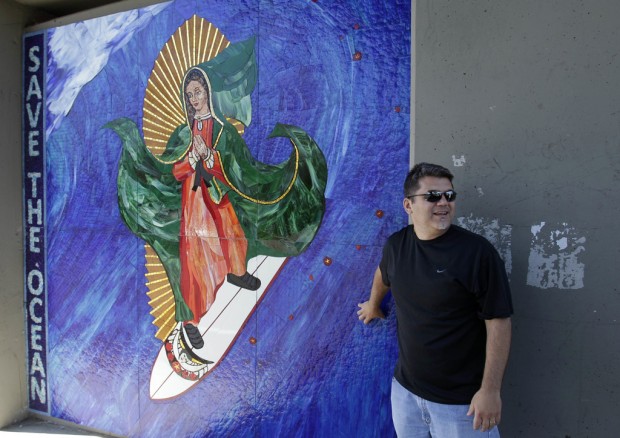
ENCINITAS, Calif. - The "Surfing Madonna" appeared just before Easter weekend and has been stirring a soulful debate in this Southern California beach town ever since.
The striking mosaic of the Virgin of Guadalupe riding a wave was affixed to a wall under a train bridge by artists disguised as construction workers in April. It technically is graffiti that should be removed under the law.
But the surfing Madonna's beauty is drawing a mass following, and even city officials who say she must go acknowledge they too have been taken by her. They have spent thousands to hire an art conservation agency to find the best way to remove her without causing damage.
The 10-by-10-foot rock and glass mosaic poses an interesting dilemma over whether a city should spend lots of money to get rid of artwork that is illegal but well-done and actually beautifies a place.
People are also reading…
Deciding what is graffiti is a growing debate worldwide with guerrilla artists gaining respect in established art circles. A number of museums have brought the street art indoors for prestigious exhibits in recent years, while pieces of illegal art snatched up by dealers have been fetching hefty sums.
A Los Angeles show billed as the first major museum exhibit of street art at the Museum of Contemporary Art in Little Tokyo sparked a similar debate last month when unauthorized etchings started showing up on buildings in the neighborhood. The exhibit included Chaz Bojorquez's stark, black-and-white "Señor Suerte" drawings, once a fixture on the concrete-lined waterways of Los Angeles, and the colorful "Howard the Duck" murals that Lee Quinones covered New York City with in the 1970s.
Support for the wave-riding Virgin has only flourished amid the controversy. She is now on Twitter and Facebook, pleading for help: "I'm the Surfing Madonna. Cherished public mosaic. Hangin' in Encinitas. Hoping to become famous enough to be saved."
Jack Quick, a local art dealer, saw the men in hard hats put up the mosaic in daylight just days before Easter. He estimates it cost $1,000 in materials and more than 100 hours to build it. The city does not know which artist or artists did the work. No one has stepped forward.
Inside a piercing blue wave, Our Lady of Guadalupe balances on a white surfboard decorated with the angelic face of Juan Diego, the indigenous boy who is said to have seen the Virgin on a Mexican hillside in 1531. Her vibrant green robe curls up around her as if blowing in the sea breeze as she surfs with her iconic serene face. Down one side are the words: "Save the Ocean."
Thousands of people have come to see the artwork. Some have brought flowers and lighted votive candles on the sidewalk under her.


