

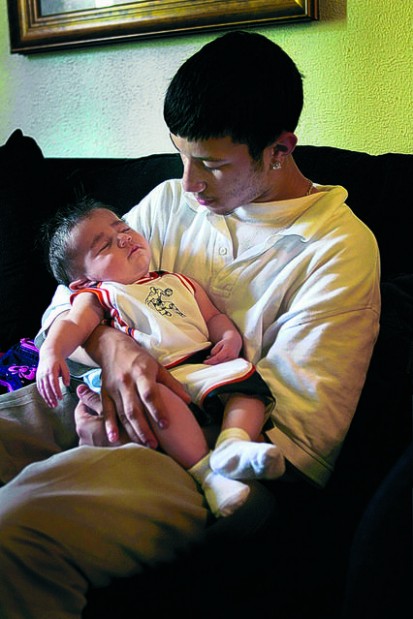
PONTIAC, Mich. — Shantaya McDaniel and Victor Reyes, teenagers who are refreshingly sensible for their age, now know what contributes to the high death rate of infants in their city and steps they can take to help keep babies alive.
Credit a six-week class called Crib Notes offered at their Lincoln Middle School for helping them apply lessons on healthy and proper eating, sleeping and living.
It was more than an academic exercise. McDaniel, 14, is helping her cousin and stepsister with their babies. Reyes, 15, is using his newfound knowledge to help raise his 3-month-old son, Giovonni.
"I was nervous at first, very nervous," said Reyes, an eighth-grader. "I thought it was going to be a little bit complicated until they showed us a video and brought a demonstration baby in. … Now that I'm good at it, it's not even a problem."
People are also reading…
High rate of infant mortality
Crib Notes, which was created and taught by public health nurses, was designed to reduce infant mortality in Pontiac, which has the highest rate in Oakland County. If the program delivers on that promise, it could serve as the catalyst for a larger effort in a state with high infant-mortality rates, although not the highest in the nation. That distinction goes to Washington, D.C., and Mississippi.
State and federal experts on infant mortality, including those at the Centers for Disease Control and Prevention, are unaware of similarly structured programs in other states. And Crib Notes' creators say the hands-on program is uncommon in the way it reaches and teaches children in middle school.
Developers of the joint project between the county's health division and Pontiac schools say it made sense to tailor the curriculum for that age group based on their interaction with babies and the opportunity to instill healthy behaviors in themselves.
"When you look at middle school-age children … these are kids that are crossing the bridge from childhood into adolescence," said Lois Winer, a nursing supervisor for the county who oversees the program. "We thought this was a perfect population to begin to educate on … prevention."
The program, taught to sixth- and eighth-graders in three schools, is not a sex-education class or one that teaches about reproductive health or pregnancy. Instead, it focuses on areas that research has linked to prematurity or infant mortality, such as smoking, obesity and sleeping in unsafe positions and places.
The message appears to be getting through. Reyes told his girlfriend and their respective parents, who help raise Giovonni, about removing bumper pads from the crib because he could be smothered. He and McDaniel also have counseled family members about sleeping with babies.
"We learned not to sleep on the couch," McDaniel said. "That's what my mom did. She's still doing that. I had to tell her, 'No, that's not good.' "
Students are selected
Teachers, counselors and administrators select the students for Crib Notes. They could be those likely to share the information with peers, help care for younger family members, baby-sit for others, or have a child of their own.
Winer said the program, which started as a pilot project in spring 2005, doesn't yet have data to show its progress. But health officials are developing a plan to follow up with participants through high school.
Funding is provided by the county, but money from the state allows for home visits by nurses to first-time, low-income pregnant women in Pontiac with a focus on black mothers. A main goal is to reduce infant mortality and the discrepancies between black and white infant mortality rates.
In Pontiac, the infant mortality rate for all races has decreased from 16.6 per 1,000 live births in 1998-2000 to 13.2 per 1,000 live births in 2003-05 — still higher than the county's average rate of 6.7 for the most recent three-year period. Michigan's overall average infant mortality rate was 8.09 per 1,000, compared with the national average rate of 6.86, according to 2002-04 figures, the most recent available from the CDC.
For that recent period, the nation's capital had an average of 11.42 deaths per 1,000 live births followed by Mississippi, with 10.32 per 1,000.
D.C.'s infant mortality rate has dropped dramatically from a high of 20.3 in 1989-91. The rate for blacks decreased from 23.89 in 1989-91 to 14.8 in 2002-04.


