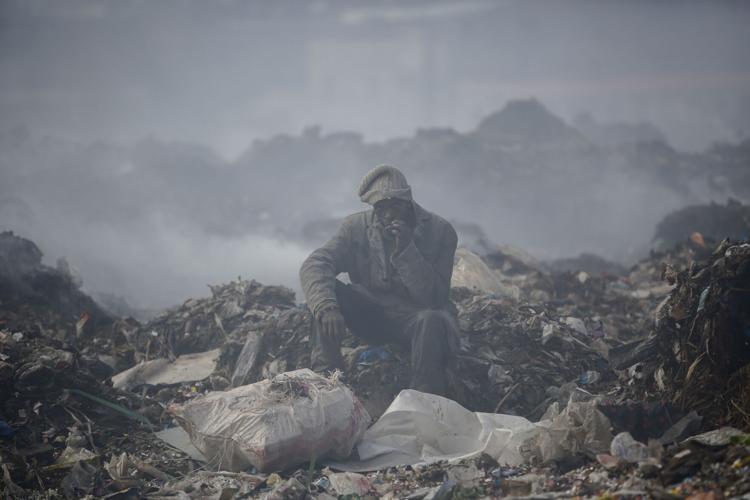
FILE - A man who scavenges recyclable materials for a living rests to smoke a cigarette on a mountain of garage amidst smoke from burning trash at Dandora, the largest garbage dump in the capital Nairobi, Kenya, Tuesday, Sept. 7, 2021.
GENEVA (AP) — The U.N. health agency says nearly everybody in the world breathes air that doesn't meet its standards for air quality, calling for more action to reduce fossil-fuel use, which generates pollutants that cause respiratory and blood-flow problems and lead to millions of preventable deaths each year.
The World Health Organization, about six months after tightening its guidelines on air quality, on Monday issued an update to its database on air quality that draws on information from a growing number of cities, towns, and villages across the globe — now totaling over 6,000 municipalities.
WHO said 99% of the global population breathes air that exceeds its air-quality limits and is often rife with particles that can penetrate deep into the lungs, enter the veins and arteries, and cause disease. Air quality is poorest in WHO's Eastern Mediterranean and Southeast Asia regions, followed by Africa, it said.
People are also reading…
Keep scrolling for photos of climate change impacts from around the world
"After surviving a pandemic, it is unacceptable to still have 7 million preventable deaths and countless preventable lost years of good health due to air pollution," said Dr. Maria Neira, head of WHO's department of environment, climate change and health. "Yet too many investments are still being sunk into a polluted environment rather than in clean, healthy air."
The database, which has traditionally considered two types of particulate matter known as PM2.5 and PM10, for the first time has included ground measurements of nitrogen dioxide. The last version of the database was issued in 2018.
Nitrogen dioxide originates mainly from human-generated burning of fuel, such as through automobile traffic, and is most common in urban areas. Exposure can bring respiratory disease like asthma and symptoms like coughing, wheezing and difficulty in breathing, and more hospital and emergency-room admissions, WHO said. The highest concentrations were found in the eastern Mediterranean region.
Particulate matter has many sources, such as transportation, power plants, agriculture, the burning of waste and industry – as well as from natural sources like desert dust. The developing world is particularly hard hit: India had high levels of PM10, while China showed high levels of PM2.5, the database showed.
"Particulate matter, especially PM2.5, is capable of penetrating deep into the lungs and entering the bloodstream, causing cardiovascular, cerebrovascular (stroke) and respiratory impacts," WHO said. "There is emerging evidence that particulate matter impacts other organs and causes other diseases as well."
The findings highlight the sheer scale of the changes needed to combat air pollution, said Anumita Roychowdhury, an air pollution expert at Center for Science and Environment, a research and advocacy organization in New Delhi.

FILE - Workers clean oil from Cavero Beach in the Ventanilla district of Callao, Peru, Friday, Jan. 21, 2022.
India and the world need to brace for major changes to try to curb air pollution, including using electric vehicles, shifting away from fossil fuels, embracing a massive scaling-up of green energy and separating types of waste, she said.
The Council on Energy, Environment and Water, a New Delhi-based think tank, found in a study that more than 60% of India's PM2.5 loads are from households and industries.
Tanushree Ganguly, who heads the council's program on air quality, called for action toward reducing emissions from industries, automobiles, biomass burning and domestic energy.
"We need to prioritize clean energy access for households that need it the most, and take active measures to clean up our industrial sector," she said.
Photos: Climate change impacts around the world

FILE - Bruce McDougal watches embers fly over his property as the Bond Fire burns through the Silverado community in Orange County, Calif., on Dec. 3, 2020. The United Nations on Monday, Feb. 28, 2022, released a new report on climate change. (AP Photo/Noah Berger, File)

FILE - Mohamed Mohamud, a ranger from the Sabuli Wildlife Conservancy, looks at the carcass of a giraffe that died of hunger near Matana Village, Wajir County, Kenya, Monday, Oct. 25, 2021. The United Nations on Monday, Feb. 28, 2022, released a new report on climate change. (AP Photo/Brian Inganga, File)
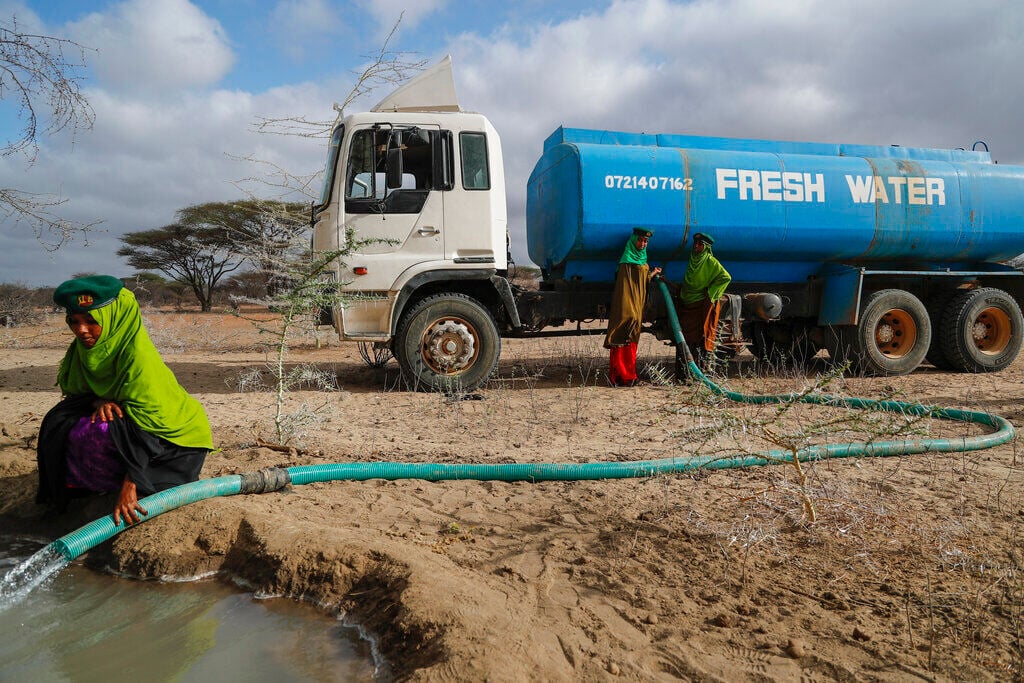
FILE - Rangers from the Sabuli Wildlife Conservancy supply water from a tanker for wild animals in the conservancy in Wajir County, Kenya, Oct. 26, 2021. The United Nations on Monday, Feb. 28, 2022, released a new report on climate change. (AP Photo/Brian Inganga, File)
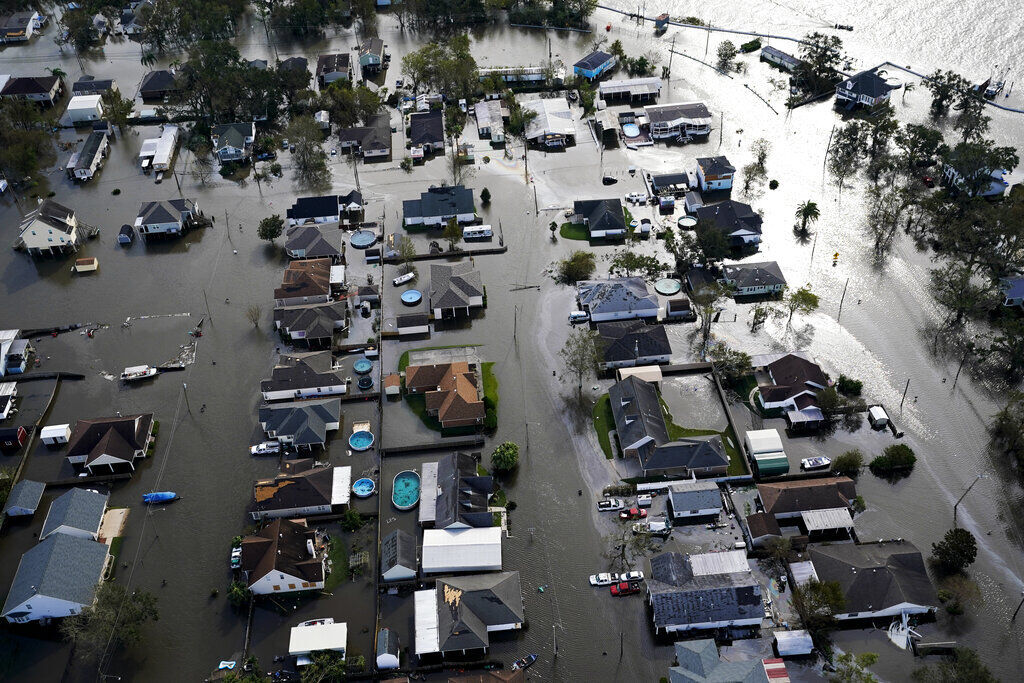
FILE - Homes are flooded in the aftermath of Hurricane Ida, Monday, Aug. 30, 2021, in Jean Lafitte, La. The United Nations on Monday, Feb. 28, 2022, released a new report on climate change. (AP Photo/David J. Phillip, File)

FILE - A youngster, with an eye drawn on her hand to show she is watching and 1.5 for countries to keep warming below 1.5 degrees Celsius, takes part in a Fridays for Future climate protest inside a plenary corridor at the SEC (Scottish Event Campus) venue for the COP26 U.N. Climate Summit, in Glasgow, Scotland, Wednesday, Nov. 10, 2021. The United Nations on Monday, Feb. 28, 2022, released a new report on climate change. (AP Photo/Alberto Pezzali, File)
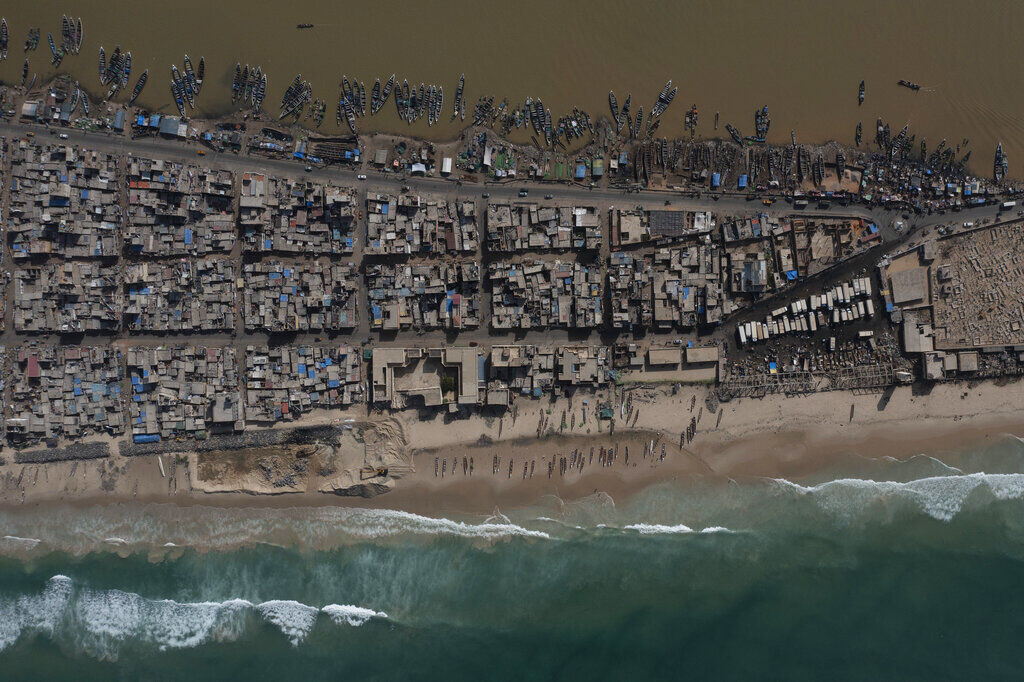
FILE - Houses lay between the Senegal river, top, and the Atlantic Ocean beach that has been affected by erosion in Saint Louis, Senegal, Wednesday, Nov. 3, 2021. The United Nations on Monday, Feb. 28, 2022, released a new report on climate change. (AP Photo/Leo Correa, File)

FILE - Shayanne Summers holds her dog, Toph, while wrapped in a blanket after several days of staying in a tent at an evacuation center at the Milwaukie-Portland Elks Lodge, Sunday, Sept. 13, 2020, in Oak Grove, Ore. The United Nations on Monday, Feb. 28, 2022, released a new report on climate change. (AP Photo/John Locher, File)

FILE - Roots are photographed near the old village of Aceredo in northwestern Spain, Friday, Feb. 11, 2022. The United Nations on Monday, Feb. 28, 2022, released a new report on climate change. (AP Photo/Emilio Morenatti, File)
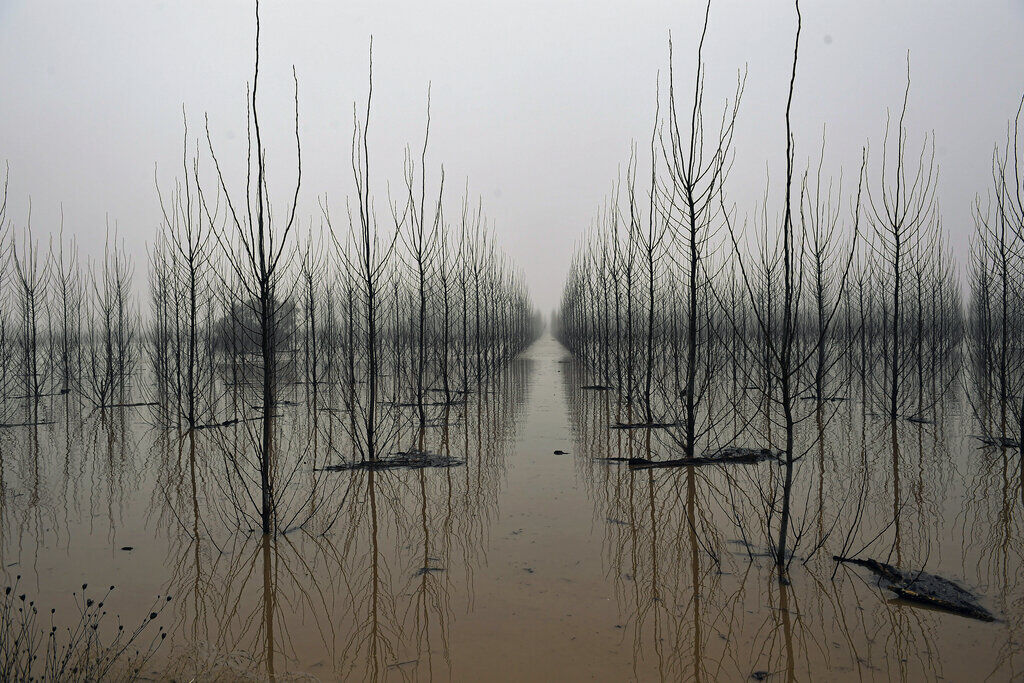
FIL E- Fog covers the landscape in a flooded area near the Ebro River in the small village of Alcala de Ebro, Aragon province, northern Spain, Dec. 13, 2021. The United Nations on Monday, Feb. 28, 2022, released a new report on climate change. (AP Photo/Alvaro Barrientos, File)

FILE - Climate activists take part in a demonstration outside the venue of the COP26 U.N. Climate Summit in Glasgow, Scotland, Friday, Nov. 12, 2021. The United Nations on Monday, Feb. 28, 2022, released a new report on climate change. (AP Photo/Scott Heppell, File)
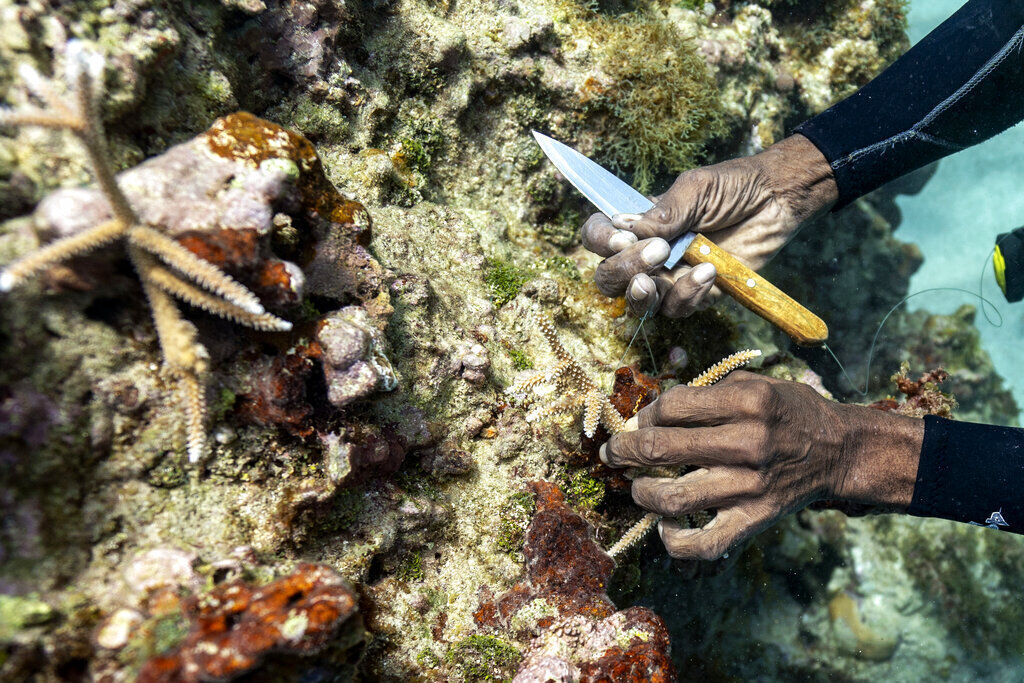
FILE - Diver Everton Simpson plants staghorn harvested from a coral nursery inside the the White River Fish Sanctuary Tuesday, Feb. 12, 2019, in Ocho Rios, Jamaica. Simpson uses bits of fishing line to tie clusters of staghorn coral onto rocky outcroppings, a temporary binding until the coral's limestone skeleton grows and fixes itself onto the rock. The goal is to jumpstart the natural growth of a coral reef. (AP Photo/David J. Phillip, File)
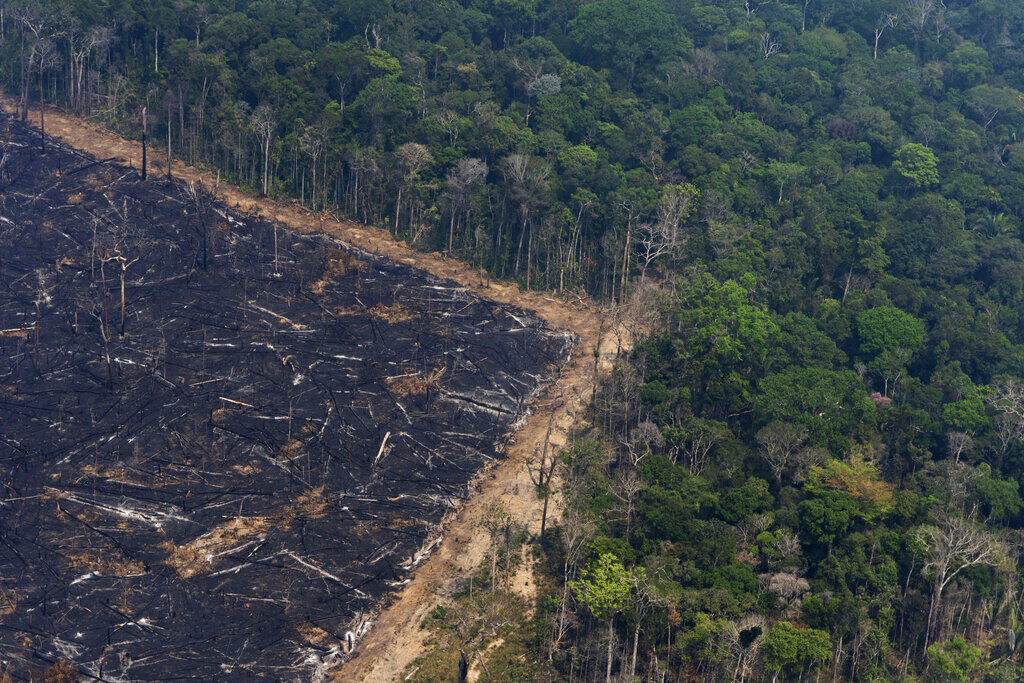
FILE - Jungle stands next to an area that was burnt due to wildfires near Porto Velho, Brazil, Friday, Aug. 23, 2019. The United Nations on Monday, Feb. 28, 2022, released a new report on climate change. (AP Photo/Victor R. Caivano, File)

FILE - Yvonne Lacobon hugs a dog beside Tommy Williams at Williams' home damaged by Hurricane Ida, Saturday, Sept. 4, 2021, in Dulac, La. The United Nations on Monday, Feb. 28, 2022, released a new report on climate change. (AP Photo/John Locher, File)
Aniruddha Ghosal in New Delhi contributed to this report.