

GRAYSLAKE, Ill. — Seven-year-old Nicholas Chamernik had rarely seen his parents cry. So he was worried when he looked up one evening to see his father wiping away tears.
"Dad, what's wrong?" he asked.
Jim Chamernik was too choked up to respond. After 18 months of grasping for answers, he and his wife, Aimee, finally had an explanation for symptoms Aimee had been having — slurred speech and weakness in her right arm among them. The diagnosis was Lou Gehrig's disease, a degenerative condition of the nervous system, also known as amyotrophic lateral sclerosis, or ALS.
There is no cure. But how could they explain that to their eldest son, the first in the family to notice his mom's slurring, when she read him bedtime stories? How do you tell a child that his mom is dying?
It would be tempting for a parent to shield a child as long as possible from such a painful reality. But the Chamerniks have chosen a different path — one of gentle honesty. Theirs is the story of two parents doing the best they can to help their children understand and cope with terminal illness.
People are also reading…
The process began that night more than two years ago with a question from their son. It has only led to more questions, and the Chamerniks have attempted to answer each one.
"Dad, what's wrong?"
Aimee — seeing that Jim was struggling — took a deep breath and sat down in the family room of their suburban Chicago home. She pulled Nicholas onto her knee and put her arms around him.
"You know I'm having trouble with my muscles, right?" Aimee began, surprised at her own composure. Her son nodded.
"Well," she said, slowly, "Daddy's sad because the doctor told me they're not going to be able to help me get better."
"... if you're still alive"
Nicholas sat there for a moment, thinking about what his mom had said and then responded in his 7-year-old way. "You know mom, when I grow up, I'm going to be a paleontologist and a St. Louis Cardinals baseball player and a zoologist and a person who studies plants," he said, breathlessly.
"Well, I'm also going to be a doctor," he said. "So if you're still alive, I can help them find out how to make you better."
Four words from that conversation still echo in Aimee's head — "if you're still alive."
They were the first indication that, at some level, Nicholas understood the gravity of her slow decline. That moment also marked the beginning of a long goodbye for a 37-year-old mother whose oldest children will be lucky to reach their teenage years before she dies.
"I didn't think she'd be alive as long as other people," says Nicholas, now 9. "But I still thought it'd be a long time."
Even Aimee's doctors don't know exactly how long she has. The average life expectancy after an ALS diagnosis, they've told her, is two to five years. It's been a little more than two so far.
Already, her children — Nicholas; Emily, now 7; and Zachary, 3 — have seen her fall several times. She reluctantly uses a cane in public spaces and struggles with tasks most people take for granted — navigating stairs, opening a soda can, unbuckling a car seat belt.
Knowing she will eventually lose her ability to move and speak, there is a quiet urgency in the Chamernik household, to pack in as much family time as possible and to have the conversations they can't have later on.
"Did you go to doctors?" Emily asked one evening.
It's a question she's asked many times, but Aimee willingly responds again.
"Lots and lots of doctors," she says, telling Emily and Nicholas about tests with needles stuck into her legs and above her eyebrow. "That one hurt more than anything," she says.
Often, her kids ask why her muscles aren't working.
"Why can't she just exercise?"
At first, Nicholas thought, "Why can't she just exercise to be stronger and faster?"
Emily remembered her mom talking about the importance of good nutrition and wondered, "Did mom eat too much dessert?"
Aimee tries to explain what's happening to her body in ways they'll understand: She tells them how motor neurons are like "mailmen" — some that still deliver "letters" from her brain to her muscles, while others have quit and headed to Florida for vacation.
Because he's a baseball fan, Nicholas is interested in Gehrig's fight with the illness. He copes by focusing on possible solutions, dreaming up inventions that might help his mom walk and even run again.
His sister's reactions are often more emotional. "Emily sometimes will run up to me and throw her arms around me so tight and say, 'Oh, Mommy, I just love you,' and say it with such intensity and hug me with such intensity that it takes my breath away," Aimee says.
"My reaction in my head is, 'No, no, don't love me that much, because if you love me that much, it's going to really hurt when I'm gone."'
Sometimes, Emily fantasizes about a special telephone to heaven she could use to call her mom. But what will she do, she wonders, when she needs a hug from her mom?
Aimee's eyes fill with tears at the thought of not being there. "There's no way to prepare yourself for the heartbreak of a child asking, 'What am I going to do when you're not here?' " she says.
She reminds Emily that her dad, brothers and other family will be there for her when she's not. "And if you're really, really still and quiet, I think you'll be able to think of what I might say," she says.
Their worries about the kids, coupled with their own grief, can overwhelm Aimee and Jim. So they meet regularly with a social worker at the Les Turner ALS Foundation in nearby Skokie to help them work through their concerns. The social worker has encouraged their honesty with the kids, but also suggested that they bring conversations back to the present whenever possible.
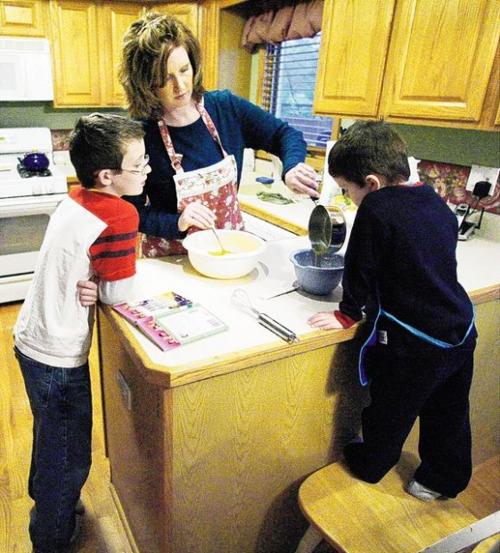
"Right now, I'm here and I'm able to do this," Aimee often reminds her kids, whether "this" is baking cookies, taking Emily to a concert or going to the World Series last fall to see her beloved Cardinals win.
As all couples do, she and Jim occasionally argue. And the kids have their moments, too.
Sometimes, they claim they can't understand Aimee's directions because of her slurred words, when they clearly do. So she calls them over to repeat what she's said.
Sick or not, Aimee knows disciplining is part of being a parent. Still, she hopes her kids will recall the happiest times.
Their home is their haven
Indeed, even with all they are facing, their two-story home remains the family's haven, filled with smiling photos and images of Pooh and Tigger on the living room walls. There often is laughter, with Nicholas, Emily and Zachary wrestling on the floor, putting together puzzles or organizing their many Pokemon stuffed animals and cards.
Nicholas is now in fourth grade. For a recent school project, he described himself as hyper, funny and brave — brave, partly because he stood in front of his class and told them about his mom and ALS.
It's one way he's become "a little activist," as his parents call him. For his last two birthday parties, he's asked friends to bring donations for ALS research instead of gifts — and raised more than $350 last year.
"I just want my mom to be healthy," he says.
Her mom describes Emily as "a pirate at heart," most comfortable in jeans and a T-shirt and quick with a wide grin that is increasingly toothless.
Like Nicholas, she's also one of her mom's most faithful helpers. They constantly retrieve items for her.
When there are too many toys on the living room floor, without prompting, Emily will say, "Mommy can't walk here — we need to clean up."
Because mornings are Aimee's most difficult time of day, Emily and Nicholas also are counted on to help get themselves ready for school. Jim races around the house doing laundry, making breakfast and bringing Aimee coffee before he goes to one of his two jobs as a law firm manager.
Aimee can't help but feel guilty about all that Jim does and about the extra responsibility the kids take on.
"As children, they're asked to do a lot of things," she says. "Sometimes I wish they could just be kids."
More than anything, Jim worries that, once Aimee is gone, he won't be enough for their children — even for little things, such as doing Emily's hair.
"It's tough for me to talk about a rosy future when there isn't one because their world revolves around their mother," he says one evening in the living room. "There's no substitution for what they're going to miss."
As he speaks, Emily sits on his lap. Nicholas and Zachary are getting ready for bed, while Aimee works in the kitchen.
Just before her birthday, it occurred to Nicholas that his mom would be the same age as Gehrig was when he died.
"I just wondered," he said, hesitantly because he didn't want to hurt his mom's feelings, "If he was 37 when he died, maybe you would die when you're 37, too."
His mom looked at him.
"I can't promise you I won't die in the next year, because I could be in a car accident or something like that," she said. "But I won't die from ALS in the next year." Immediately, she could sense his relief.
That conversation remains his safety net — and while he used to call home during school lunch to make sure his mom was OK, he doesn't anymore.
"I hope I'm not misleading him. It would be fairly shocking for me to drop off in the next six months," Aimee says. "But a little part of me — there's that reality that this is fatal and you can't know."
If the disease is strong though, so is a mother's will. Aimee focuses these days on her vow to her son to go on living.
"Now," she tells herself, "you better do everything in your power to make sure that's true."
On StarNet: Find an audio slide show, "A Mother's Long Goodbye," at
"It's tough for me to talk about a rosy future when there isn't one."
Jim Chamernik
Speaking of his children's attachment to their mother


