Jason Gates spends a lot of his time thinking about trash, and how we can generate less of it.
Since 2013 his San Francisco-based startup, Compology, has used cameras and artificial intelligence to monitor what's thrown into dumpsters and trash containers at businesses such as McDonald's restaurants and Nordstrom department stores. The point is to make sure dumpsters are actually full before they're emptied and to stop recyclable materials like cardboard from being contaminated by other junk so it, too, doesn't become waste.
"We've found that most businesses and people have the right intentions about recycling, but oftentimes they just don't know what the proper way to recycle is," said Gates, CEO of Compology.
To help them do it correctly, Compology puts trash-monitoring cameras and sensors inside industrial waste containers. The cameras take photos several times each day and when the container is lifted for dumping. An accelerometer helps trigger the camera on garbage day.
People are also reading…
AI software analyzes the images to figure out how full the container is and can also let a customer know when something is where it shouldn't be, such as a bag of trash tossed into a dumpster filled with cardboard boxes for recycling. Gates said the company's cameras can cut the amount of non-recyclable materials thrown in waste containers by as much as 80%.
With McDonald's dumpsters in Las Vegas, for instance, Compology's cameras and sensors showed the company was generally doing a good job recycling cardboard packaging. But occasionally garbage bags were thrown in there, too, Gates said.
"Once we saw the bags of trash go inside the cardboard containers, we sent a notification to the people on site via text message, letting them know that they should remove it before the truck comes the next morning and telling them that putting trash in the recycling container is a form of contamination, which they should not do in the future," he said.

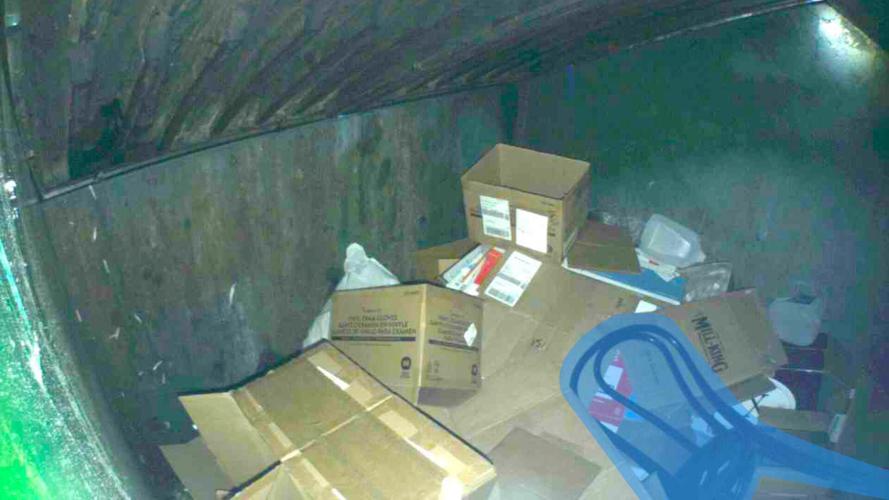
Compology's artificial intelligence system detects a contaminant in an image from one of its cameras.
Brent Bohn, who owns and operates dozens of McDonald's restaurants in the Las Vegas and Phoenix areas, uses Compology at restaurants in Las Vegas to help ensure restaurant workers are recycling properly.
"The cameras have really streamlined that for us and provided accountability for us, but also for our suppliers and the haulers that we work with," he said.
Compology trained its system to sort trash with tens of millions of images, Gates said, and it uses pictures taken from within dumpsters that are now in use to get better at determining fullness and what's inside. So far, it has processed over 80 million images from the 162,000 cameras it has installed.
"The more images we get of the inside of dumpsters, the more accurate we can be," he said.
Part of why Gates sees Compology's work as vital is because the United States, which used to send much of its scrap and waste to China, is no longer doing so. China began banning the imports of recycling materials in 2017, citing environmental concerns from mixed-incontaminants, and expanded its ban in 2018.
Since then, the US has struggled to determine what to do with its recyclables, with some cities simply halting recycling programs. Cleaning up materials stateside could make it easier for the country to recycle on its own (and, in fact, it's one of the US Environmental Protection Agency's goals to raise the domestic recycling rate to 50% by 2030; it currently hovers around 32%).

Compology places cameras and sensors in businesses' dumpsters to monitor what's thrown inside.
Compology's service costs businesses between $10 and $20 per month per dumpster. It's saving them generally thousands of dollars per dumpster per year on waste-hauling costs, Gates said, as it can also use AI to predict what the service schedule for each dumpster should be, so it will only be picked up when it's likely to be full.
Over time, Gates hopes Compology can help standardize how waste is measured and reported — something that isn't currently consistent in the US.
"You've been able to measure how much electricity, water, gas you've used for decades," Gates said. "What we're doing is being able to meter how much waste you produce."
7 ways you can reduce your use of plastic, foil and other kitchen disposables
7 ways you can reduce your use of plastic, foil and other kitchen disposables
Paper towels

This photo provided by Bed Bath & Beyond shows microfiber cloths from Real Simple which are sold exclusively at Bed Bath & Beyond. (Bed Bath & Beyond via AP)
"Keeping paper towel use to a minimum is one of the things Martha Stewart is really serious about," Tyrell says. Each workspace in the magazine's test kitchen features cloth tea towels, bar towels (similar to rags) and a roll of select-a-size paper towels, she says. The latter is used sparingly.
Tea towels are great for drying hands or dishes, or folding up to use as a hot mitt. Bar towels can be used for most messes. Paper towels are reserved for messes like juice from meat or raw egg.
"It helps to have all your towel options in one place, so I'd recommend keeping rags or bar towels near where you keep the paper towels," Tyrell says. If cloth towels aren't handy, you probably won't use them, she advises.
And if you can't wean yourself off paper towels, there are now several types of reusable ones made of bamboo and other sustainable materials that can be used numerous times before tossing them out, says Brandi Broxson, articles editor at Real Simple magazine. Cleaner paper towels can be recycled.
Plastic shopping bags

Barbara Redcay, not shown, loads reusable grocery bags into her vehicle after shopping at a store in Clarence, N.Y., Wednesday, Nov. 17, 2010. (AP Photo/David Duprey)
Carry your own canvas or string tote bags for groceries and other purchases. The key, as with bar towels, is to keep them handy.
"There are so many types of reusable bags out there that there's really no excuse for bringing home single-use plastic shopping bags anymore," Tyrell says.
Americans throw away around 100 billion plastic bags a year, she says.
Plastic produce bags

Avoid plastic produce bags by keeping a few lightweight mesh bags — often sold as "multi-use straining bags" — in your purse when you head to the grocery store, Tyrell says.
"They're also great for making nut milks or straining yogurt," she adds.
If your grocery store doesn't use compostable produce bags, you can always bring some of your own.
To avoid plastic wrapping on meat or fish, try asking the butcher at the grocery store to wrap it instead in paper, which is biodegradable. Or bring a reusable container to put it in.
Plastic baggies
There are a variety of new products that can be used as an alternative to baggies. Broxson, at Real Simple, recommends one called Stashers. They're like zip-top plastic bags but are made of Silicon, and can be washed in the dishwasher and reused. They are watertight, and can go from freezer to microwave

Second graders at Hammond Elementary School in Laurel, Md. enjoy lunch break in the cafeteria on Friday April 22, 2005. The school has adopted a program called "Waste Free Wednesday" which encourages students to become more aware of the amount of trash they are throwing away during lunches. Examples of materials that end up in the school's trash bins include lunches that are packed in plastic type baggies instead of reusable plastic containers. (AP Photo/ Matt Houston)
Plastic wrap

This photo provided by Bees Wrap shows the wrap in use in a variety pack of colors and sizes. (Bees Wrap via AP)
Both Broxson and Tyrell recommend Bee's Wrap as an alternative to typical plastic cling wrap. It's made of fabric coated in a mixture of wax, oil and tree resin, and sticks to the top of bowls and jars. Like plastic wrap, it conforms to all sorts of shapes. Unlike plastic wrap, it can be washed and reused, and remains sticky for months, Bronson says.
"It's not great for wrapping something drippy like a tuna sandwich, where maybe parchment paper or aluminum foil might be preferable. But as a container covering, or to wrap drier types of foods or sandwiches, it's great," she says.
Aluminum foil

"Luckily, unbleached parchment paper works great for baking and roasting, and also for wrapping sandwiches and snacks," and is biodegradable, Broxson says.
"If you must use aluminum foil, you can wad it up into a ball and reuse it as a scouring sponge for baking dishes to get one more use out of it before throwing it away," she suggests. Clean aluminum foil can be recycled if it's free from food residue. And many stores now sell recycled aluminum foil.
Plastic straws and utensils

In this Wednesday, July 11, 2018, photo, a glass straw is seen in a drink at Aimee Promislow and Fred Tischler's home where they operate their glass straw company, Glass Sipper, in Vancouver. (Darryl Dyck/The Canadian Press via AP)
The test kitchens at Martha Stewart Living have switched from plastic to stainless steel straws, says Tyrell.
"I carry my own titanium fork and spoon, with a nylon connector so they can even be used as tongs. They're super-lightweight, and kind of cool," she says. "Way nicer than plastic."
The-CNN-Wire™ & © 2020 Cable News Network, Inc., a WarnerMedia Company. All rights reserved.