

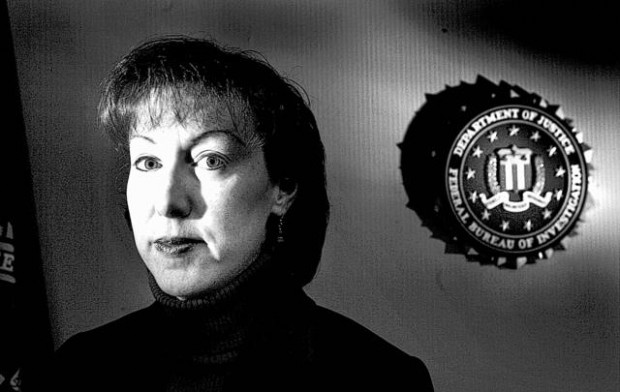
MINNEAPOLIS — Employing a respectful demeanor toward suspects who would inspire only revulsion in others, Maureen Lese is in the vanguard of the FBI's attempts to combat one of the fastest-growing illegal activities on the Internet.
"You will find a lot of agents who don't want to work these cases," said Lese, who has focused exclusively on child-pornography cases for the past seven years. "People tell me I'm going to get to that point where I'll say, 'Enough is enough.' But I take such satisfaction in the work that I do to stop the predators and rescue children."
Staying cool in the face of offenders who see nothing wrong in their repeated victimization of children, treating them instead with outward respect, she said, is a key tool to uncovering their crimes.
She won't say much about her methods, but there is no doubt that she is one of the best at one of the bureau's ugliest jobs. Last fall she received the 2007 U.S. Attorney's Office Law Enforcement Recognition Award.
People are also reading…
"You can lead people to make statements against their own self-interest," said Ralph Boelter, FBI special agent in charge of the Minneapolis office. "Maureen is a master at that."
Sitting down with one suspect at his workplace, Lese was direct and matter-of-fact.
"Do you know why we're here?" she recalled asking.
"Yes," he said. "It's about the pictures."
He told her about the folder on his home computer marked "private," the one that contained images of him having sex with his three young daughters.
The information Lese pulled out of the man helped lock him away for 30 years. His name is public information, but the Star Tribune is not naming him because it would identify his children.
"When you start talking to these guys, you never know what you're going to find," she said.
Lese has been an FBI agent for more than 16 years. Her interest in the bureau goes back further.
"I was always interested in law enforcement," she said. "I had this need for justice and to try to make things more fair for people."
She studied accounting and graduated from the University of Iowa in 1987 with a degree in psychology because "I knew that was a way to get into the FBI."
Lese also knew she had to work a few years after college before the FBI would take her. For three years, she worked at the Illinois Math and Science Academy. She joined the FBI in 1992.
In the case of Lyle Robert Paton, Lese wasn't the one to catch him. She came into the case long after his arrest. But her work helped nail the repeat offender.
Paton, a married Minneapolis man with two previous convictions — one involving sex with a 14-year-old boy and another for possessing obscene material — was seen entering the woods of St. Paul's Lilydale Park with a digital camera and five boys. After a resident alerted authorities, a police officer arrested Paton as the group left the park.
Police learned that Paton had been photographing the boys in the nude. In fact, he'd photographed some of the boys for years after befriending them and their families. In all, investigators identified 25 victims of sexual abuse or exploitation.
A big part of Lese's job, she said, is getting guilt-ridden or disbelieving family members to cooperate and let their children talk to investigators. "It's a hard thing for kids and parents to admit to," she said.
She convinced them in much the same way she convinces offenders: calmly and with respect. In 2007, Paton received five concurrent life terms for producing child pornography. But her strongest skill may be getting bad guys to spill.
In June 2006, the Minnesota task force learned about Todd Edward Hammond through other pedophiles caught in Florida and Kentucky.
The Andover, Minn., man had been having sex with a 12-year-old mentally disabled boy. Hammond took his laptop, a Web camera and the boy to hotel rooms where he sexually assaulted the boy on live streaming video that he sent to other pedophiles' computers.
Like many pedophiles, Hammond had gained parents' and kids' trust. He worked as a mentor to children at risk.
"His victim was one of the kids at risk who needed a father figure," Lese said.
She sat down with Hammond in the Anoka County, Minn., jail and asked him to tell his story. "He was willing to talk," she said.
He was sentenced in July 2007 to 30 years in federal prison.
COMBATING CHILD PORNOGRAPHY
FBI Special Agent Maureen Lese said there are things you can do if you suspect you see child pornography on your, or someone else's, computer:
• Contact the Internet service provider. Give as much detailed information about the site as you can, such as the Internet address, name of the site and types of images you saw.
• Contact the CyberTipline at www.cybertipline.org Even if you get only a little information, don't be afraid to raise a red flag.
• Remember: Every piece of child pornography means a child was, or continues to be, victimized. Lese said that if you see it, don't ignore that feeling in the pit of your stomach.
Source: Star Tribune (Minneapolis)


