

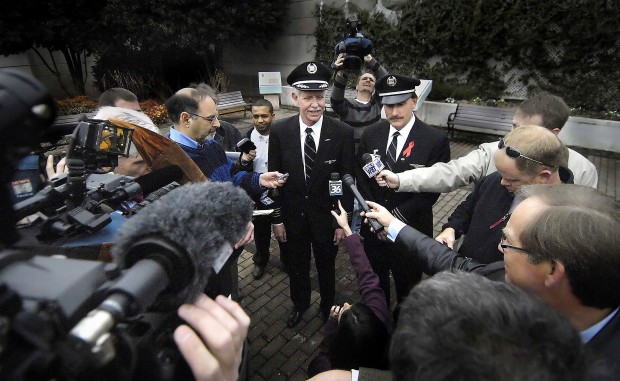
WASHINGTON - The National Transportation Safety Board, saying the seemingly miraculous safe water landing of a US Airways plane in the Hudson River last year did not go as smoothly as it could have and might easily have been a tragedy, issued new recommendations Tuesday based on lessons learned in the incident.
The plane, an Airbus A320, was equipped with inflatable life vests, lifelines and slide rafts, which officials said were crucial to passengers' safe escape. But in some instances, the equipment was poorly positioned and didn't function as intended.
"The success of this ditching mostly resulted from a series of fortuitous circumstances," said Jason Fedok, a survival factors investigator, who stressed that the proximity of emergency workers and boats in the New York area made for a swift rescue.
The Charlotte, N.C.-bound flight took off from LaGuardia Airport on the afternoon of Jan. 15, 2009. About two minutes after takeoff, a flock of Canada geese collided with the plane's engines, causing them to lose almost all thrust and forcing pilot Chesley "Sully" Sullenberger to pull off a desperate water landing on the Hudson.
People are also reading…
All 150 passengers and five crew members survived. But investigators said that some of the safety and contingency plans for such an event were either ignored or could not be performed in the three minutes of chaos that ensued.
The flight crew lost valuable time attempting to relight the engines after the collision had occurred, unaware that there was no hope of restoring them to working use. When the decision was made to land the plane on the Hudson, the crew did not prepare passengers for a water landing and could not complete the appropriate engine failure checklist.
The plane was equipped with - though not required to carry - life vests and slide rafts, but just two passengers were able to don the vests before the plane landed on the water. Only 19 passengers attempted to retrieve their vests, and 10 reported having difficulty doing so.
Federal Aviation Administration flight ditching parameters were unrealistic in the case of a low-altitude dual engine failure, the NTSB investigation found. Sullenberger was unable to land the plane according to the guidelines for pitch, descent rate and flight path. The landing caused two of the four slide rafts to be submerged underwater, leaving many passengers to stand on the wings of the sinking plane without any protection from the frigid water below.
The plane was also equipped with four lifelines to keep passengers from falling into the water, but that equipment was stowed in the front and back of the plane, inaccessible to flight attendants.
After flights attendants handed out some life vests, 33 passengers were fitted with them but most said they were unable to secure the waist straps.
Despite these setbacks, the safety board applauded the skill and professionalism of Sullenberger and the flight crew. It concluded that had the plane not been equipped for an overwater landing - which was not a requirement for the New York-to-Charlotte route - the accident could have been deadly.
"The lifesaving equipment was critical in the positive outcome of this accident," said NTSB Chairwoman Deborah Hersman in an interview with reporters. "Had they not had this equipment, the results could have been very different."
That finding led the NTSB to recommend a new requirement that all planes, even those traveling primarily over land, be stocked with life vests and flotation seat cushions for each passenger. A similar recommendation by the FAA was withdrawn in 2003, "due to cost concerns," Fedok said.
Because the NTSB found that 70 percent of the passengers on the Charlotte-bound flight watched less than half of the preflight safety briefing and more than 90 percent failed to read the seat pocket safety card, the board recommended that airlines be required to "implement creative and effective methods of overcoming passengers' inattention."


