

LAS VEGAS — Perhaps the Las Vegas Strip has gotten too bright for its own good.
Clark County officials are considering a law that could dim lights on Strip marquees and other signs that blind or dazzle motorists.
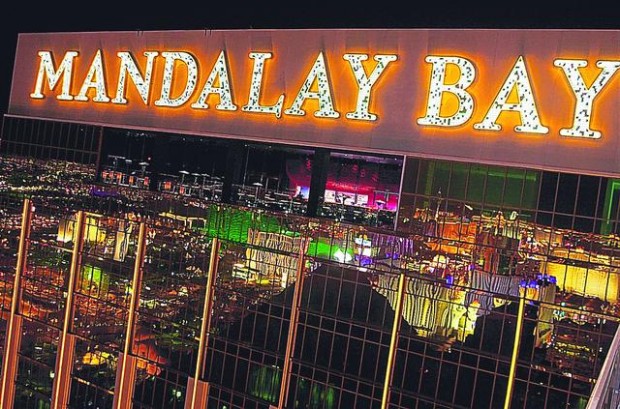
Critics point to a Mandalay Bay marquee that floods Interstate 15 with flashing — and some say blinding — light.
Local lighting-industry officials say most Strip hotel marquees have sensors that keep their brightness in check by adjusting sign lights depending on conditions, such as changing sunlight.
Current sign settings are well below the brightness limits being considered by the county, the illumination industry says.
The county's ordinance allows only signs that do not "illuminate with such brilliance as to blind or dazzle the vision of travelers." County officials admit such an ordinance is vague and unenforceable.
People are also reading…
"We're looking to establish a more concrete ordinance," said Clark County Planner Chuck Pulsipher, noting that the county has received complaints about marquees near Interstate 15, particularly the Mandalay Bay marquee that was built without a brightness-control sensor by a company that no longer is in business. "This is about getting better light-pollution control," he said.
The county still is determining what the brightness standards should be, based on a measurement called "nits" — the amount of candle power emitted in 1 square meter at the source of the light. The numbers being bandied about are a maximum output of 5,000 to 6,000 nits during daylight and 2,500 to 4,000 nits at night.
Bob Klausmeier, electronics specialist for Yesco, the oldest local lighting company, which also has about 70 percent of the electronic-marquee market on the Strip, says most local resorts could easily meet such standards. Klausmeier said he also is critical of harsh-light signs because they give his business a bad name.
"That sign (behind the Mandalay Bay) is a hazard," Klausmeier said. "It lacks sufficient brightness controls and does harm to our industry because people think that a high level of brightness is what we are about. But it's not. We want people to look at our signs and read the messages, not turn away because they are too distracting."
Calls to the MGM Mirage about the brightness of the signs for its 10 Strip resorts, including the marquee behind Mandalay Bay, were not returned.
Other resorts either did not return calls or, like Harrah's Entertainment, which owns 10 properties on or near the Strip, referred all questions to Yesco, which installed and maintains its marquees.
Klausmeier said for all the speculation that bright, blinking signs cause accidents, there is little or no scientific evidence to support that theory.
A study in Cleveland, he said, found no significant change in accident rates in particular areas six months before and six months after signs were installed. A 2006 AAA-commissioned study, however, found that when a driver — for any reason — takes his eyes off the road for more than two seconds, the odds more than double that he will crash.
The Federal Highway Administration has said it plans to study whether billboards with moving features, such as changing electronic messages, increase collisions.


