

WASHINGTON — For kids to do better in math, their teachers might have to go back to school.
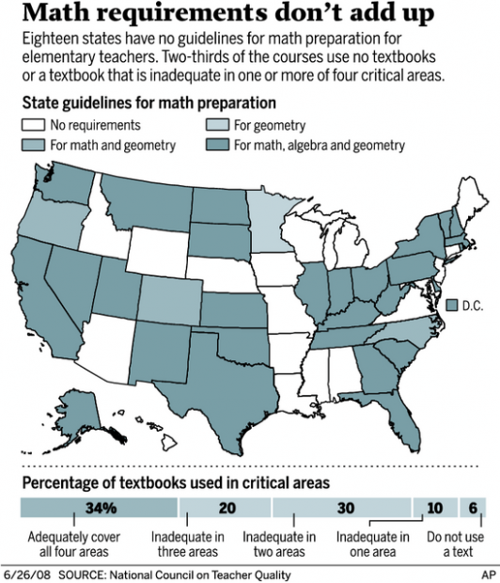
Elementary-school teachers are poorly prepared by education schools to teach math, finds a study being released today by the National Council on Teacher Quality.
Math relies heavily on cumulative knowledge, making the early years critical.
The study by the non-partisan research and advocacy group comes a few months after a federal panel reported that U.S. students have widespread difficulty with fractions, a problem that arises in elementary school and prevents kids from mastering more complicated disciplines like algebra later on.
The report looked at 77 elementary-education programs around the country, or roughly 5 percent of the institutions that offer undergraduate elementary-teacher certification.
People are also reading…
It found the programs, within colleges and universities, spend too little time on elementary-math topics.
Author Julie Greenberg said education students should take courses that give them a deeper understanding of arithmetic and multiplication. She said the courses should explain how math concepts build upon one another and why certain ideas need to be emphasized in the classroom.
Teacher candidates know their multiplication tables, but "They don't come to us knowing why multiplication works the way it does," said Denise Mewborn, who heads the University of Georgia department of math and science education.
The university was cited in the report for having an "exemplary program," while nine others met basic requirements. The rest offered too little math coursework or coursework that was considered weak, according to the report.
The University of Georgia requires teacher candidates to take courses to help them understand concepts underlying elementary-school math, as well as math courses not designed for teachers.
The report found significant differences in the number and kind of courses required by each education program.
Education schools also are not being selective enough, the report stated. Most require applicants to take an admissions test. But the test, which typically includes reading, writing and math sections, is far too easy, according to the report.
"Almost anyone can get in. Compared to the admissions standards found in other countries, American education schools set exceedingly low expectations for the mathematics knowledge that aspiring teachers must demonstrate," said the report.
U.S. children often fall in the middle or bottom of the pack on international math tests.
Jane West, vice president of government relations for the American Association of Colleges for Teacher Education, said her organization had not received a copy of the report Wednesday. The National Council on Teacher Quality plans to release it publicly at a news conference today.
The report also criticized the tests education students take when they complete their coursework, which are generally relied on by states in granting teacher licenses.
In many cases, the prospective teachers are judged on an overall score only, meaning they could do badly on the math portion but still pass if they do well in the other areas.
Since states oversee the preparation of teachers, the report recommends they set tougher coursework and test standards.
Francis Fennell, the past president of the National Council of Teachers of Mathematics, said the report fails to examine the math instruction students receive while attending community colleges, where many elementary-school teachers start their higher education.
On the Net
National Council on Teacher Quality: http://www.nctq.org/p/


