TOK, Alaska — Alaska’s rugged and frigid interior, where it can get as cold as minus 50 degrees Fahrenheit, is not the place you’d expect to find an electric school bus.
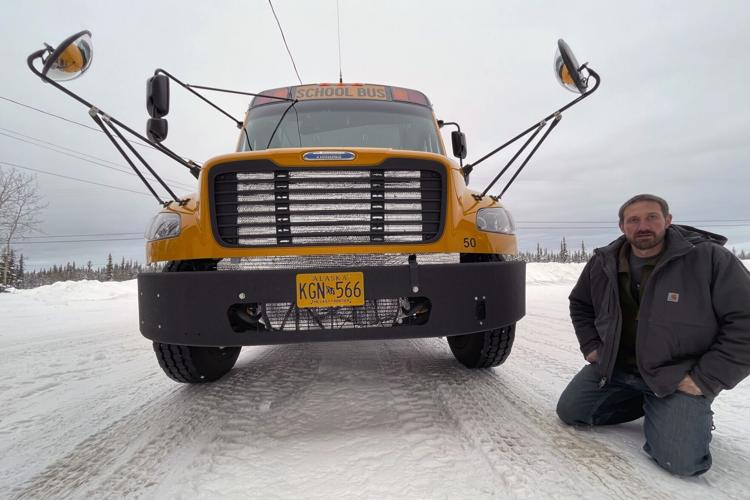
But here is Bus No. 50, with a cartoon horse decal on its side, quietly traversing about 40 miles of snowy and icy roads each day in Tok, shuttling students to school not far from the Canadian border.

Stretch Blackard, owner of Tok Transportation, poses with an electric school bus on Feb. 2 in Tok, Alaska.
It works OK on the daily route. But cold temperatures rob electric vehicle batteries of traveling range, so No. 50 can’t go on longer field trips, or to Anchorage or Fairbanks.
It’s a problem that some owners of electric passenger vehicles and transit officials are finding in cold climates worldwide. At 20 degrees Fahrenheit, electric vehicles just don’t go as far as they do at the ideal 70 degrees, so longer trips can be difficult in the coldest weather. Part of it is that keeping passengers warm using traditional technology drains the battery.
People are also reading…
Some automakers and drivers fear lower battery range in the cold could limit acceptance of electric cars, trucks and buses, at a time when emissions from transportation must go down sharply to address climate change. There is hope. Scientists are racing to perfect new battery chemistries that don’t lose as much energy in cold weather as today’s lithium-ion systems.
Also, cars equipped with efficient heat pumps don’t lose as much range in the cold.
“It is a problem to have batteries in cold weather, and we have a pretty cold climate, one of the coldest in North America,” said Stretch Blackard, owner of Tok Transportation, which contracts with the schools.

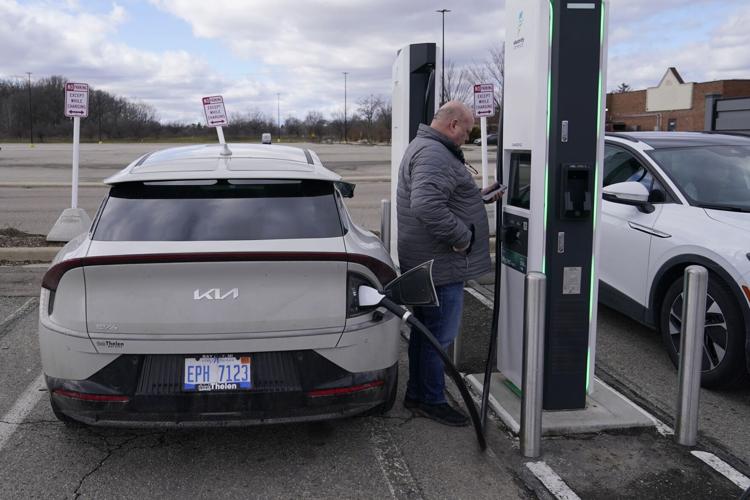
Mark Gendregske of Alger, Michigan, charges his Kia EV6 on Feb. 10 in Ypsilanti, Mich.
When the temperature hits zero, his cost to run Tok’s electric bus doubles. Tok has among the highest electricity prices in the nation.
In the coldest weather, 0 down to minus 10 Fahrenheit, the electric bus costs roughly $1.15 per mile, versus 40 cents per mile for a diesel bus, Blackard said. The cost of the electric bus drops to about 90 cents a mile when it’s warm, but he says the costs make it unworkable and he wouldn’t buy another one.
Many owners of personal electric vehicles also find that long-distance winter travel can be hard. EVs can lose anywhere from 10% to 36% of their range as cold spells come at least a few times each winter in many U.S. states.
Mark Gendregske of Alger, Michigan, said it starts to get serious when temperatures drop to the 10 to 20 Fahrenheit range. “I see typically more than 20% degradation in range as well as charging time,” he said while recharging his Kia EV6 in a shopping center parking lot near Ypsilanti, Michigan. “I go from about 250 miles of range to about 200.”
Gendregske, an engineer for an auto parts maker, knew the range would drop, so he said with planning, the Kia EV still gets him where he needs to go, even with a long commute.
Around three-quarters of this EV range loss is due to keeping occupants warm, but speed and even freeway driving are factors. Some drivers go to great lengths not to use much heat so they can travel farther, wearing gloves or sitting on heated seats to save energy.
To be fair, gasoline engines also can lose about 15% of their range in the cold.

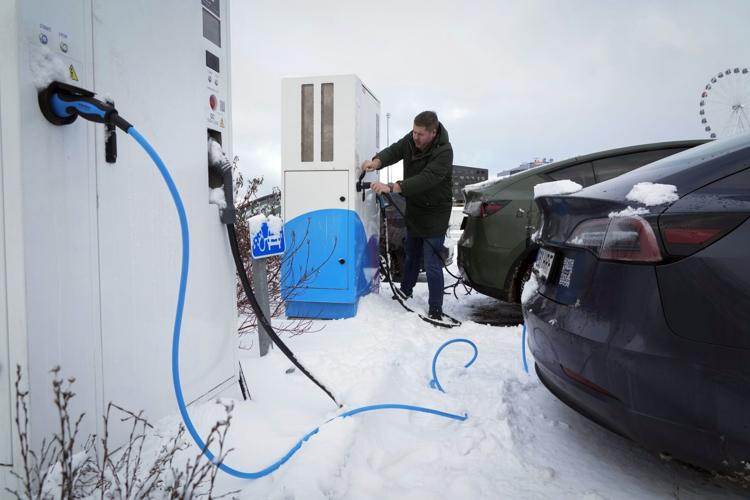
A driver charges an electric car Feb. 11 at a parking lot of a shopping mall in Tallinn, Estonia.
The range loss has not slowed EV adoption in Norway, where nearly 80% of new vehicle sales were electric last year.
Recent tests by the Norwegian Automobile Federation found models really vary. The relatively affordable Maxus Euniq6 came the closest to its advertised range and was named the winner. It finished only about 10% short of its advertised 220-mile range. The Tesla S was about 16% under its advertised range. At the bottom: Toyota’s BZ4X, which topped out at only 200 miles, nearly 36% below its advertised range.
Recurrent, a U.S. company that measures battery life in used EVs, said it has run studies monitoring 7,000 vehicles remotely, and reached findings similar to the Norwegian test.
CEO Scott Case said many EVs use resistance heating for the interior. The ones that do better are using heat pumps.
Heat pumps draw heat from the outside air even in cold temperatures, and have been around for decades but only recently were developed for automobiles, Case said. “That is definitely what needs to be in all of these cars,” he added.
General Motors is among those working on solutions. By testing, engineers can make battery and heat management changes in existing cars and learn for future models, said Lawrence Ziehr, project manager for energy recovery on GM’s electric vehicles.

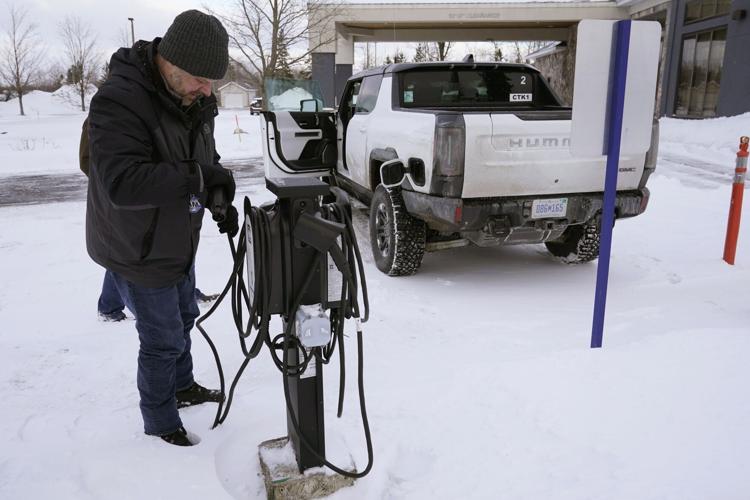
Lawrence Ziehr, project manager for energy recovery on GM's electric vehicles, connects a Hummer EV to a charging station Feb. 22 in Sault Ste. Marie, Mich.
GM recently sent a squadron of EVs from the Detroit area to Michigan’s chilly Upper Peninsula to test the impact of cold weather on battery range.
Despite stopping to charge twice on the way, a GMC Hummer pickup, with about 329 miles of range per charge, made the 315 mile trip to Sault Ste. Marie with only about 35 miles left, barely enough to reach GM’s test facility.
At universities too, scientists are working on chemistry changes that could make cold weather loss a thing of the past.
Neil Dasgupta, associate professor of mechanical and materials science engineering at the University of Michigan, says they’re developing new battery designs that allow ions to flow faster or enable fast charging in the cold.
He expects improvements to find their way from labs into vehicles in the next two to five years.
States With the Most Alternative Fueling Stations
States With the Most Alternative Fueling Stations

Photo Credit: New Africa / Shutterstock
In just a matter of years, electric vehicles have emerged as the clear future of the automotive industry.
In 2008, the nascent car manufacturer Tesla released its first Roadster models, targeting sales of 100 units per month. Over the ensuing years, Tesla grew into one of the largest companies in the world by market capitalization and today leads the global market for EVs, selling nearly 1 million units per year. While Tesla remains the top choice for buyers in the EV market, the company’s success has also paved the way for other electric vehicle startups like Rivian.
More established automakers have also ventured into the EV market in recent years. The launch of the Nissan Leaf in 2010 was an initial foray for established manufacturers into electric vehicles, and other large automakers have added EVs and hybrids to their lineup over time. Some are going even further: General Motors, Toyota, and Volkswagen are among the large manufacturers who have announced plans to go all-electric and eventually stop selling gas-powered vehicles altogether.
A combination of factors explain EVs’ growing success. The technology behind electric vehicles has improved, as batteries now provide longer range on a charge. Consumer interest has increased, with buyers viewing EVs as a way to reduce their environmental impact and potentially save on fuel costs. In the European Union and U.S. states like New York and California, policymakers have moved to limit the sale of combustion vehicles and incentivize EV purchases for consumers as a part of larger efforts to reduce carbon emissions.
Despite these trends, barriers remain to an all-EV future in the U.S. Chief among them is the development of a nationwide charging infrastructure for electric vehicles.
The number of EV charging stations in the US has increased sharply over the past decade

While EV owners frequently charge their vehicles at home, widespread availability of charging stations would allow people with EVs to travel greater distances more easily. Already over the last decade, the number of EV chargers in the U.S. has increased from less than 500 to more than 115,000. These numbers are poised to rise even faster in the near future. The Bipartisan Infrastructure Law enacted in 2021 will invest $7.5 billion in a national network of electric vehicle charging stations, with a goal of building 500,000 chargers by 2030.
Only about 20 percent of chargers are fast chargers

More electric vehicle chargers will not be sufficient by themselves to increase adoption of electric vehicles. The U.S. must also add the right kinds of chargers to the mix, since different kinds of chargers replenish vehicles’ batteries at vastly different rates. Nearly four in five chargers in the U.S. currently are Level 2 chargers, which add approximately 25 miles of range per hour of charging. This rate is acceptable for charging near home or at the office, but it is too slow for anyone taking a longer trip. In contrast, the fastest chargers, DC Fast, add 100 to 200 miles of range per 30 minutes of charging—but this category only represents 21.1% of all chargers nationally.
Roughly one third of the EV chargers in the US are in California

The U.S. electric charging infrastructure must also be distributed more evenly to encourage widespread adoption of electric vehicles. One state, California, currently far outpaces the rest of the country in the availability of chargers. California is home to 41,225 electric vehicle chargers, which amounts to approximately one-third of the nation’s total. As the birthplace of Tesla and one of the country’s most environmentally progressive states, California’s robust charging infrastructure is unsurprising. Nonetheless, other states lag far behind on this measure: second-place New York has less than one-fifth the number of EV chargers as California.
When adjusting for size, however, California falls to second on the list of states with the most chargers. Instead, Vermont—a smaller state with a strong environmentalist streak—stands out as the location with the most electric vehicle charging ports per capita.
The data used in this study is from the U.S. Department of Energy. To determine the states with the most alternative fueling stations, researchers at CoPilot calculated the number of electric vehicle charging ports per capita. In the event of a tie, the state with the greater total number of electric vehicle charging ports was ranked higher. The data includes charging ports at both public and private stations.
Here are the states with the most alternative fuel stations.
15. Virginia

Photo Credit: Sean Pavone / Shutterstock
- EV chargers per 100k residents: 38.4
- Total EV chargers: 3,301
- Level 1 chargers: 247
- Level 2 chargers: 2,296
- DC fast chargers: 758
14. New York

Photo Credit: dibrova / Shutterstock
- EV chargers per 100k residents: 39.4
- Total EV chargers: 7,621
- Level 1 chargers: 42
- Level 2 chargers: 6,733
- DC fast chargers: 846
13. Connecticut

Photo Credit: Sean Pavone / Shutterstock
- EV chargers per 100k residents: 40.2
- Total EV chargers: 1,430
- Level 1 chargers: 76
- Level 2 chargers: 1,040
- DC fast chargers: 312
12. Nevada

Photo Credit: Andrey Bayda / Shutterstock
- EV chargers per 100k residents: 43.1
- Total EV chargers: 1,353
- Level 1 chargers: 16
- Level 2 chargers: 993
- DC fast chargers: 344
11. Maine

Photo Credit: Sean Pavone / Shutterstock
- EV chargers per 100k residents: 46.6
- Total EV chargers: 629
- Level 1 chargers: 24
- Level 2 chargers: 470
- DC fast chargers: 135
10. Washington

Photo Credit: mahaloshine / Shutterstock
- EV chargers per 100k residents: 56.3
- Total EV chargers: 4,328
- Level 1 chargers: 218
- Level 2 chargers: 3,394
- DC fast chargers: 716
9. Maryland

Photo Credit: f11photo / Shutterstock
- EV chargers per 100k residents: 56.4
- Total EV chargers: 3,416
- Level 1 chargers: 47
- Level 2 chargers: 2,785
- DC fast chargers: 584
8. Oregon

Photo Credit: Bob Pool / Shutterstock
- EV chargers per 100k residents: 57.5
- Total EV chargers: 2,439
- Level 1 chargers: 88
- Level 2 chargers: 1,917
- DC fast chargers: 434
7. Hawaii

Photo Credit: Izabela23 / Shutterstock
- EV chargers per 100k residents: 59.2
- Total EV chargers: 833
- Level 1 chargers: 30
- Level 2 chargers: 724
- DC fast chargers: 79
6. Rhode Island

Photo Credit: ESB Professional / Shutterstock
- EV chargers per 100k residents: 59.4
- Total EV chargers: 628
- Level 1 chargers: 82
- Level 2 chargers: 509
- DC fast chargers: 37
5. Utah

Photo Credit: Sean Pavone / Shutterstock
- EV chargers per 100k residents: 60.9
- Total EV chargers: 1,978
- Level 1 chargers: 17
- Level 2 chargers: 1,722
- DC fast chargers: 239
4. Colorado

Photo Credit: Roschetzky Photography / Shutterstock
- EV chargers per 100k residents: 68.5
- Total EV chargers: 3,978
- Level 1 chargers: 89
- Level 2 chargers: 3,307
- DC fast chargers: 582
3. Massachusetts

Photo Credit: Travellaggio / Shutterstock
- EV chargers per 100k residents: 70.7
- Total EV chargers: 4,871
- Level 1 chargers: 74
- Level 2 chargers: 4,369
- DC fast chargers: 428
2. California

Photo Credit: Chones / Shutterstock
- EV chargers per 100k residents: 104.7
- Total EV chargers: 41,225
- Level 1 chargers: 676
- Level 2 chargers: 33,690
- DC fast chargers: 6,817
1. Vermont

Photo Credit: Sean Pavone / Shutterstock
- EV chargers per 100k residents: 139.7
- Total EV chargers: 871
- Level 1 chargers: 71
- Level 2 chargers: 725
- DC fast chargers: 75