

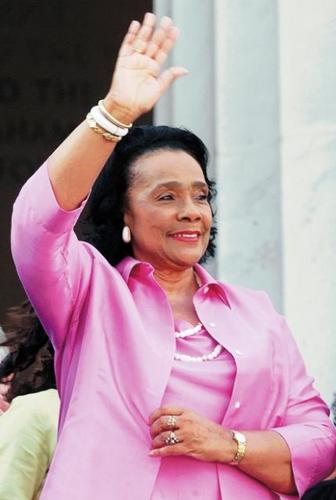
ATLANTA — Coretta Scott King wore her grief with remarkable grace, and it made her one of the most influential figures in the struggle for civil rights.
The "first lady of the civil rights movement," who died in her sleep Tuesday at age 78, was a supportive lieutenant to her husband, the Rev. Martin Luther King Jr., and after his assassination in 1968, she carried on his work while raising their four children.
Coretta Scott King died at an alternative medicine clinic in Mexico. Arrangements were being made to fly the body to Atlanta. She had been recovering from a serious stroke and heart attack suffered last August. Just two weeks ago, she made her first public appearance in a year on the eve of her late husband's birthday.
She pushed politicians for more than a decade to have her husband's birthday observed as a national holiday, achieving success in 1986.
People are also reading…
Former Atlanta Mayor Andrew Young, one of Martin Luther King's top aides, said Coretta Scott King's fortitude rivaled that of her husband. "She was strong if not stronger than he was," Young said.
News of her death led to tributes to King across Atlanta, including a moment of silence in the Georgia Capitol and piles of flowers placed at the tomb of her slain husband. Flags at the King Center — the institute devoted to the civil rights leader's legacy — were lowered to half-staff.
"She wore her grief with grace. She exerted her leadership with dignity," the Rev. Joseph Lowery, who helped found the Southern Christian Leadership Conference with Martin Luther King in 1957.
She supported her husband during the most dangerous and tumultuous days of the civil rights movement. After his death in Memphis, Tenn., on April 4, 1968, the young widow said she was "more determined than ever that my husband's dream will become a reality."
In 1968, she founded the Martin Luther King Jr. Center for Nonviolent Social Change in Atlanta and used it to confront hunger, unemployment, voting rights and racism.
King became a symbol of her husband's struggle for peace and brotherhood, presiding with a quiet, stoic dignity over seminars and conferences.
In Washington, President Bush hailed her as "a remarkable and courageous woman and a great civil rights leader."
King died at Santa Monica Health Institute in Rosarito Beach, Mexico, south of San Diego, said her sister, Edythe Scott Bagley of Cheyney, Pa. She had gone to California to rest and be with relatives, according to Young.
Coretta Scott was studying voice at the New England Conservatory of Music and planning on a singing career when a friend introduced her to King, a young Baptist minister studying at Boston University.
"She said she wanted me to meet a very promising young minister from Atlanta," King once said, adding with a laugh: "I wasn't interested in meeting a young minister at that time."
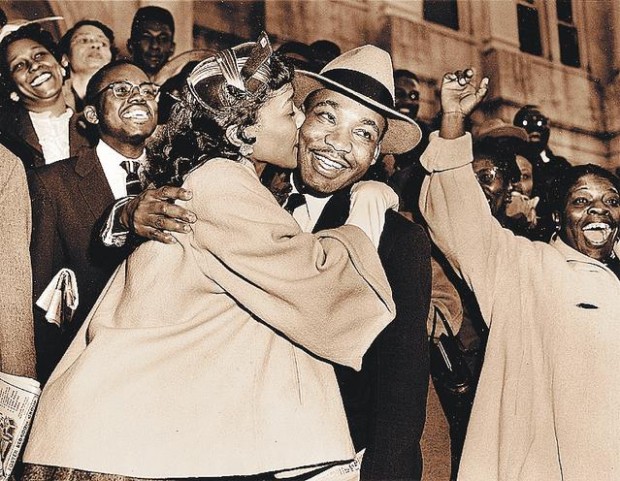
She recalled that on their first date he told her: "You know, you have everything I ever wanted in a woman. We ought to get married someday." Eighteen months later, in 1953, they did.
The couple moved to Montgomery, Ala., where he became pastor of the Dexter Avenue Baptist Church and helped lead the 1955-56 Montgomery bus boycott that Rosa Parks set in motion when she refused to give up her seat on a segregated bus. With that campaign, King began enacting his philosophy of nonviolent, direct social action.
Over the years, Mrs. King was with her husband in his finest hours. She was at his side as he received the Nobel Peace Prize in 1964. She marched beside him from Selma, Ala., into Montgomery in 1965 on the triumphant drive for a voting rights law.
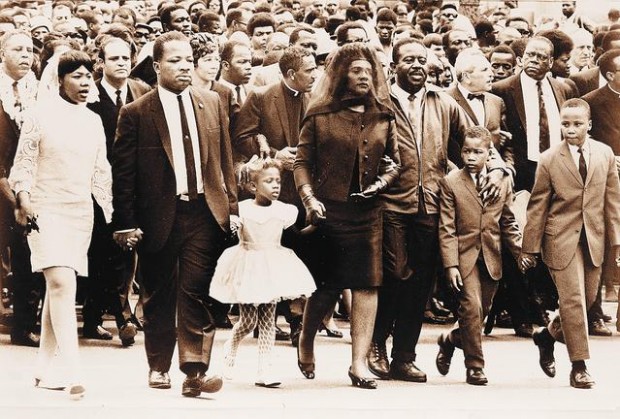
Only days after his death, she flew to Memphis with three of her children to lead thousands marching in honor of her husband and to plead for his cause.
"I think you rise to the occasion in a crisis," she once said. "I think the Lord gives you strength when you need it. God was using us — and now he's using me, too."
Her husband's womanizing had been an open secret during the height of the civil rights movement. In January, a new book, "At Canaan's Edge" by Taylor Branch, put his infidelity back in the spotlight. It said that not long before he was assassinated, King confessed a long-standing affair to his wife while she was recovering from a hysterectomy.
The King family, especially Coretta Scott King and her father-in-law, Martin Luther King Sr., were highly visible in 1976 when former Georgia Gov. Jimmy Carter ran for president. When an integration dispute at Carter's Plains church created a furor, Coretta Scott King campaigned at Carter's side the next day.
She later was named by Carter to serve as part of the U.S. delegation to the United Nations, where Andrew Young was the ambassador.
In 1997, she spoke out in favor of a push to grant a trial for James Earl Ray, who pleaded guilty to killing her husband and then recanted.
"Even if no new light is shed on the facts concerning my husband's assassination, at least we and the nation can have the satisfaction of knowing that justice has run its course in this tragedy," she told a judge.
The trial never took place; Ray died in 1998.
King was born April 27, 1927, in Perry County, Ala. Her father ran a country store. To help her family during the Depression, young Coretta picked cotton. Later, she worked as a waitress to earn her way through Antioch College in Yellow Springs, Ohio.
In 1993, on the 25th anniversary of her husband's death, King said the war in Vietnam that her husband opposed "has been replaced by an undeclared war on our central cities, a war being fought by gangs with guns for drugs. The value of life in our cities has become as cheap as the price of a gun."
In London, she stood in 1969 in the same carved pulpit in St. Paul's Cathedral where her husband preached five years earlier.
"Many despair at all the evil and unrest and disorder in the world today," she preached, "but I see a new social order and I see the dawn of a new day."
● Coretta Scott King continued the legacy of the Rev. Martin Luther King Jr. for almost 38 years.
Born April 27, 1927, in Perry County, Ala.
l June 18, 1953 - Marries the Rev. Martin Luther King Jr.
l February 1959 - A month with husband in India studying Gandhi's techniques of nonviolence
l Jan. 24, 1960 - King family moves to Atlanta
l Aug. 28, 1963 - King delivers "I Have A Dream" speech
l Dec. 10, 1964 - King receives Nobel Peace Prize
l April 4, 1968 - King assassinated
l June 26, 1968 - Founded the Martin Luther King Jr. Memorial Center in Atlanta
March 27, 1979 - Testified before Congress in support of a national holiday honoring Martin Luther King Jr.
l Nov. 3, 1983 - President Reagan signed bill, Martin Luther King Jr. National Holiday
l Jan. 20, 1986 - First national celebration of King holiday
l Aug. 16, 2005 - Suffered stroke
l Jan 16, 2006 - Watched 20th anniversary of Martin Luther King holiday
AP


