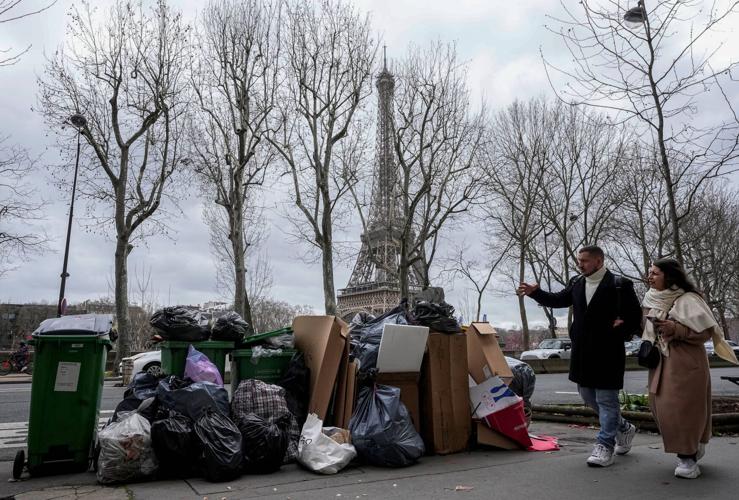
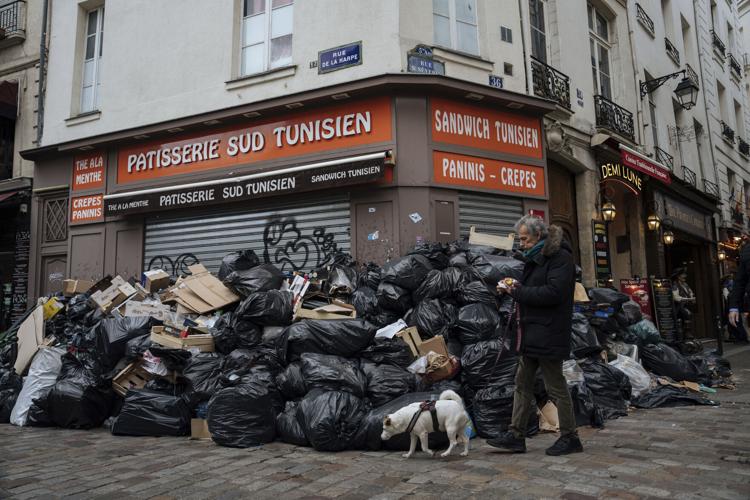
PARIS — The City of Light is losing its luster with tons of garbage piling up on Paris sidewalks as sanitation workers were on strike for a ninth day Tuesday. The creeping squalor is the most visible sign of widespread anger over a bill to raise the French retirement age by two years.

People walk past uncollected garbage near the Eiffel Tower on Sunday in Paris.
The stench of rotting food has begun escaping from some rubbish bags and overflowing bins. Neither the Left Bank palace housing the Senate nor, across town, a street steps from the Elysee Palace, where waste from the presidential residence is apparently being stocked, was spared by the strike.
More than 7,000 tons of garbage had piled up by Tuesday. Some of that was seen being tossed into white trucks from a private company along the protest route ahead of a planned march Wednesday, the third in nine days. Police said the cleanup was for security reasons.
Other French cities are also having garbage problems, but the mess in Paris, the showcase of France, has quickly become emblematic of strikers’ discontent.
People are also reading…

A man walks past piles of garbage Monday in Paris.
“It’s a bit too much because it was even hard to navigate” some streets, said 24-year-old British visitor Nadiia Turkay after touring the French capital. She added that it was "upsetting, to be honest,” because on “beautiful streets ... you see all the rubbish and everything. The smell.”
Turkay nevertheless sympathized with striking workers and accepted her discomfort as being "for a good cause.”
Even the strikers themselves, who include garbage collectors, street cleaners and underground sewer workers, are concerned about what Paris is becoming in their absence.
“It makes me sick,” said Gursel Durnaz, who has been on a picket line for nine days. “There are bins everywhere, stuff all over. People can’t get past. We’re completely aware.”
But, he added, President Emmanuel Macron has only to withdraw his plan to increase the French retirement age “and Paris will be clean in three days.”

A man walks past uncollected garbage Monday in Paris.
Strikes have intermittently hobbled other sectors including transport, energy and ports, but Macron remains undaunted as his government presses ahead with trying to get the unpopular pension reform bill passed in parliament. The bill would raise the retirement age from 62 to 64 for most people and from 57 to 59 for most people in the sanitation sector.
Sanitation workers say two more years is too long for the essential but neglected services they render.
“What makes France turn are the invisible jobs. ... We are unfortunately among the invisible people,” said Jamel Ouchen, who sweeps streets in a chic Paris neighborhood. He suggested politicians go on a “discovery day” to learn first-hand what it takes to keep the city clean.
“They won’t last a single day,” Ouchen said.
Health is a prime concern within the sanitation sector, officially acknowledged with the current early retirement at 57, though many people work longer to increase their pensions. With the exception of sewage workers, there appear to be no long-term studies to confirm widespread claims of shortened life expectancy among sanitation workers.
Still, health reasons were behind Ali Chaligui’s decision to switch his job as a garbage collector for an office position in logistics. Chaligui, 41, says he still suffers after-effects 10 years later, like tendinitis, shoulder and ankle problems.
“Monsieur Macron wants us to die on the job,” said Frederic Aubisse, a sewer worker and member of the executive committee of the sanitation section of the leftist CGT union, at the forefront of the mobilization against the pension plan.
The stakes will be high on Wednesday for both the government and striking workers. Unions are organizing their eighth nationwide protest march since January. The action is timed to coincide with a closed-door meeting of seven senators and seven lower-house lawmakers who will try to reach a consensus on the text of the bill. Success would send the legislation back to both houses for voting on Thursday.
But nothing is certain, and the ticking clock appears to have fed the determination of strikers.
Durnaz, 55, is among those on the picket line at an incineration plant south of Paris, one of three serving the capital — all blocked since March 6. He has only been home twice to see his wife and three children. “It’s cold, it rains, there’s wind,” he said.
Even if the bill becomes law, “we have other options,” said Durnaz. “It’s not over.”
“Nothing is written in stone,” Aubisse, the union official, added. He cited an unpopular 2006 law to promote youth employment that was pushed through by then-Prime Minister Dominique de Villepin despite massive student protests that triggered a political crisis. Months later, it was abandoned in a parliamentary vote.
If the pension reform is voted through, “Things will happen,” Aubisse said. “That’s sure and certain.”
The Most Unionized Industries in the U.S.
The Most Unionized Industries in the U.S.

Photo Credit: Billion Photos / Shutterstock
After decades of declining power and influence, organized labor in the U.S. is making a comeback.
The COVID-19 pandemic has set off a number of shifts in the labor market that have given workers more power. Labor participation rates fell sharply early in the pandemic and still have not recovered to pre-pandemic levels. The Great Resignation saw millions of workers leave their jobs in search of better pay or working conditions. With the labor market still tight, employers have struggled to recruit and retain employees.
In this context, workers have been organizing at rates not seen in decades. One of the most high-profile examples is the union drive at Starbucks stores across the U.S. over the last year. Around 250 Starbucks locations have voted to unionize since the first Starbucks union formed in Buffalo, NY late in 2021. Employees at other major companies have also attempted unionization, including retail and factory workers at Apple and Amazon. And the trend extends to white collar industries like tech, academia, and media, where unionization has historically been limited.
According to the National Labor Relations Board, 1,522 votes on unionization have taken place so far in 2022. This is the highest number of union elections since 2015 and an increase of more than 50% over 2021.
Union membership has sharply declined in recent decades

The recent uptick in unionization could begin to reverse a decades-long decline in union membership rates. The peak of union membership over the last 50 years was in 1979, when 24.1% of American workers were union members. That figure has since fallen by more than half, with only 10.3% of workers in a union as of 2021. In raw numbers, there are nearly 7 million fewer union members in the U.S. now than there were in the late 1970s.
Recent trends in unionization are significant to bother workers and employers. Unionization and collective bargaining materially affect the compensation and working conditions that workers experience, for better or for worse. In turn, these factors can affect employers’ ability to staff their businesses and the overhead costs they must pay to operate.
The difference between union and nonunion wages has also declined

Compensation is one of the most notable differences between unionized and non-unionized workers, as unions are often able to negotiate for higher wages. And as unions’ influence has declined over time, so too has the gap in compensation between union and non-union employee wages. At the height of unionization in the late 1970s and early 1980s, union members made over 30% more per hour than their non-union counterparts. Today, union members continue to earn more than non-union workers, but the gap between the two is just 11%.
The new growth in union membership is unlikely to return the U.S. to historic levels of unionization, and union representation will continue to be stronger in some industries than others. Certain sectors of the economy have significantly higher rates of union membership than others, including transportation, utilities, public administration, and education. At the highest end, some industries have union membership rates greater than 50%.
The data used in this analysis is from Unionstats.com. Researchers at Smartest Dollar calculated the union membership rate for 247 industries, ranking them from highest to lowest. In the event of a tie, the industry with the greater union coverage rate was ranked higher.
Here are the most unionized industries.
15. Administration of economic programs and space research

Photo Credit: Andrey Armyagov / Shutterstock
- Union membership rate: 25.0%
- Union coverage rate: 28.1%
- Total union membership: 138,656
- Total union coverage: 156,072
- Sector: Public Administration
14. Pulp, paper, and paperboard mills

Photo Credit: Sergey Nemirovsky / Shutterstock
- Union membership rate: 25.1%
- Union coverage rate: 26.1%
- Total union membership: 47,959
- Total union coverage: 49,928
- Sector: Nondurable Goods Manufacturing
13. Administration of environmental quality and housing programs

Photo Credit: Viewfoto studio / Shutterstock
- Union membership rate: 25.2%
- Union coverage rate: 28.8%
- Total union membership: 76,932
- Total union coverage: 88,138
- Sector: Public Administration
12. Natural gas distribution

Photo Credit: Zivica Kerkez / Shutterstock
- Union membership rate: 25.6%
- Union coverage rate: 25.6%
- Total union membership: 29,094
- Total union coverage: 29,094
- Sector: Utilities
11. Administration of human resource programs

Photo Credit: mavo / Shutterstock
- Union membership rate: 26.2%
- Union coverage rate: 29.5%
- Total union membership: 332,403
- Total union coverage: 373,761
- Sector: Public Administration
10. Sewage treatment facilities

Photo Credit: People Image Studio / Shutterstock
- Union membership rate: 26.4%
- Union coverage rate: 28.0%
- Total union membership: 30,428
- Total union coverage: 32,259
- Sector: Utilities
9. Public finance activities

Photo Credit: Feoktistoff / Shutterstock
- Union membership rate: 27.2%
- Union coverage rate: 33.0%
- Total union membership: 90,118
- Total union coverage: 109,429
- Sector: Public Administration
8. Foundries

Photo Credit: DedMityay / Shutterstock
- Union membership rate: 29.5%
- Union coverage rate: 29.5%
- Total union membership: 15,053
- Total union coverage: 15,053
- Sector: Durable Goods Manufacturing
7. Air transportation

Photo Credit: ersin ergin / Shutterstock
- Union membership rate: 38.4%
- Union coverage rate: 40.2%
- Total union membership: 231,414
- Total union coverage: 242,337
- Sector: Transportation & Warehousing
6. Elementary and secondary schools

Photo Credit: Ground Picture / Shutterstock
- Union membership rate: 39.1%
- Union coverage rate: 43.6%
- Total union membership: 3,457,197
- Total union coverage: 3,862,835
- Sector: Educational Services
5. Justice, public order, and safety activities

Photo Credit: LightField Studios / Shutterstock
- Union membership rate: 40.9%
- Union coverage rate: 43.2%
- Total union membership: 1,093,245
- Total union coverage: 1,153,724
- Sector: Public Administration
4. Bus service and urban transit

Photo Credit: LeManna / Shutterstock
- Union membership rate: 42.5%
- Union coverage rate: 43.5%
- Total union membership: 190,016
- Total union coverage: 194,251
- Sector: Transportation & Warehousing
3. Rail transportation

Photo Credit: Ryan DeBerardinis / Shutterstock
- Union membership rate: 54.0%
- Union coverage rate: 56.8%
- Total union membership: 107,632
- Total union coverage: 113,299
- Sector: Transportation & Warehousing
2. Postal Service

Photo Credit: Drazen Zigic / Shutterstock
- Union membership rate: 58.8%
- Union coverage rate: 64.1%
- Total union membership: 369,623
- Total union coverage: 403,417
- Sector: Transportation & Warehousing
1. Labor unions

Photo Credit: Billion Photos / Shutterstock
- Union membership rate: 65.0%
- Union coverage rate: 67.0%
- Total union membership: 52,163
- Total union coverage: 53,821
- Sector: Other Services, Exc. Public Admin.