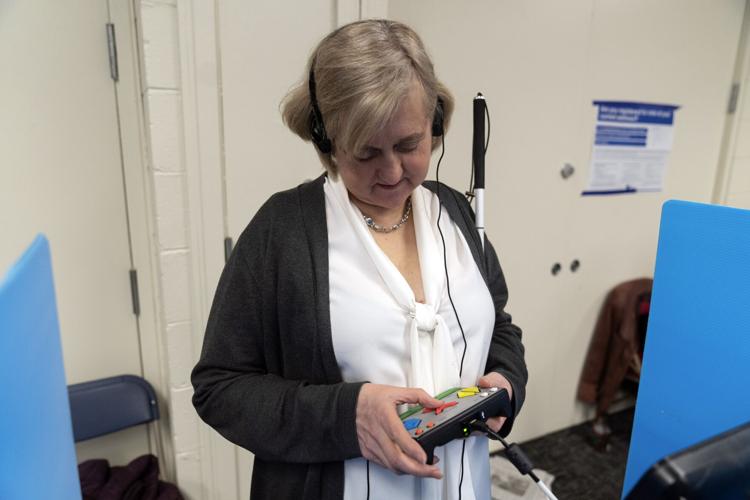
WASHINGTON — Patti Chang walked into her polling place in Chicago earlier this year, anxious about how poll workers would treat her, especially as a voter who is blind. Even though she was accompanied by her husband, she said she was ignored until a poll worker grabbed her cane and pulled her toward a voting booth.

Patti Chang, who is blind, uses headphones and audio along with an electronic controller outfitted with braille to vote in the Chicago mayoral runoff election at the Roden Branch of the Chicago Public Library on March 22 in Chicago.
Like many voters with disabilities, Chang faces barriers at the polls most voters never even consider — missing ramps or door knobs, for example. The lack of help or empathy from some poll workers just adds to the burden for people with disabilities.
“It doesn’t help you want to be in there if you’re going to encounter those kinds of low expectations,” said Chang, 59. “So why should I go vote if I’m going to have to fight with the poll workers? I’m an adult and I should be able to vote without that.”
Chang had a better experience when she cast an early ballot in March in the runoff election for Chicago mayor, even as access to the ballot box remains a challenge across the city for voters like her.
People are also reading…

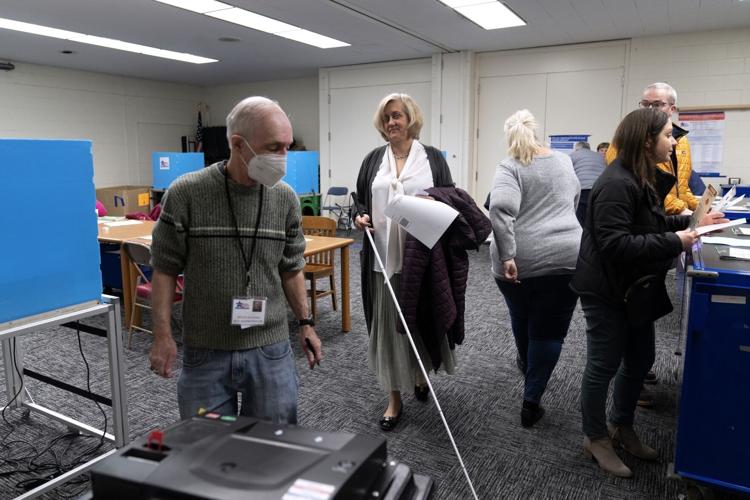
Patti Chang, who is blind, gets help from poll worker Bruce Mocking to vote in the Chicago mayoral runoff election at the Roden Branch of the Chicago Public Library on March 22 in Chicago.
Chicago is among numerous voting jurisdictions across the United States with poor access to polling locations for disabled voters. Since 2016, the Department of Justice has entered into more than three dozen settlements or agreements to force better access in cities and counties under the Americans with Disabilities Act. Many of those places are holding elections this year.
The department’s targets are almost certainly an undercount of the number of places with poor access, according to disability rights activists who attempt to track ADA compliance and complaints from voters.
Several, including Chicago, either missed their deadlines without making all the requested changes or asked for an extension.
Chicago’s agreement with the federal government started in 2017 but has been extended twice; the current deadline is November 2024, the next presidential election. As of February, the city had 302 polling places that complied fully with the ADA and 327 with low accessibility or none at all for disabled voters.
The expense of bringing aging buildings up to code is one challenge in complying, said Max Bever, a spokesperson for the city’s board of elections. Some polling places could be forced to close.
“Things can be identified and surveyed, we can know the status of certain buildings — but actually making and funding the appropriate changes can be a long and difficult process,” he said.
People with disabilities make up about one-fourth of the U.S. adult population, according to the Centers for Disease Control and Prevention. They have been ensnared in battles over access to the polls as many Republican-led states have passed restrictive voting laws in recent years, including over limits on what assistance a voter can receive and whether someone else can return a voter’s mailed ballot.
In Wisconsin, disability rights activists scored a victory when they filed a legal challenge in federal court after the state Supreme Court, with a conservative majority, ruled that only the voter can return an absentee ballot. The federal court said that ran afoul of the Voting Rights Act. Nevertheless, voters with disabilities complained that the federal law was being ignored in the run-up to Wisconsin’s high-stakes election Tuesday, when control of the state’s high court flipped.
They said local election officials throughout Wisconsin were giving incorrect information on websites, in mailings and at polling places saying voters can’t receive help or have someone else return their ballot — without making the distinction that such assistance is allowed for voters with disabilities.
Disability must be considered a fundamental right to enhance accessibility throughout the country, said Herbert Humphrey, the ADA coordinator for Jackson, Mississippi.
“Typically, when you hear civil rights, you think about race. But no, civil rights includes the disability community, as well,” he said.

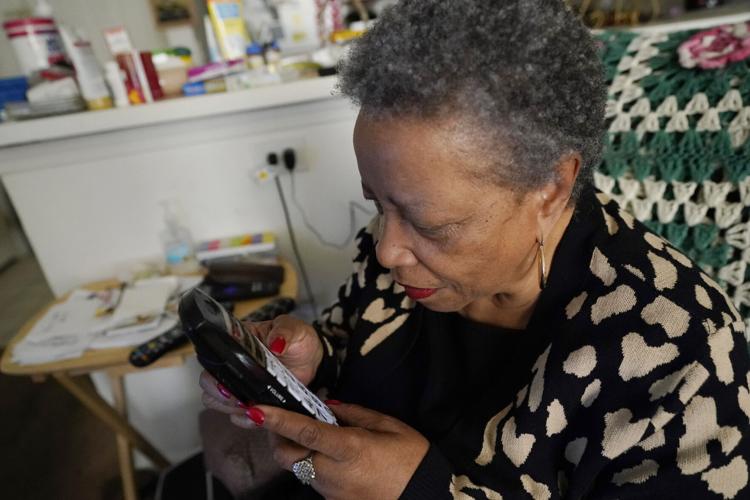
Lee Cole, 74, who is blind, uses a cordless telephone with enlarged numbers so she can make phone calls March 24 at her Jackson, Miss., apartment.
Disjointed coordination between election authorities and disability advocates has been a persistent problem in Mississippi, especially related to reliable transportation. It was the reason Lee Cole, who is blind, missed a local election in Jackson in January.
That frustrated Cole, 74, because she said she tries to vote in every election.
“I live in senior housing now and we can’t always vote because we can’t get to the site, and that’s unfortunate,” she said.
Mississippi’s local and state officials haven’t been receptive or collaborative, said Greta Kemp Martin, litigation director for Disability Rights Mississippi.
Before the COVID-19 pandemic, Martin said the group met with Mississippi Secretary of State Michael Watson to discuss accessibility issues statewide. But Martin said Watson seemed uninterested, except when asking if the group had reached out to the election commission.
“His attorneys were helpful, but we received no follow-up from them about the issues that we outlined,” Martin said.
Watson’s office said in a statement that it has communicated its efforts to the organization to best assist voters with disabilities in Mississippi and welcomes further dialogue for future elections.
“Ensuring ADA compliance in localized polling places lies with each county, and the Mississippi Secretary of State’s Office does not have enforcement authority,” the statement said. “Whether the designated polling places are county-owned or privately-owned, the counties are responsible for ensuring the polling places they have selected are ADA compliant.”
Smart devices that could improve the lives of people with disabilities
Smart devices that could improve the lives of people with disabilities

It’s estimated that 1 in 4 adults in the United States lives with a disability. These may range from physical and motor impairments caused by conditions like cerebral palsy to memory loss resulting from Alzheimer’s. The category of adults with disabilities is varied and many individuals have needs that are unique to their lifestyle, age, and condition. But new smart devices are increasingly offering convenient solutions that can offer support for diverse needs.
IoT Secure compiled a list of smart devices that have additional utilities for people with disabilities from a collection of news and expert reports. These innovations include some of the underlying mechanisms that power smart devices like voice-activated assistance and the use of movement sensors. Some have systems that coordinate home monitoring devices that can reduce or report elderly falls, as well as apps users can control from their smartwatches. Wristband devices have the advantage of being less likely to be dropped—or lost somewhere in the house—than a cell phone.
Many adults with disabilities need a little bit of support in order to live independently and maintain their best quality of life, and smart devices may help.

Voice assistants

One of the major ways internet of things, or IoT, can help make life more convenient is by letting smart devices interface using voice commands. For people that have difficulty typing or coordinating hand movements, this can make it easier to write emails, memos, or other reports. Instead of typing on a keyboard, they can use their voice to complete tasks with much less friction.
For users in the home, anyone can use voice search to set up reminders, access entertainment, search education resources, and more. This can be especially convenient for those with mobility challenges, who can call out to devices from almost anywhere, reducing the need to make extra trips around their house or type with many different devices.
Video doorbell

A video doorbell is a great option for people with motor disabilities or visual impairment because it takes away the mystery of whether someone is at the door—and who it might be.
Even if someone can’t make it to the door in time to be handed their package, they’ll have a way to see who stopped by and follow up as needed. This reduces stress and the risks of the elderly falling while hurrying to the door. Using an intercom, residents can speak with whoever is outside to leave instructions for packages and other deliveries. This also makes it safer so they don’t need to open the door to strangers.
Smart locks

It’s been decades since keycards started to take over the world of hotels, and drivers have enjoyed keyless ignition in their cars for years. But home locks have lagged behind, still usually requiring metal keys and a mechanical tumbler with deadbolt locks that are operated by hand.
But IoT devices also extend to smart locks, which can be operated by voice or by app access through a phone or other device. Users can open their front doors to visitors without having to make a trip from the kitchen or even the backyard. For those prone to memory loss—or losing their keys–this also makes it faster and safer to get home safely.
Smart light bulbs

Smart light bulbs were one of the first IoT home devices offered to consumers, and timers and customized dimmers can be controlled remotely. These are great in general because they allow a tailored experience without having to call an electrician to rewire a switch or light fixture.
For people with disabilities, they offer access to lighting without having to fumble in the dark reaching the switch. They have long lifetimes, so it also saves the effort of getting on a ladder to change hard-to-reach ceiling bulbs. When combined with the right sensors, they can also do important work like flashing when someone approaches the front door—one of the major ways hard-of-hearing or deaf individuals have used their doorbells for decades.
Robotic vacuum cleaners

Vacuuming a home is a surprisingly taxing task. It’s physical in the sense of pushing the vacuum cleaner around the house but also stooping to plug and unplug the machine and navigating the vac under beds or other pieces of furniture in the home. Robotic vacuum cleaners like Roomba can cut down on the number of times someone must manually vacuum their home. This is helpful for people with physical disabilities but can also help those with memory issues, reducing the need for them to remember and complete a task.
Smart security systems

Smart security systems do a lot more than simply monitor the perimeter for intrusion. Although they do monitor for unwanted visitors, these devices can also observe your home for a host of issues, like leaky plumbing or an increase in basement humidity, both of which could cause significant property damage. Sensors are able to detect a movement that’s out of the ordinary, giving people more information about what’s going on in their homes. These tools help all homeowners, but especially those who may face mobility and physical challenges that limit their access to attics, stairs, and under-the-house crawlspaces.
Smart watch

The smartwatch is one of the most recognizable and popular IoT devices, turning a regular timepiece into a remote control for our digital lives. The smartwatch can be equipped with apps to call emergency services in case of a fall and injury. It can monitor health information like heart rate and activity level for people who may have cognitive disabilities and can’t self-report this data to relatives and physicians. The smartwatch can also interface with almost anything else run by an app, making it an even more convenient way to interact with smart doorbells, security systems, and more.
Smart smoke detector

The classic smoke detector is loud and mounted on the ceiling, both of which make sense for what the device is doing. But with smart technology, people no longer have to climb on a stepladder to turn off the smoke detector. A smart smoke detector can even send a phone alert before its loud sound is triggered, letting users address the problem without a disruptive and upsetting noise experience. Once the detector is set up in its position on or near the ceiling, it can be controlled almost entirely remotely.
Video-conferencing devices

Videophones date back decades but connecting these devices to Wi-Fi means they can be accessed anytime with little effort. People can check in with loved ones to ask about daily routines and “visit” with elderly relatives on a regular basis, even if they live far away. Having devices “always online” also reduces the friction in using them, meaning older adults may be more likely to use the devices both to ask for help and also simply to socialize. It’s easy to switch on a call and see and talk with a friend while cooking dinner, for example, or for speaking to relatives and close friends, even without leaving the bed.
Smart sensors

Many of the devices on this list rely on specific sensors. But together, a full set of sensors can take away a lot of the uncertainty and anxieties from aging in place alone. Imagine a home where you know anytime a window is opened or where the lights turn on, triggered by motion detectors. For someone living independently, this could help in feeling more secure against burglaries. For those monitoring loved ones who need a little bit of support, this could mean peace of mind that their elderly parents or aging disabled relatives are sleeping soundly.
This story originally appeared on IoT Secure and was produced and distributed in partnership with Stacker Studio.