DENVER — Every weekday at 5280 High School in Denver starts the same way.
Students in recovery from drug and alcohol addiction gather on the steps of the school’s indoor auditorium to discuss a topic chosen by staff members. One recent morning, they talked about mental health and sobriety. A teenage boy dressed in tan corduroys, a black hoodie, and sneakers went first.
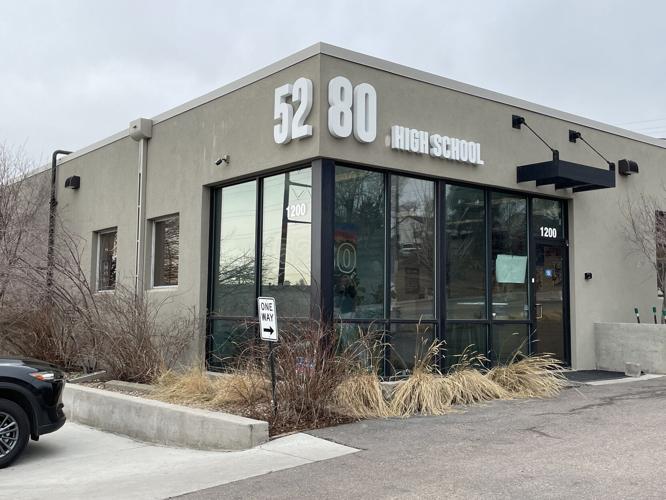
Denver's 5280 High School is one of 43 secondary schools in the U.S. with a program designed for students recovering from substance use disorder and related mental health disorders.
“I didn’t want to have, like, any emotion,” he said. “So I thought, like, the best way to, like, put it down would be to do more and more and more drugs.”
A classmate said she started doing drugs for fun and then got hooked. Another student said his addiction negatively impacts his mental health. A third announced an upcoming milestone.
“In, like, two days, I’ll be six months sober,” she said, as her classmates cheered.
People are also reading…
The students attend Colorado’s only recovery high school — one of 43 nationwide. These secondary schools are designed for students who are recovering from substance use disorder and might also be dealing with related mental health disorders. The Denver school opened in 2018 as a public charter school that today enrolls more than 100 students annually.
One of those cheering classmates was sophomore Alexis Castillo, 16, who listened supportively during that recent morning meeting. She is in recovery for alcohol and fentanyl addictions. Several of her friends attended the school when she enrolled during her freshman year and initially loved it. But after a while some of Castillo’s friends left and she grew disillusioned. She stopped going to class and wasn’t motivated to work her recovery steps.
“They give you a lot of accountability,” she said. “That was not something I wanted.”
Castillo relapsed and school staffers helped her get into rehab. Three months later, she was back at the school, sober and ready to do the work.
The school’s mission is to help kids learn to live a substance-free life while receiving an education.
“They can go on to college or a career and really handle anything that life throws at them,” said 5280’s founder and executive director, Dr. Melissa Mouton.
In 2022, nearly a third of 12th graders and 1 in 5 10th graders reported using an illicit drug in the previous year, according to a national survey from the Monitoring the Future project conducted by the University of Michigan Survey Research Center. Those numbers have steadily decreased over the past 25 years. However, data from UCLA shows overdose deaths among teens doubled in the first year of the pandemic, mainly attributed to the increased prevalence of fentanyl-laced drugs.
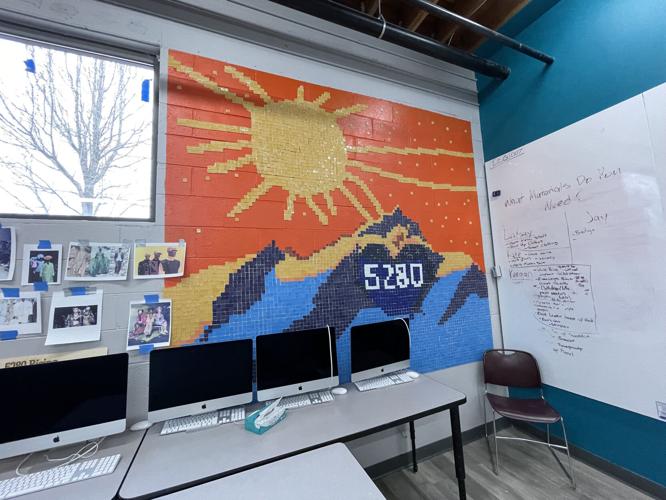
A mosaic in the computer lab at 5280 High School in Denver.
The first recovery high school opened in Silver Spring, Maryland, in 1979 and similar programs now operate in 21 states. Compared with their peers at regular schools who have gone through treatment, recovery high school students have better attendance and are more likely to stay sober, and their graduation rate is at least 21% higher, according to one study.
“For this particular group of young people who have these disorders, this can be a lifesaver,” said John Kelly, director of the Recovery Research Institute at Massachusetts General Hospital. “It can help them create a social norm of recovery.”
There are three components to effective drug and alcohol treatment, according to Dr. Sharon Levy, a pediatrician and addiction medicine specialist at Boston Children’s Hospital. The first part is medical, which includes seeing a doctor, drug testing, and using medications like buprenorphine to treat opioid addiction. The second is emotional support from counseling to address co-occurring mental health disorders. And there is a behavioral health component that, for kids, can include recovery schools.
“Recovery schools offer an opportunity really for peer support and mutual aid in a kind of a supervised and structured way,” Levy said.
Recovery high schools often weave components of treatment into the school day — activities like 5280’s daily recovery program meeting. In the afternoon, the school offers wellness electives such as basketball and journaling.
Recovery schools do face challenges. Most are publicly funded charter or alternative schools that carry a higher cost of educating students than traditional schools do. This is due to a smaller enrollment, the need for mental health and recovery personnel, higher faculty-to-student ratios, and other factors.
The Denver school enrolls about 100 students annually, making it one of the biggest recovery high schools in the nation. This year, the per-pupil cost is about $25,000 but the school receives only about $15,000 from federal, state, and local funding, Mouton said. The remaining money comes from donors.
Given the complex needs of the students, “recovery schools will always be small,” she said.
Pooling such students together may also raise a concern that students will trigger one another to use drugs and alcohol and relapse, but, Levy said, that’s a risk with any social interaction.
“So, if you’re in an environment where the recovery is kind of front and center and people are watching and monitoring and supervising,” she said, “I think that’s helpful for a lot of kids.”
Where do US opioid trials and settlements stand?
Explaining the current state of the opioid crisis
Three trials are underway now, in Florida, West Virginia and Washington state. New legal settlements are being reached practically every week to provide governments money to fight the crisis and in some cases funds for medicines to reverse overdoses or to help with treatment.
In all, more than 3,000 lawsuits have been filed by state and local governments, Native American tribes, unions, hospitals and other entities in state and federal courts over the toll of opioids. Most allege the industry created a public nuisance in a crisis that has been linked to the deaths of 500,000 Americans over the past two decades.
Collectively, businesses already have faced settlements, judgements and civil and criminal penalties totaling more than $47 billion. The main entities targeted are the companies that manufactured and sold the pills; the businesses that distributed them; and the pharmacies that dispensed them.
Here's an overview of the litigation and settlements involving the various companies:
Purdue Pharma
Purdue is the maker of OxyContin, an extended-release version of oxycodone that packed higher doses into pills. The drug, released in 1996, became a heavily marketed blockbuster drug — and is associated closely with the epidemic's first wave.
Like other opioids, it was promoted not just for post-surgery and cancer pain but for chronic pain — an area where doctors previously were reluctant to prescribe such powerful drugs.
Faced with thousands of lawsuits, the company went into bankruptcy protection in 2019 to help reach a settlement.
A deal is now in place, but it's not final.
It calls for members of the Sackler family who own the company to give up their stakes, making way for it to become a new entity — to be known as Knoa Pharma — with profits funding the fight against the opioid crisis. Additionally, family members are to pay $5.5 billion to $6 billion over time, with a portion of the money going to victims.
Earlier this year, three members of the family attended an online hearing in which parents described losing children to addictions that started with OxyContin, and people recovering from addictions described their journeys.
As part of the exchange, Sackler family members would get protection from lawsuits over opioids.
For the settlement to be finalized, a higher court must overturn a judge's ruling that threw out an earlier version of the deal. A hearing on that is scheduled for April 29 before the U.S. 2nd Circuit Court of Appeals.
In the meantime, activists and some U.S. senators are asking the Justice Department to consider charges against family members.
Other drugmakers
In a major court victory for drugmakers last year, a California judge ruled against some local governments in their case against pharmaceutical companies Johnson & Johnson, Endo International and Teva Pharmaceutical Industries.
Some of those drugmakers — Johnson & Johnson, Allergan and Teva — are now on trial in West Virginia.
But companies have largely been settling suits.
Mallinckrodt, which was a leading producer of generic oxycodone, also used bankruptcy court to reach a settlement, agreeing to a $1.6 billion nationwide deal in 2020.
Johnson & Johnson has agreed to a $5 billion nationwide settlement. It was announced alongside a separate settlement involving the three biggest drug wholesalers. The company's Janssen subsidiary stopped selling its fentanyl patches and pain pills in the U.S. in 2020. J&J was also the first drugmaker to be held liable for the opioid crisis in a trial, though the Oklahoma Supreme Court later overturned the ruling.
Endo made the opioid Opana, which was eventually removed from the market. The company has been reaching individual settlements with states. Deals since last year with Florida, New York, Texas, West Virginia and some district attorneys in Tennessee have totaled well over $200 million.
Late last year, a New York jury found Teva partly responsible for the state's opioid crisis through its marketing of the fentanyl drugs Actiq and Fentora. Most of the other companies the state and two counties sued settled before or during a trial last year. A separate trial is to be held to determine damages.
Since the New York trial, Teva has reached settlements with Texas, Florida and Rhode Island totaling more than $250 million. It will also provide drugs to reverse overdoses and treat addictions.
Allergan, now a subsidiary of AbbVie, has been settling suits involving the extended-release morphine pill Kadian. It reached one major settlement with New York last year. Since then, it has been part of the multi-company settlements in Florida and Rhode Island.
Executives from drugmaker Insys were convicted in 2019 of bribing doctors across the U.S. to prescribe their sublingual fentanyl spray Subsys. Company founder John Kapoor was sentenced to 5 1/2 years in federal prison.
The company also paid $225 million to resolve federal investigations into allegations that it paid kickbacks and used other illegal marketing tactics.
Distribution companies
The three big national companies — AmerisourceBergen, Cardinal Health and McKesson — finalized their settlement, worth a total of $21 billion over 18 years, in February.
The deal, combined with Johnson & Johnson's, is expected to be the single biggest settlement between companies in the drug industry and governments.
The total amounts include separate settlements covering all federally recognized Native American tribes.
With settlement money starting to flow to state and local governments, officials are figuring out how to prioritize it. The funds are arriving at a precarious time: The number of U.S. overdose deaths from all drugs topped 100,000 in a 12-month period for the first time last year. The majority of those deaths are from opioids — and particularly illicit synthetic versions including fentanyl.
Unlike the tobacco settlements of the 1990s, there are safeguards intended to steer most of the opioid settlement funds to addressing the crisis. Public health experts have ideas for how to do that, but the decisions are up to government officials.
The distribution companies also went to trial last year in West Virginia. A judge has not yet ruled.
Closing arguments in Washington state's trial against the distributors are expected this week.
Pharmacies
Pharmacy chains have been sued less often than companies that make or distribute opioids. In one groundbreaking case, a federal jury in Ohio last year found CVS, Walgreens and Walmart recklessly distributed massive amounts of pain pills in Lake and Trumbull counties.
Late last month, CVS settled in Florida. That left Walgreens to go to trial Monday.
Consulting company
Global consulting firm McKinsey & Company also reached deals last year with the states, Washington, D.C., and U.S. territories for advising businesses on how to sell more prescription opioids amid the overdose crisis. Those settlements totaled more than $600 million.
A group of U.S. senators is pushing for a federal investigation, saying there were conflicts when the company consulted on opioid-related issues both for companies and the U.S. Food and Drug Administration.