

Charging gold prices for rent; Puppies for Parole; no tests at this school
- Updated
Odd and interesting news from the Midwest.

- By MITCHELL KIRK Pharos-Tribune
- Updated
LOGANSPORT, Ind. (AP) — Tree stumps line the Wabash River's bank along Little Turtle Waterway in Logansport, their tops covered in teeth marks angling up to a point.
"It's amazing how quick they can cut them down," said Ralph Sherrill, a volunteer for the waterway.
He's referring to beavers and how their increased presence in the area has led to a decreased presence of vegetation the nonprofit responsible for the waterway would like to preserve.
Volunteers have been executing a plan to safeguard trees without evicting the river rodents.
"We want to protect anything that has any kind of berries on it for the bird population we have," Sherrill said, like wild cherry trees.
Patrick Mayer, north region private land supervisor with the Indiana Department of Natural Resources Division of Fish and Wildlife, said beavers can grow 3 to 4 feet long and weigh 30 to 70 pounds. They use their webbed back feet to swim while using their broad tails as a rudder to steer.
Beavers are most active at night, Mayer continued, adding they feed on bark, aquatic leaves and shoots. Females give birth to litters of three to four kits in the spring or early summer.
They get the tree trunks, limbs, branches, sticks and twigs for their lodges by chewing them down with the two middle teeth on the top and bottom rows of their jaws. Beavers mix the wood with mud to build up the floor of their lodge from the bottom of a water source up to the surface. They use the same materials to erect the dome over top. The chamber inside can be accessed by at least one tunnel leading up from under the water.
"They're pretty ingenious little dudes," Mayer said. "They just get in the wrong spot. Like any wildlife, they don't know boundaries."
Sherrill is boggled by the beavers' presence on the Wabash River, figuring they'd prefer smaller water sources like the ponds north of Logansport off of Ind. 17 that are regularly dotted with lodges.
He suspects the Wabash River beavers are living within the piles of logs and branches on an island near the confluence with the Eel River.
A beaver swam in from that direction on a recent night. It never came ashore to do any gnawing, however, perhaps spooked by the two fisherman with flashlights nearby.
Mayer said it's not uncommon for beavers to reside on rivers despite their width. Rather than damming the entire channel, which they'll often do across creeks and streams, they'll burrow into the riverbank and use mud to adhere limbs, branches and sticks in front of the entrance.
Little Turtle Waterway volunteers have been wrapping the bases of trees they want to protect with wire mesh to block beavers from chewing them down.
"That's going to be one of our big projects this spring and summer," Sherrill said.
Sherrill doesn't mind if the beavers take some trees, he said, just as long as they're not the kind that draw birds to the trail with their fruit.
Mayer called wire mesh an effective tactic. He also said the beavers' behavior along Little Turtle Waterway meets the criteria of a nuisance animal, which landowners can kill without a permit in Indiana.
The most effective way to handle beavers, Mayer said, is to take advantage of the trapping season, which lasts from the middle of November through the middle of March.
One of the larger stumps between Little Turtle Waterway and the river is about 27 inches around.
Sherrill pointed out one tree a beaver started on before leaving partway through. Another tree was chewed down by one of the rodents but was left along the bank.
Mayer said that's not necessarily unusual, explaining the beaver or group of beavers responsible for the chopping likely got scared and ran off before being able to finish the job. Oftentimes they'll chew for no other reason than to keep their four chopping teeth in shape, he added.
Beavers have been busy off and on along Little Turtle Waterway over the past few years, Sherrill said, adding it wasn't always that way.
"At one time in this area, beavers were just unknown," he said.
That didn't surprise Mayer, who explained populations ebb and flow. While owls and coyotes are known to nab kits from time to time, beavers' main predators are people, he said.
Mayer stressed beavers are scared of people and chances of an attack are extremely low unless they're cornered.
___
Source: (Logansport) Pharos-Tribune, http://bit.ly/1WeAtAC
___
Information from: Pharos-Tribune, http://www.pharostribune.com
This is an AP-Indiana Exchange story offered by the (Logansport) Pharos-Tribune.

- By ZACH PLUHACEK Lincoln Journal Star
- Updated
LINCOLN, Neb. (AP) — He started in grad school, buying bulk bags of tan bricks when his budget allowed and piecing them together over the course of five years.
John Tooker's Nebraska State Capitol now stands 3 feet tall, and consists of 25,755 bricks, the Lincoln Journal Star (http://bit.ly/26gKQIN ) reports.
It's 1/140th the size of the actual building, with Lego landscaping that's accurate down to the single bush.
"I meant for it to be a little bit smaller," the 29-year-old said last week, his masterpiece filling two tables in the dining room of his Country Club neighborhood home.
Tooker, a lifelong Lincoln resident and Lego fan, spends his days working as a computer engineer at EFJohnson, which manufactures two-way radios for police and firefighters.
Nights and weekends are Lego time.
"Legos engulf our life," says his wife, Nicole. "He's always sorting them. He's always doing something with them.
"His creativity shines through on this."
John is a member of the Lincoln and Omaha Lego User Group, or LOLUG, a community of adult Lego enthusiasts who meet regularly to talk about their custom sets called My Own Creations, or MOCs, which they display in annual shows and in pictures online.
In 2014, he tried to visit Texas' Legoland theme park by himself and was turned away because he didn't take along a kid. He returned last year with Jessica, his 3-year-old daughter.
His creations are tucked in corners all over the Tookers' living room: a dragon, a castle, a half-dozen LEGO roses he gave to Nicole for Valentine's Day, the Lego cake topper he made for their wedding.
A wall in their basement is stacked with plastic containers, an elaborate and always-changing filing system for tens of thousands of Lego pieces.
On his desk at work: another dragon, another castle.
He's built dozens of Lego castles over the years, none as massive as the Capitol.
"I've seen a lot of other people's projects and just wanted to do something as grand as they have," he said.
The tower, which John designed on his computer and finished first, has been displayed at six or seven LOLUG shows over the past few years. The rest of the building came together through trial and error, and first appeared in an expo at Omaha's Lauritzen Gardens last year.
It draws attention at those shows, something original and unique to Nebraska.
"Some people even say thank you," he said.
When it isn't on display, he stores the Capitol in 13 sections in boxes in his basement.
He doesn't plan to dismantle it, and would consider giving the set to a museum someday, he said.
"As long as I could keep seeing it, that'd be fine."
___
Information from: Lincoln Journal Star, http://www.journalstar.com
An AP Member Exchange shared by the Lincoln Journal Star.
- Updated
TOPEKA, Kan. (AP) — A 24-year-old Topeka man faces charges accusing him of dragging a police officer during a traffic stop.
The Topeka Capital-Journal reports (http://j.mp/1SkbUB0 ) that Dyllon Alan Tucker is charged with aggravated kidnapping and other charges stemming from the incident April 14.
Authorities said the officer stopped an SUV driven by Tucker, who then assaulted the officer and drove away, dragging the officer who had her arm in the car. As she was pulled down the street, the officer opened fire and wounded Tucker.
The officer was treated at a hospital and released.
The charges against Tucker were filed late Tuesday and became public Friday.
It's unclear if Tucker has a lawyer. He's being held in the Shawnee County Jail on a $500,000 surety bond.
___
Information from: The Topeka (Kan.) Capital-Journal, http://www.cjonline.com
- Updated
SPRINGFIELD, Mo. (AP) — A Springfield third-grader is selling lemonade to help pay for his adoption.
Nine-year-old Tristan Jacobson sold $1 lemonades Friday in front of the home he shares with Donnie Davis and her husband, Jimmy, who have been Tristan's kinship guardians since Tristan was 5.
The Springfield News-Leader reports (http://j.mp/26lC9gj ) the money from the lemonade stand and a weekend yard sale will go toward helping pay about $5,000 in legal fees so Tristan can be adopted.
Donnie Davis says she and her husband already consider Tristan their son. She says the adoption is "more for reassurance for him, knowing that he has his forever family and he has our name."
___
Information from: Springfield News-Leader, http://www.news-leader.com
- Updated
LINCOLN, Neb. (AP) — A 22-year-old Lincoln man has been sentenced to eight to 10 years in prison for having sex with a 12-year-old girl.
The Lincoln Journal Star reports (http://bit.ly/1TpBhAb ) that Dakota Campbell was sentenced Thursday in Lancaster County District Court after pleaded no contest to third-degree sexual assault of a child and felony child abuse.
Police say the sexual abuse was reported after the girl told a friend of the family, who told her father.
Court records say the girl left her home in January 2014 and had sex with Campbell at a friend's house. She told police Campbell told her not to tell anyone, because he would get into trouble.
Campbell will have to register as a sex offender when he's released.
___
Information from: Lincoln Journal Star, http://www.journalstar.com
- Updated
WARSAW, Ind. (AP) — A northern Indiana teenager who was 12 years old when he helped kill his friend's stepfather has a shot at freedom.
Paul Henry Gingerich turned 18 in February, and under a state law that bears his name, a judge can now consider three alternative sentencing options, including Gingerich's release. The judge could also transfer him to adult prison to serve the remainder of his 25-year sentence or place him on probation, home detention or work release.
Gingerich was believed to be the youngest person in Indiana to be sentenced as an adult. His case sparked an outcry that led to legislation known as "Paul's Law," which allows alternative sentences for juveniles who commit serious crimes.
Gingerich appeared Friday in a Kosciusko County courtroom for a hearing on those options, the Indianapolis Star reported (http://indy.st/1Quf5QL ). Gingerich's attorney, Monica Foster, is asking for probation or home detention. A decision is likely by summer.
"There is simply no legitimate penological purpose to be served by committing Paul Gingerich to further incarceration," Foster wrote in court records. "Indeed, to commit Paul Gingerich to an adult prison would run a very real risk of destroying the progress that has undeniably been made by this young man."
Gingerich and then-15-year-old Colt Lundy shot and killed Lundy's stepfather, Phillip Danner, in 2010 at his home near Lake Wawasee, about halfway between Fort Wayne and South Bend. Each boy fired two shots, hitting the 49-year-old man four times. The slaying was part of a plot by the boys and another friend to run away to California or Arizona.
The lead investigator on the case, John Tyler, ran through details of the crime at Friday's hearing.
Pendleton Juvenile Correctional Facility Superintendent Alison Yancey also testified, speaking about Gingerich's progress while in custody, including his becoming an honor student and his participation in community services.
The Indiana Department of Correction has determined that Gingerich has a low risk of re-offending.
Judge James Heuer called his progress "impressive" but also said he has to consider the victim's family, some of whom attended Friday's hearing.
Danner's family didn't make a statement in court and left immediately after the hearing.
___
Information from: The Indianapolis Star, http://www.indystar.com
- Updated
HAMILTON, Ohio (AP) — A southwest Ohio man is charged in federal court after authorities say he made arrangements to purchase a child for sex.
The Dayton Daily News reports (http://bit.ly/1SWOz41 ) the Butler County Sheriff's Office says 39-year-old Craig Maher admitted to agents during a search of his Fairfield Township home Thursday that he planned to drug and sexually assault the child and photograph the acts.
Court documents say the investigation began when an informant told authorities Maher contacted them online saying he was seeking a young girl to have sex with.
Maher allegedly told the informant he'd pay up to $500 for sex acts with a child.
He's charged in federal court with attempting selling or buying of children in matters involving child pornography.
The sheriff's office says more charges against Maher are possible.
___
Information from: Dayton Daily News, http://www.daytondailynews.com
- Updated
HAMILTON, Ohio (AP) — Injury and property crashes have increased with the raising of speed limits on the state's rural interstate highways, according to the Ohio Highway Patrol.
The highway patrol said that there's been a 21 percent increase in crashes on interstate highways where the speed limit has been raised to 70 miles per hour since 2013, The Hamilton-Middletown Journal-News reported (http://bit.ly/1SBEVdd).
Highway patrol troopers have investigated nearly 334,000 crashes on all roads, state routes and interstate highways from 2011 through 2015.
A state analysis showed that crashes jumped by 19 percent— from about 8,600 in the two years before the increase to about 10,200 in the two years after.
The patrol said that during that same time, fatalities decreased slightly from 48 to 43.
"Motorists have to understand that as speed (of the car) increases, the reaction time decreases to adjust to conditions such as changing lanes, an object in the road, something falling off a truck or a deer crossing the road," said Lt. Craig Cvetan, the Ohio Highway Patrol's public affairs commander.
In 1987, Congress relaxed a restriction that required states to adopt a maximum speed limit of 55 miles per hour in order to receive highway funds. Lawmakers allowed states to increase speed limits to 65 miles per hour on rural interstates. The law was completely repealed in 1995.
Maximum speed limits are set by the states and have been on the rise since then, the newspaper reported.
- Updated
CAPE GIRARDEAU, Mo. (AP) — A dog left abandoned, then trained by prisoners, is now helping a Southeast Missouri State University student deal with an often-debilitating disorder.
The Southeast Missourian (http://bit.ly/23JZmtT ) reports that 19-year-old Marissa New suffers from sensory processing disorder, which hinders her ability to properly organize appropriate responses to sensory signals.
People with disorder can have varying challenges, such as hyper- or hyposensitivity to certain stimuli. Marissa is affected by sensory overload, a condition that occurs when the body's senses becomes overwhelmed or overstimulated.
"Your sensory system is out of sync, basically, so things are intensified -- touch, smell, taste, everything. Everything is intensified," she said.
Sound affects her the most, and the overload can result in migraines and "shutdowns," where her vision becomes blurred, her hearing is muffled and communication becomes difficult.
She decided to apply for a service animal. In October, she welcomed Creed, a 2-year-old mixed breed and a graduate of the Missouri Department of Corrections' Puppies for Parole program. In the program, rescue dogs are paired with inmates at several Missouri prisons, who spend months training and socializing the dogs to make them suitable for adoption.
Many of the dogs get even further training, allowing them to serve as therapy dogs that visit hospitals, schools or nursing homes, mobility dogs for those in wheelchairs, or service dogs for children with autism or people like Marissa who have needs that a dog can help.
"He's my hero," she said of Creed.
She has taught Creed several ways to help mitigate her disabilities.
"It took me about a month and a half to train him with all of the tasks," she said. "He caught on really quickly and he's a very, very smart dog."
Creed now knows four tasks. He watches Marissa's back when people are behind her; he blocks strangers to keep them a certain distance from her; he applies deep pressure on her lap, chest or legs to help regulate her sensory system; and he stops unwanted anxious behaviors like fidgeting or scratching.
Creed also knows to look both ways when crossing a street — something Marissa may need help with if she is experiencing a shutdown; and he can sense a pending shutdown, then helps her get to a safe location to prevent falling.
The dog has helped her gain independence.
"Before I had him I was basically locked away in my dorm room all the time, and now I'm able to go out and do normal things," she said.
Marissa's twin sister, Lexi, also has a service dog, Izzy. The two were paired in 2013 after Izzy was diagnosed with postural orthostatic tachycardia syndrome, a neurological condition that affects the autonomic nervous system and causes migraines, an abnormally rapid heart rate and temporary losses of consciousness due to sudden decreases in blood pressure.
Izzy alerts Lexi to her changes in heart rate and when she might be at risk of passing out or fainting, then helps her retrieve a phone to call for help. The dog barks to alert others if Lexi passes out or needs help.
"Not only does she help me physically, but she helps me socially, as there are many nights that I can't hang out with my friends and she provides the companionship for when I am sick and by myself," Lexi said.
___
Information from: Southeast Missourian, http://www.semissourian.com
- By STEVE MOSELEY York News-Times
- Updated
YORK, Neb. (AP) — Age arrives with a variety of potential challenges, from mental and physical to financial difficulties and more.
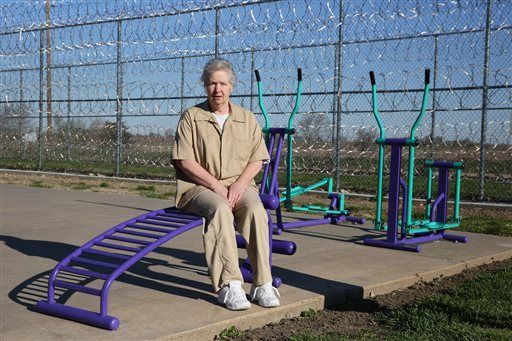
Wilma Castor's senior citizen years have been — and will continue to be — spent behind razor wire at the Nebraska Correctional Center for Women, the York News-Times (http://bit.ly/26gI4TN ) reports.
Castor, 67, and the most elderly woman in the 348-inmate population, has spent the last 20 years locked away following her 1997 conviction for first-degree murder as well as six other felonies and a misdemeanor in Buffalo County.
Her son, Eddy, was convicted of being an accessory to murder in the shooting death of Castor's ex-husband in Kearney.
Castor agreed to sit down and chat about the realities of being a most unlikely and non-traditional grandmother and great grandmother.
Referring to herself as "a mother bear," Castor said she has a son, grandson, granddaughter and great grandson living in Oregon. The son, she said, is severely diabetic to the point of needing transfusions.
For that reason he and his family cannot come to York to visit, which is why Castor has applied for transfer from York to a prison in Oregon.
Castor has the $4,000 she is required to pay for her share of the cost and Nebraska has given its blessing. Oregon has yet to give the green light.
Keeping track of her Oregon family has obvious challenges from prison; however Castor said she does have access to email and the telephone.
"My son sends me plenty of photos, too," she said.
Castor has learned "not to get too close to people" at NCCW because they come and go so much.
"I have had maybe three friends" over the years "that I still keep in touch with."
She gets frustrated with fellow inmates who are given multiple chances to stay out of prison, only to repeatedly throw them away and return in what becomes a revolving door.
Several women she can think of "have been in and out of here every year or every other on the same number. Why not give someone else a chance?"
Audra Jensen of the NCCW staff explained that if an inmate violates parole and is returned to prison she will retain the same inmate identification number because it's still the same conviction and sentence. If, however, she completes her sentence and is released, but then re-offends, she will be given a new number.
Inmates who squander multiple chances to get and keep their freedom frustrate Castor.
She tells them, "If you're going to do life, don't do it on the installment plan."
As for standing up to face the music, she commented, "We all did something" to become inmates. "You need to own it . it's you," not somebody else's fault.
Special accommodations to age for Castor are few because she is in excellent health, but for diabetes, a knee replacement and "a little arthritis."
"When it's snowy or icy I get a plate brought to me" in the building where she sleeps.
Breakfast is 6:15-7:30 a.m. and work begins after that, except for inmate cooks who report at 5:45 in the morning.
She calls herself "fortunate" to have just two roommates at the present time. Most rooms in her area house three-to-four, however in another building as many as seven share a room.
Sleeping is often a problem for older people, but not so for Castor who "turns up my music" on her MP3 player, turns to face the wall and sleeps like a baby.
"To 90 percent of the people in here I'm Grandma," she said.
Many jobs at NCCW don't amount to much in terms of either strain or time, but not so for Castor who cleans the school 7-8 hours a day, five days a week.
"I am a cleaner, not a porter," she stressed, adding, "I take my job seriously."
Her area of responsibility is the lower floor of the building in which inmates work to obtain a high school General Equivalency Degree.
She is not a regular student herself, however Castor does take classes of special interest from time to time. Extra math is one example she cited.
"Stuff they would have in college, but I can't get to college."
Castor, who loves to crochet, creates lap blankets and hats for donation at the local hospital. She and others in the crochet group also make shawls for military veterans.
Grinning, she admitted the crochet ladies get a bit competitive.
"A lot of times we try to out-do each other," she said. "It's fun," she said, adding, "I can't stand to sit still and be bored."
Castor said the facility needs a place for crafts. "A lot of people here would be interested in that."
Of life on the outside, before prison, she said, "I didn't have a Cadillac, but I had a nice car."
Asked if she is prone to reflect on where she is and how she got there, Castor answered, "At times I've looked back and wondered why . then there's the answer: I am a mother hen. Don't mess with my kids."
___
Information from: York News-Times, http://www.yorknewstimes.com
An AP Member Exchange shared by the York News-Times.

- By ANDREW WELSH-HUGGINS AP Legal Affairs Writer
- Updated
COLUMBUS, Ohio (AP) — A federal judge says a group of downtown Columbus property owners can collect rent based on the price of gold as part of a century-old agreement.
The judge's ruling means rent paid by the company that leases the Commerce Building from the owners could jump from $6,000 annually to nearly $350,000.
At issue is the original 1919 lease, which included a so-called "gold clause," a provision common at the time that linked rent to the price of gold to account for inflation.
Commonwealth Investments, the company paying the $6,000 annual rent, argued that a 1977 law rendered any previous gold clauses invalid.
The ruling last month by Judge George Smith affects rent owed since August 2014, when the property owners sued.
- By CHRIS GRAVES and CARA OWSLEY The Cincinnati Enquirer
- Updated
YELLOW SPRINGS, Ohio (AP) — Oskar Dennis sees the tiny green plant on the forest floor and abruptly stops, sliding a bit in the mud.
"T . Ta . Taaaaa .," he struggles to recall the plant's name as he uses his skinny walking stick to point at it. "What's it called again? I know this, I know this."
"Oh that's right: Toad Trillium!" the 6-year-old squeals as he picks up his pace to catch up with the rest of his kindergarten classmates as they hike the Glen Helen Nature Preserve.
Oskar and his seven classmates, decked out in galoshes, rain jackets and backpacks slung over narrow shoulders, are hiking the preserve just like they do every Monday. They chatter among themselves, tell "spooky stories" inside the crevice of a stone cave on a break before scurrying up a rock wall to head back to their classroom: A log, a tarp tied off between trees and a fire pit.
This is Forest Kindergarten, where the glow of green illuminating these children's faces is from moss and ferns not from cellphone screens and computers. In its first year, the outdoor classroom is part of the nonprofit, alternative The Antioch School, where all the K-6 children lead their learning and discover working together is often smarter than working alone. Here, making a mistake is heralded as a chance to learn and not as the impetus to get sent to the principal's office. In fact, there is no principal here. The United States' oldest Democratic school, about an hour north of Cincinnati, is governed by a board, employs five teachers and a school manager and receives no state funding.
And hold on to your No. 2 pencils: There are no grades, no tests and no homework. There's no stressed-out, hover parents wondering if their kindergartner is reading or writing or wondering if their primary-school kids need tutors.
There is just learning for the sake of knowledge. Exploration for the sake of wonderment. Discovery.
In an era of teaching to the test, graduation requirements and school funding tied to teacher performance and kids who are seemingly-always plugged-in and too-often zoned-out, here's a handful of six-year-olds learning big life lessons in little ways.
If you stay long enough, you realize it's what you don't hear that speaks the loudest. There is no bickering. There's no whining. There is rarely a student who asks for help. Instead, if you shut up and listen these kids will eagerly tell you what they know. You'll discover just how much they know.
And it's delightful— even in a Monday downpour.
That is precisely the point, says teacher Lindie Keaton. It was Keaton's idea to bring Forest Kindergarten here after she studied the approach. This is her 10th year of teaching kindergarten at The Antioch School. She previously taught in public schools.
"I love the outdoors and I wanted to do this for a long time. This type of education— the Democratic process —is fostering a love of learning, is fostering faith and trust in themselves," she says as her entire class squeezes into the cave and holds a flashlight up to walls and one student begins to tell a story.
"Play is really, really important in the learning process," she adds.
Keaton is quick to add that, while the students set rules and lead their learning, she does set perimeters when it comes to safety: "That is not negotiable." A nine-page document outlines her learning objectives and goals for her class. She uses it as a guide, not a checklist.
"My primary goal for the social and emotional development of each individual child is for him/her to see himself/herself as an independent, strong, capable individual, learner and teacher," she wrote in that document.
The play-as-learning concept is far from new and science backs up its need. Learning outside the cinder block walls is already baked into The Antioch School, so Forest Kindergarten wasn't much of a stretch. All Antioch School students go outside daily, often repeatedly on their free-time breaks.
The kindergartners are extraordinarily self-reliant. Keaton trusts them to develop a "plan" for nearly everything they do. Then she expects them to follow though. And they do. A plan can be as routine as leaving the forest to go to the bathroom alone and come back. Yes, they go places by themselves. A plan may also involve resolving conflicts with other students. Those generally take meetings and the students lead these conversations.
Liz Griffin, the school's development director, acknowledges she was a bit worried about how her children would acclimate to traditional schools upon graduation.
Her eighth-grade son is a straight-A student. Her daughter is in her last year at Antioch. She said she doesn't remind her son about his homework and believe it or not, she says, he doesn't argue with his sister.
Really?
"I know it sounds incredible, but my kids never, ever fight," she says, adding that her son was taken aback by the lack of respect shown to teachers." This school has made me a better parent."
Oskar's mom, Sally Dennis, like many parents is super involved in the school. She will teach the older group next year, when 28-year teacher Chris Powell retires.
Dennis beams when told a series of stories her son told a stranger out on the trail.
They went a little something like this:
"My family and I are vegetarians. We do it because it hurts animals ... The cavemen did it because they needed the meat then. But we don't anymore. Are you a vegetarian? Why not? Don't you think it hurts animals?"
Gulp.
Saved by a classmate with an urgent math problem.
"Yeah, 40 plus 40 is 80," Oskar tells his buddy, Alec Reeves, also 6.
"OK then what is 50 plus 50?" Reeves asks.
They ponder it together.
Then somewhere along the hike or back in the outdoor classroom, Oskar finds a stick and shoves it into his backpack.
"This one's perfect," he says. "I'm going to whittle it into a magic wand."
Then this wee storyteller grows quiet. The wheels are turning. You can almost see the mental work happening.
But Oskar, no wand is necessary.
Magic happens here daily.
___
Information from: The Cincinnati Enquirer, http://www.enquirer.com
- Updated
INDIANAPOLIS (AP) — A new Indiana law will allow physicians to write prescriptions for patients without having to meet in person.
The law signed last month by Gov. Mike Pence overturns a requirement for physicians and patients to meet in person before a prescription can be written. Indiana patients will soon be able to talk with doctors through a video call, with doctors able to write prescriptions.
"This is the future of things," said Dr. Stephen Tharp, an internal medicine physician with the St. Vincent Medical Group in Frankfort. "We have to utilize new technologies to help people."
Forty-six states now allow "tele-prescribing" and once Indiana joins in only Alaska, Arkansas and Texas will prohibit it.
The Indianapolis Business Journal (http://bit.ly/1Ti25Cg ) reports the new law takes effect July 1. Hospitals, physician associations, insurance companies, and technology companies that connect patients and doctors supported the legislation.
State Rep. Cindy Kirchhofer, who sponsored the legislation, said she heard repeatedly from insurers, health providers and employers about allowing for prescriptions using telecommunication.
"And then I thought, 'You're talking about access to health care services in rural Indiana,'" said Kirchhofer, who works as a risk manager for Franciscan St. Francis Health.
Indianapolis-based health insurer Anthem Inc. launched an online service in other states three years ago connecting patients and doctors through two-way video. Members can sign up and view profiles of doctors, and video calls can be taken and questions can be answered by doctors without appointments.
The company says a typical visit online has a cost of $49.
"People have an ankle sprain and want to know if they have to go to the emergency room and get an X-ray," said John Jesser, vice president for Anthem. "The doctors can help you, show you where to press on your ankle, help you rule out things like a fracture. It can save you from spending a whole Saturday afternoon in an ER, just waiting for an X-ray."
Under the law, doctors won't be allowed to prescribe controlled substances such as oxycodone or morphine if there hasn't been a meeting in person with the patient.
___
Information from: Indianapolis Business Journal, http://www.ibj.com
More like this...
- By MITCHELL KIRK Pharos-Tribune
LOGANSPORT, Ind. (AP) — Tree stumps line the Wabash River's bank along Little Turtle Waterway in Logansport, their tops covered in teeth marks angling up to a point.
"It's amazing how quick they can cut them down," said Ralph Sherrill, a volunteer for the waterway.
He's referring to beavers and how their increased presence in the area has led to a decreased presence of vegetation the nonprofit responsible for the waterway would like to preserve.
Volunteers have been executing a plan to safeguard trees without evicting the river rodents.
"We want to protect anything that has any kind of berries on it for the bird population we have," Sherrill said, like wild cherry trees.
Patrick Mayer, north region private land supervisor with the Indiana Department of Natural Resources Division of Fish and Wildlife, said beavers can grow 3 to 4 feet long and weigh 30 to 70 pounds. They use their webbed back feet to swim while using their broad tails as a rudder to steer.
Beavers are most active at night, Mayer continued, adding they feed on bark, aquatic leaves and shoots. Females give birth to litters of three to four kits in the spring or early summer.
They get the tree trunks, limbs, branches, sticks and twigs for their lodges by chewing them down with the two middle teeth on the top and bottom rows of their jaws. Beavers mix the wood with mud to build up the floor of their lodge from the bottom of a water source up to the surface. They use the same materials to erect the dome over top. The chamber inside can be accessed by at least one tunnel leading up from under the water.
"They're pretty ingenious little dudes," Mayer said. "They just get in the wrong spot. Like any wildlife, they don't know boundaries."
Sherrill is boggled by the beavers' presence on the Wabash River, figuring they'd prefer smaller water sources like the ponds north of Logansport off of Ind. 17 that are regularly dotted with lodges.
He suspects the Wabash River beavers are living within the piles of logs and branches on an island near the confluence with the Eel River.
A beaver swam in from that direction on a recent night. It never came ashore to do any gnawing, however, perhaps spooked by the two fisherman with flashlights nearby.
Mayer said it's not uncommon for beavers to reside on rivers despite their width. Rather than damming the entire channel, which they'll often do across creeks and streams, they'll burrow into the riverbank and use mud to adhere limbs, branches and sticks in front of the entrance.
Little Turtle Waterway volunteers have been wrapping the bases of trees they want to protect with wire mesh to block beavers from chewing them down.
"That's going to be one of our big projects this spring and summer," Sherrill said.
Sherrill doesn't mind if the beavers take some trees, he said, just as long as they're not the kind that draw birds to the trail with their fruit.
Mayer called wire mesh an effective tactic. He also said the beavers' behavior along Little Turtle Waterway meets the criteria of a nuisance animal, which landowners can kill without a permit in Indiana.
The most effective way to handle beavers, Mayer said, is to take advantage of the trapping season, which lasts from the middle of November through the middle of March.
One of the larger stumps between Little Turtle Waterway and the river is about 27 inches around.
Sherrill pointed out one tree a beaver started on before leaving partway through. Another tree was chewed down by one of the rodents but was left along the bank.
Mayer said that's not necessarily unusual, explaining the beaver or group of beavers responsible for the chopping likely got scared and ran off before being able to finish the job. Oftentimes they'll chew for no other reason than to keep their four chopping teeth in shape, he added.
Beavers have been busy off and on along Little Turtle Waterway over the past few years, Sherrill said, adding it wasn't always that way.
"At one time in this area, beavers were just unknown," he said.
That didn't surprise Mayer, who explained populations ebb and flow. While owls and coyotes are known to nab kits from time to time, beavers' main predators are people, he said.
Mayer stressed beavers are scared of people and chances of an attack are extremely low unless they're cornered.
___
Source: (Logansport) Pharos-Tribune, http://bit.ly/1WeAtAC
___
Information from: Pharos-Tribune, http://www.pharostribune.com
This is an AP-Indiana Exchange story offered by the (Logansport) Pharos-Tribune.
- By ZACH PLUHACEK Lincoln Journal Star
LINCOLN, Neb. (AP) — He started in grad school, buying bulk bags of tan bricks when his budget allowed and piecing them together over the course of five years.
John Tooker's Nebraska State Capitol now stands 3 feet tall, and consists of 25,755 bricks, the Lincoln Journal Star (http://bit.ly/26gKQIN ) reports.
It's 1/140th the size of the actual building, with Lego landscaping that's accurate down to the single bush.
"I meant for it to be a little bit smaller," the 29-year-old said last week, his masterpiece filling two tables in the dining room of his Country Club neighborhood home.
Tooker, a lifelong Lincoln resident and Lego fan, spends his days working as a computer engineer at EFJohnson, which manufactures two-way radios for police and firefighters.
Nights and weekends are Lego time.
"Legos engulf our life," says his wife, Nicole. "He's always sorting them. He's always doing something with them.
"His creativity shines through on this."
John is a member of the Lincoln and Omaha Lego User Group, or LOLUG, a community of adult Lego enthusiasts who meet regularly to talk about their custom sets called My Own Creations, or MOCs, which they display in annual shows and in pictures online.
In 2014, he tried to visit Texas' Legoland theme park by himself and was turned away because he didn't take along a kid. He returned last year with Jessica, his 3-year-old daughter.
His creations are tucked in corners all over the Tookers' living room: a dragon, a castle, a half-dozen LEGO roses he gave to Nicole for Valentine's Day, the Lego cake topper he made for their wedding.
A wall in their basement is stacked with plastic containers, an elaborate and always-changing filing system for tens of thousands of Lego pieces.
On his desk at work: another dragon, another castle.
He's built dozens of Lego castles over the years, none as massive as the Capitol.
"I've seen a lot of other people's projects and just wanted to do something as grand as they have," he said.
The tower, which John designed on his computer and finished first, has been displayed at six or seven LOLUG shows over the past few years. The rest of the building came together through trial and error, and first appeared in an expo at Omaha's Lauritzen Gardens last year.
It draws attention at those shows, something original and unique to Nebraska.
"Some people even say thank you," he said.
When it isn't on display, he stores the Capitol in 13 sections in boxes in his basement.
He doesn't plan to dismantle it, and would consider giving the set to a museum someday, he said.
"As long as I could keep seeing it, that'd be fine."
___
Information from: Lincoln Journal Star, http://www.journalstar.com
An AP Member Exchange shared by the Lincoln Journal Star.
TOPEKA, Kan. (AP) — A 24-year-old Topeka man faces charges accusing him of dragging a police officer during a traffic stop.
The Topeka Capital-Journal reports (http://j.mp/1SkbUB0 ) that Dyllon Alan Tucker is charged with aggravated kidnapping and other charges stemming from the incident April 14.
Authorities said the officer stopped an SUV driven by Tucker, who then assaulted the officer and drove away, dragging the officer who had her arm in the car. As she was pulled down the street, the officer opened fire and wounded Tucker.
The officer was treated at a hospital and released.
The charges against Tucker were filed late Tuesday and became public Friday.
It's unclear if Tucker has a lawyer. He's being held in the Shawnee County Jail on a $500,000 surety bond.
___
Information from: The Topeka (Kan.) Capital-Journal, http://www.cjonline.com
SPRINGFIELD, Mo. (AP) — A Springfield third-grader is selling lemonade to help pay for his adoption.
Nine-year-old Tristan Jacobson sold $1 lemonades Friday in front of the home he shares with Donnie Davis and her husband, Jimmy, who have been Tristan's kinship guardians since Tristan was 5.
The Springfield News-Leader reports (http://j.mp/26lC9gj ) the money from the lemonade stand and a weekend yard sale will go toward helping pay about $5,000 in legal fees so Tristan can be adopted.
Donnie Davis says she and her husband already consider Tristan their son. She says the adoption is "more for reassurance for him, knowing that he has his forever family and he has our name."
___
Information from: Springfield News-Leader, http://www.news-leader.com
LINCOLN, Neb. (AP) — A 22-year-old Lincoln man has been sentenced to eight to 10 years in prison for having sex with a 12-year-old girl.
The Lincoln Journal Star reports (http://bit.ly/1TpBhAb ) that Dakota Campbell was sentenced Thursday in Lancaster County District Court after pleaded no contest to third-degree sexual assault of a child and felony child abuse.
Police say the sexual abuse was reported after the girl told a friend of the family, who told her father.
Court records say the girl left her home in January 2014 and had sex with Campbell at a friend's house. She told police Campbell told her not to tell anyone, because he would get into trouble.
Campbell will have to register as a sex offender when he's released.
___
Information from: Lincoln Journal Star, http://www.journalstar.com
WARSAW, Ind. (AP) — A northern Indiana teenager who was 12 years old when he helped kill his friend's stepfather has a shot at freedom.
Paul Henry Gingerich turned 18 in February, and under a state law that bears his name, a judge can now consider three alternative sentencing options, including Gingerich's release. The judge could also transfer him to adult prison to serve the remainder of his 25-year sentence or place him on probation, home detention or work release.
Gingerich was believed to be the youngest person in Indiana to be sentenced as an adult. His case sparked an outcry that led to legislation known as "Paul's Law," which allows alternative sentences for juveniles who commit serious crimes.
Gingerich appeared Friday in a Kosciusko County courtroom for a hearing on those options, the Indianapolis Star reported (http://indy.st/1Quf5QL ). Gingerich's attorney, Monica Foster, is asking for probation or home detention. A decision is likely by summer.
"There is simply no legitimate penological purpose to be served by committing Paul Gingerich to further incarceration," Foster wrote in court records. "Indeed, to commit Paul Gingerich to an adult prison would run a very real risk of destroying the progress that has undeniably been made by this young man."
Gingerich and then-15-year-old Colt Lundy shot and killed Lundy's stepfather, Phillip Danner, in 2010 at his home near Lake Wawasee, about halfway between Fort Wayne and South Bend. Each boy fired two shots, hitting the 49-year-old man four times. The slaying was part of a plot by the boys and another friend to run away to California or Arizona.
The lead investigator on the case, John Tyler, ran through details of the crime at Friday's hearing.
Pendleton Juvenile Correctional Facility Superintendent Alison Yancey also testified, speaking about Gingerich's progress while in custody, including his becoming an honor student and his participation in community services.
The Indiana Department of Correction has determined that Gingerich has a low risk of re-offending.
Judge James Heuer called his progress "impressive" but also said he has to consider the victim's family, some of whom attended Friday's hearing.
Danner's family didn't make a statement in court and left immediately after the hearing.
___
Information from: The Indianapolis Star, http://www.indystar.com
HAMILTON, Ohio (AP) — A southwest Ohio man is charged in federal court after authorities say he made arrangements to purchase a child for sex.
The Dayton Daily News reports (http://bit.ly/1SWOz41 ) the Butler County Sheriff's Office says 39-year-old Craig Maher admitted to agents during a search of his Fairfield Township home Thursday that he planned to drug and sexually assault the child and photograph the acts.
Court documents say the investigation began when an informant told authorities Maher contacted them online saying he was seeking a young girl to have sex with.
Maher allegedly told the informant he'd pay up to $500 for sex acts with a child.
He's charged in federal court with attempting selling or buying of children in matters involving child pornography.
The sheriff's office says more charges against Maher are possible.
___
Information from: Dayton Daily News, http://www.daytondailynews.com
HAMILTON, Ohio (AP) — Injury and property crashes have increased with the raising of speed limits on the state's rural interstate highways, according to the Ohio Highway Patrol.
The highway patrol said that there's been a 21 percent increase in crashes on interstate highways where the speed limit has been raised to 70 miles per hour since 2013, The Hamilton-Middletown Journal-News reported (http://bit.ly/1SBEVdd).
Highway patrol troopers have investigated nearly 334,000 crashes on all roads, state routes and interstate highways from 2011 through 2015.
A state analysis showed that crashes jumped by 19 percent— from about 8,600 in the two years before the increase to about 10,200 in the two years after.
The patrol said that during that same time, fatalities decreased slightly from 48 to 43.
"Motorists have to understand that as speed (of the car) increases, the reaction time decreases to adjust to conditions such as changing lanes, an object in the road, something falling off a truck or a deer crossing the road," said Lt. Craig Cvetan, the Ohio Highway Patrol's public affairs commander.
In 1987, Congress relaxed a restriction that required states to adopt a maximum speed limit of 55 miles per hour in order to receive highway funds. Lawmakers allowed states to increase speed limits to 65 miles per hour on rural interstates. The law was completely repealed in 1995.
Maximum speed limits are set by the states and have been on the rise since then, the newspaper reported.
CAPE GIRARDEAU, Mo. (AP) — A dog left abandoned, then trained by prisoners, is now helping a Southeast Missouri State University student deal with an often-debilitating disorder.
The Southeast Missourian (http://bit.ly/23JZmtT ) reports that 19-year-old Marissa New suffers from sensory processing disorder, which hinders her ability to properly organize appropriate responses to sensory signals.
People with disorder can have varying challenges, such as hyper- or hyposensitivity to certain stimuli. Marissa is affected by sensory overload, a condition that occurs when the body's senses becomes overwhelmed or overstimulated.
"Your sensory system is out of sync, basically, so things are intensified -- touch, smell, taste, everything. Everything is intensified," she said.
Sound affects her the most, and the overload can result in migraines and "shutdowns," where her vision becomes blurred, her hearing is muffled and communication becomes difficult.
She decided to apply for a service animal. In October, she welcomed Creed, a 2-year-old mixed breed and a graduate of the Missouri Department of Corrections' Puppies for Parole program. In the program, rescue dogs are paired with inmates at several Missouri prisons, who spend months training and socializing the dogs to make them suitable for adoption.
Many of the dogs get even further training, allowing them to serve as therapy dogs that visit hospitals, schools or nursing homes, mobility dogs for those in wheelchairs, or service dogs for children with autism or people like Marissa who have needs that a dog can help.
"He's my hero," she said of Creed.
She has taught Creed several ways to help mitigate her disabilities.
"It took me about a month and a half to train him with all of the tasks," she said. "He caught on really quickly and he's a very, very smart dog."
Creed now knows four tasks. He watches Marissa's back when people are behind her; he blocks strangers to keep them a certain distance from her; he applies deep pressure on her lap, chest or legs to help regulate her sensory system; and he stops unwanted anxious behaviors like fidgeting or scratching.
Creed also knows to look both ways when crossing a street — something Marissa may need help with if she is experiencing a shutdown; and he can sense a pending shutdown, then helps her get to a safe location to prevent falling.
The dog has helped her gain independence.
"Before I had him I was basically locked away in my dorm room all the time, and now I'm able to go out and do normal things," she said.
Marissa's twin sister, Lexi, also has a service dog, Izzy. The two were paired in 2013 after Izzy was diagnosed with postural orthostatic tachycardia syndrome, a neurological condition that affects the autonomic nervous system and causes migraines, an abnormally rapid heart rate and temporary losses of consciousness due to sudden decreases in blood pressure.
Izzy alerts Lexi to her changes in heart rate and when she might be at risk of passing out or fainting, then helps her retrieve a phone to call for help. The dog barks to alert others if Lexi passes out or needs help.
"Not only does she help me physically, but she helps me socially, as there are many nights that I can't hang out with my friends and she provides the companionship for when I am sick and by myself," Lexi said.
___
Information from: Southeast Missourian, http://www.semissourian.com
- By STEVE MOSELEY York News-Times
YORK, Neb. (AP) — Age arrives with a variety of potential challenges, from mental and physical to financial difficulties and more.
Wilma Castor's senior citizen years have been — and will continue to be — spent behind razor wire at the Nebraska Correctional Center for Women, the York News-Times (http://bit.ly/26gI4TN ) reports.
Castor, 67, and the most elderly woman in the 348-inmate population, has spent the last 20 years locked away following her 1997 conviction for first-degree murder as well as six other felonies and a misdemeanor in Buffalo County.
Her son, Eddy, was convicted of being an accessory to murder in the shooting death of Castor's ex-husband in Kearney.
Castor agreed to sit down and chat about the realities of being a most unlikely and non-traditional grandmother and great grandmother.
Referring to herself as "a mother bear," Castor said she has a son, grandson, granddaughter and great grandson living in Oregon. The son, she said, is severely diabetic to the point of needing transfusions.
For that reason he and his family cannot come to York to visit, which is why Castor has applied for transfer from York to a prison in Oregon.
Castor has the $4,000 she is required to pay for her share of the cost and Nebraska has given its blessing. Oregon has yet to give the green light.
Keeping track of her Oregon family has obvious challenges from prison; however Castor said she does have access to email and the telephone.
"My son sends me plenty of photos, too," she said.
Castor has learned "not to get too close to people" at NCCW because they come and go so much.
"I have had maybe three friends" over the years "that I still keep in touch with."
She gets frustrated with fellow inmates who are given multiple chances to stay out of prison, only to repeatedly throw them away and return in what becomes a revolving door.
Several women she can think of "have been in and out of here every year or every other on the same number. Why not give someone else a chance?"
Audra Jensen of the NCCW staff explained that if an inmate violates parole and is returned to prison she will retain the same inmate identification number because it's still the same conviction and sentence. If, however, she completes her sentence and is released, but then re-offends, she will be given a new number.
Inmates who squander multiple chances to get and keep their freedom frustrate Castor.
She tells them, "If you're going to do life, don't do it on the installment plan."
As for standing up to face the music, she commented, "We all did something" to become inmates. "You need to own it . it's you," not somebody else's fault.
Special accommodations to age for Castor are few because she is in excellent health, but for diabetes, a knee replacement and "a little arthritis."
"When it's snowy or icy I get a plate brought to me" in the building where she sleeps.
Breakfast is 6:15-7:30 a.m. and work begins after that, except for inmate cooks who report at 5:45 in the morning.
She calls herself "fortunate" to have just two roommates at the present time. Most rooms in her area house three-to-four, however in another building as many as seven share a room.
Sleeping is often a problem for older people, but not so for Castor who "turns up my music" on her MP3 player, turns to face the wall and sleeps like a baby.
"To 90 percent of the people in here I'm Grandma," she said.
Many jobs at NCCW don't amount to much in terms of either strain or time, but not so for Castor who cleans the school 7-8 hours a day, five days a week.
"I am a cleaner, not a porter," she stressed, adding, "I take my job seriously."
Her area of responsibility is the lower floor of the building in which inmates work to obtain a high school General Equivalency Degree.
She is not a regular student herself, however Castor does take classes of special interest from time to time. Extra math is one example she cited.
"Stuff they would have in college, but I can't get to college."
Castor, who loves to crochet, creates lap blankets and hats for donation at the local hospital. She and others in the crochet group also make shawls for military veterans.
Grinning, she admitted the crochet ladies get a bit competitive.
"A lot of times we try to out-do each other," she said. "It's fun," she said, adding, "I can't stand to sit still and be bored."
Castor said the facility needs a place for crafts. "A lot of people here would be interested in that."
Of life on the outside, before prison, she said, "I didn't have a Cadillac, but I had a nice car."
Asked if she is prone to reflect on where she is and how she got there, Castor answered, "At times I've looked back and wondered why . then there's the answer: I am a mother hen. Don't mess with my kids."
___
Information from: York News-Times, http://www.yorknewstimes.com
An AP Member Exchange shared by the York News-Times.
- By ANDREW WELSH-HUGGINS AP Legal Affairs Writer
COLUMBUS, Ohio (AP) — A federal judge says a group of downtown Columbus property owners can collect rent based on the price of gold as part of a century-old agreement.
The judge's ruling means rent paid by the company that leases the Commerce Building from the owners could jump from $6,000 annually to nearly $350,000.
At issue is the original 1919 lease, which included a so-called "gold clause," a provision common at the time that linked rent to the price of gold to account for inflation.
Commonwealth Investments, the company paying the $6,000 annual rent, argued that a 1977 law rendered any previous gold clauses invalid.
The ruling last month by Judge George Smith affects rent owed since August 2014, when the property owners sued.
- By CHRIS GRAVES and CARA OWSLEY The Cincinnati Enquirer
YELLOW SPRINGS, Ohio (AP) — Oskar Dennis sees the tiny green plant on the forest floor and abruptly stops, sliding a bit in the mud.
"T . Ta . Taaaaa .," he struggles to recall the plant's name as he uses his skinny walking stick to point at it. "What's it called again? I know this, I know this."
"Oh that's right: Toad Trillium!" the 6-year-old squeals as he picks up his pace to catch up with the rest of his kindergarten classmates as they hike the Glen Helen Nature Preserve.
Oskar and his seven classmates, decked out in galoshes, rain jackets and backpacks slung over narrow shoulders, are hiking the preserve just like they do every Monday. They chatter among themselves, tell "spooky stories" inside the crevice of a stone cave on a break before scurrying up a rock wall to head back to their classroom: A log, a tarp tied off between trees and a fire pit.
This is Forest Kindergarten, where the glow of green illuminating these children's faces is from moss and ferns not from cellphone screens and computers. In its first year, the outdoor classroom is part of the nonprofit, alternative The Antioch School, where all the K-6 children lead their learning and discover working together is often smarter than working alone. Here, making a mistake is heralded as a chance to learn and not as the impetus to get sent to the principal's office. In fact, there is no principal here. The United States' oldest Democratic school, about an hour north of Cincinnati, is governed by a board, employs five teachers and a school manager and receives no state funding.
And hold on to your No. 2 pencils: There are no grades, no tests and no homework. There's no stressed-out, hover parents wondering if their kindergartner is reading or writing or wondering if their primary-school kids need tutors.
There is just learning for the sake of knowledge. Exploration for the sake of wonderment. Discovery.
In an era of teaching to the test, graduation requirements and school funding tied to teacher performance and kids who are seemingly-always plugged-in and too-often zoned-out, here's a handful of six-year-olds learning big life lessons in little ways.
If you stay long enough, you realize it's what you don't hear that speaks the loudest. There is no bickering. There's no whining. There is rarely a student who asks for help. Instead, if you shut up and listen these kids will eagerly tell you what they know. You'll discover just how much they know.
And it's delightful— even in a Monday downpour.
That is precisely the point, says teacher Lindie Keaton. It was Keaton's idea to bring Forest Kindergarten here after she studied the approach. This is her 10th year of teaching kindergarten at The Antioch School. She previously taught in public schools.
"I love the outdoors and I wanted to do this for a long time. This type of education— the Democratic process —is fostering a love of learning, is fostering faith and trust in themselves," she says as her entire class squeezes into the cave and holds a flashlight up to walls and one student begins to tell a story.
"Play is really, really important in the learning process," she adds.
Keaton is quick to add that, while the students set rules and lead their learning, she does set perimeters when it comes to safety: "That is not negotiable." A nine-page document outlines her learning objectives and goals for her class. She uses it as a guide, not a checklist.
"My primary goal for the social and emotional development of each individual child is for him/her to see himself/herself as an independent, strong, capable individual, learner and teacher," she wrote in that document.
The play-as-learning concept is far from new and science backs up its need. Learning outside the cinder block walls is already baked into The Antioch School, so Forest Kindergarten wasn't much of a stretch. All Antioch School students go outside daily, often repeatedly on their free-time breaks.
The kindergartners are extraordinarily self-reliant. Keaton trusts them to develop a "plan" for nearly everything they do. Then she expects them to follow though. And they do. A plan can be as routine as leaving the forest to go to the bathroom alone and come back. Yes, they go places by themselves. A plan may also involve resolving conflicts with other students. Those generally take meetings and the students lead these conversations.
Liz Griffin, the school's development director, acknowledges she was a bit worried about how her children would acclimate to traditional schools upon graduation.
Her eighth-grade son is a straight-A student. Her daughter is in her last year at Antioch. She said she doesn't remind her son about his homework and believe it or not, she says, he doesn't argue with his sister.
Really?
"I know it sounds incredible, but my kids never, ever fight," she says, adding that her son was taken aback by the lack of respect shown to teachers." This school has made me a better parent."
Oskar's mom, Sally Dennis, like many parents is super involved in the school. She will teach the older group next year, when 28-year teacher Chris Powell retires.
Dennis beams when told a series of stories her son told a stranger out on the trail.
They went a little something like this:
"My family and I are vegetarians. We do it because it hurts animals ... The cavemen did it because they needed the meat then. But we don't anymore. Are you a vegetarian? Why not? Don't you think it hurts animals?"
Gulp.
Saved by a classmate with an urgent math problem.
"Yeah, 40 plus 40 is 80," Oskar tells his buddy, Alec Reeves, also 6.
"OK then what is 50 plus 50?" Reeves asks.
They ponder it together.
Then somewhere along the hike or back in the outdoor classroom, Oskar finds a stick and shoves it into his backpack.
"This one's perfect," he says. "I'm going to whittle it into a magic wand."
Then this wee storyteller grows quiet. The wheels are turning. You can almost see the mental work happening.
But Oskar, no wand is necessary.
Magic happens here daily.
___
Information from: The Cincinnati Enquirer, http://www.enquirer.com
INDIANAPOLIS (AP) — A new Indiana law will allow physicians to write prescriptions for patients without having to meet in person.
The law signed last month by Gov. Mike Pence overturns a requirement for physicians and patients to meet in person before a prescription can be written. Indiana patients will soon be able to talk with doctors through a video call, with doctors able to write prescriptions.
"This is the future of things," said Dr. Stephen Tharp, an internal medicine physician with the St. Vincent Medical Group in Frankfort. "We have to utilize new technologies to help people."
Forty-six states now allow "tele-prescribing" and once Indiana joins in only Alaska, Arkansas and Texas will prohibit it.
The Indianapolis Business Journal (http://bit.ly/1Ti25Cg ) reports the new law takes effect July 1. Hospitals, physician associations, insurance companies, and technology companies that connect patients and doctors supported the legislation.
State Rep. Cindy Kirchhofer, who sponsored the legislation, said she heard repeatedly from insurers, health providers and employers about allowing for prescriptions using telecommunication.
"And then I thought, 'You're talking about access to health care services in rural Indiana,'" said Kirchhofer, who works as a risk manager for Franciscan St. Francis Health.
Indianapolis-based health insurer Anthem Inc. launched an online service in other states three years ago connecting patients and doctors through two-way video. Members can sign up and view profiles of doctors, and video calls can be taken and questions can be answered by doctors without appointments.
The company says a typical visit online has a cost of $49.
"People have an ankle sprain and want to know if they have to go to the emergency room and get an X-ray," said John Jesser, vice president for Anthem. "The doctors can help you, show you where to press on your ankle, help you rule out things like a fracture. It can save you from spending a whole Saturday afternoon in an ER, just waiting for an X-ray."
Under the law, doctors won't be allowed to prescribe controlled substances such as oxycodone or morphine if there hasn't been a meeting in person with the patient.
___
Information from: Indianapolis Business Journal, http://www.ibj.com
More like this...
Most Popular
-
 Lake Mead's drops raise prospect of unaffordable Hoover Dam electricity
 -
'Copper corridor' revival could bring jobs, pollution back to Arizona town
-
Tucson's San Xavier Mission is ready for her close-up
-
Court rules Arizona AG Kris Mayes illegally withheld information
-
State budget proposal eliminates Tucson's Rio Nuevo economic development

