

Ending Jesus lunches; lobster caper; ring lost before proposal
- Updated
Odd and interesting news from the Midwest
- By HUEY FREEMAN (Decatur) Herald and Review
- Updated
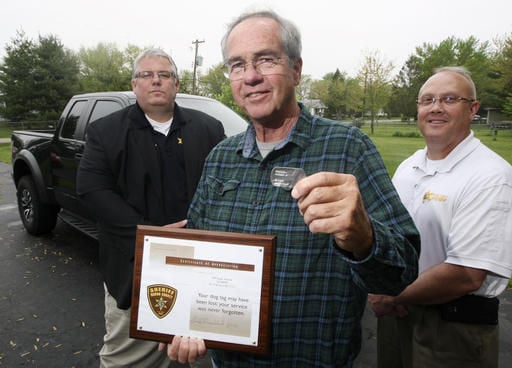
DECATUR, Ill. (AP) — Roger Randol was hunting for pheasant near Macon a few months after he returned home from his overseas hitch in the Army during the Vietnam War, most likely in the fall of 1971.
He dropped his dog tag somewhere out there, maybe near a vacant house where he had parked.
Forty-five years later a farmer found that thin stainless steel tag, 2 inches long by 1 1/8 inches wide, close to where a house had once stood.
Rather than discarding it, the farmer turned it over to Moweaqua Police Chief Robert "Mate" Maynard, who handed it off to Macon County Sheriff Thomas Schneider.
With the help of the county's Veteran's Assistance Commission, Schneider performed a little research about Randol. He discovered that he served during the Vietnam War era and attained the rank of specialist.
Schneider, who doesn't hide his admiration for military veterans, had a plaque made up for Randol, which included the dates of his service and this statement: "Your dog tag may have been lost; your service was never forgotten."
Randol was working on the shed about 60 yards behind his house when he spotted a monster-size black truck pull up in his driveway. Two lawmen, Schneider and Lt. Jon Butts, got out of the truck.
He had no idea what they were doing at his house.
"He showed me my dog tag," Randol said. "Then he said, 'I want you to have this plaque.'"
Randol, who enlisted when he was 19, after his brother Clayton and a good friend had been drafted into the Army, has never received much recognition for his service.
In 1969, when Randol told a recruiter he wanted to serve in the Army, the war was unpopular among most young people. The recruiter told him it was unusual for someone to volunteer at that time.
Ironically, the young man who was willing to serve in Vietnam was sent instead to South Korea, where he served for 14 months. There was some occasional shooting, including a few U.S. soldiers killed in action shortly before his arrival, but nothing like the magnitude of the combat action in nearby Vietnam.
"I served in a combat zone, in the DMZ (demilitarized zone separating North and South Korea)," Randol said. "We were getting ready to go to combat in Cambodia. We were on red alert. They were getting ready to send us."
At that time, news hit the states that American troops had been fighting in Cambodia, which sent the anti-war movement into a frenzy of demonstrations. Orders for more troops in the region were canceled.
Although he served as a weapons instructor in the storied 7th Infantry Division, Randol has not accepted recognition as a Vietnam veteran, such as attending the welcome home ceremonies held in Decatur for the past five years.
Randol was sent for basic and advanced training to Fort Ord, near Monterey, Calif. One of his fondest memories was meeting one of the all-time great rock singers on a commercial plane ride from Los Angeles to Monterey. One of his fellow soldiers was playing a tape of a Janis Joplin song, when Janis herself spoke up from a nearby seat.
"How do you like my new song?" she said.
Randol approached her for an autograph and found her to be a warm, friendly young lady. He was sad to hear of her death a few months later. Randol later passed on that autograph to his daughter, Stacey, a singer/songwriter who lives in Nashville.
After the sheriff and his right-hand man presented Randol with the plaque and his lost dog tag April 14, he wanted to let everyone know how much he appreciated it.
He wrote a letter to the editor in which he said, "Such a heart-felt, caring gesture made this aging soldier instantly remember why he had decided, as a young man, to enlist in the Army and leave home to serve his country."
Elaine Robertson, Randol's sister, said he remembered when his brother "Bugs," as Roger was known, wanted to join their brother in Vietnam. As she recalled, the Army told their family that they were not allowing two brothers to serve in country at that time.
"It was a very dramatic time for all of us," said Robertson, who graduated from Macon High School, as did all her siblings. "We lost high school friends. You either went to college or you went to Vietnam. I'm so proud of both my brothers. They love this country and fulfilled wherever they were asked to serve."
She said she appreciated what Schneider did.
"This guy went way out of his way, with a plaque," Robertson said. "Just to hand it back would have been sufficient. I was so thrilled. This sheriff was kind of enough to go way out of his way to recognize my brother."
___
Source: (Decatur) Herald and Review, http://bit.ly/1VIqN2y
___
Information from: Herald & Review, http://www.herald-review.com
This is an Illinois Exchange story shared by the (Decatur) Herald and Review.
- Updated
INDIANAPOLIS (AP) — An Indianapolis man is asking the public to help him find an engagement ring he lost in route to propose to his girlfriend.
WXIN-TV reports (http://bit.ly/1rvJkCu ) Justin Hart spent several hours Tuesday and Wednesday looking for the ring he says he lost while riding his bike.
Hart says the custom-made ring was in a branded leather pouch. He says he remembered having the ring at a grocery store where he picked up flowers.
He says he has checked online and asked random pedestrians if they have seen the jewelry.
Hart says he and his girlfriend have been together for more than 10 years.
___
Information from: WXIN-TV, http://fox59.trb.com/news/
- Updated
ST. PAUL, Minn. (AP) — With little debate, Minnesota's Senate on Wednesday passed a ban on cellphone cases designed to look like handguns.
Lawmakers first called attention to the lookalike cases last summer, arguing they're bound to be mistaken for a real firearm and could lead to a disaster. The Senate's unanimous vote to ban them puts the measure in the hands of the House, where lawmakers have also expressed support for the ban.
"This is a dead ringer for a pistol," said Sen. Ron Latz, a St. Louis Park Democrat who authored the bill.
Currently sold online, the cases are designed to slip into a pocket with a handle designed to look like the grip of a handgun. If the House follows suit and Gov. Mark Dayton signs the bill, owning manufacturing or selling the cases would be a petty misdemeanor and could result in a $300 fine.
Law enforcement organizations also backed the ban, saying the cases could lead to tragic confusion. But Sen. Torrey Westrom, R-Elbow Lake, wondered if lawmakers were creating a slippery slope that would lead to more bans on other potentially dangerous look-alikes.
Latz said the gun impostor cases are crying out for a ban.
"Without a doubt, something that looks like this ... ought to be included in our prohibition."
- By KANTELE FRANKO Associated Press
- Updated
COLUMBUS, Ohio (AP) — The state seized five tigers and five other animals from a northeast Ohio farm Wednesday, saying it hasn't met the requirements of a law cracking down on exotic animal ownership.
The Ohio Department of Agriculture had worked with Stump Hill Farm in Massillon on its efforts to get accreditation from the Zoological Association of America and thereby be exempt from the permit requirements, but took action against the facility after those attempts stalled and the state learned Huntsman had improperly acquired more restricted animals, spokeswoman Erica Hawkins said.
Officials took the tigers, two pumas, two baboons and one chimpanzee from the property to the state's temporary holding facility in Reynoldsburg, Hawkins said. She said she couldn't immediately provide information about the condition of the animals.
Stump Hill owner Cyndi Huntsman argues that her nonprofit farm is a licensed educational facility and thus exempt from permit requirements for dangerous wild animals.
Her attorney, John Juergensen, said the animals weren't a safety threat and Huntsman was being unfairly "picked on" by the state while an administrative hearing was still pending. Instead of putting the animals under distress, officials should have waited until the matter was resolved, Juergensen said.
"They were perfectly fine where they were. They weren't a danger to anybody," he said, alleging that officials seized the creatures simply "because they could."
One of the seized tigers was a former live "Obie" mascot for football games at nearby Massillon Washington High School, he said.
The state had considered Stump Hill to be the last large facility not complying with the stricter rules Ohio enacted after a suicidal man released lions, tigers and other creatures from a Zanesville-area farm in 2011.
The agriculture director's order to transfer the animals indicates that Huntsman had a state wildlife education permit but that it was issued only for a bald eagle, not other animals. Juergensen said the language isn't limited that way.
Huntsman, who was among owners that challenged the state law, said she had refused to surrender the animals that were seized. She has the right to appeal the transfer order through an administrative appeal to the department. Juergensen said he's also meeting Thursday with the judge who granted the warrant to raise concerns about what happened.
Huntsman previously surrendered six black bears, two brown bears and four alligators last year to decrease the number of animals at the farm as she pursued accreditation, Hawkins said.
In recent years, more than 110 animals have been seized by the state or surrendered by owners. Wednesday's action is the second-largest of those seizures.
The state took 11 animals, including six tigers, from a small, roadside sanctuary in northwest Ohio in January 2015. One lion died, and the other creatures were moved to out-of-state facilities while the owner's challenge proceeds in court.
In October, four bears were seized from an owner who refused to surrender them in Germantown, southwest of Dayton. The same week, a sanctuary near Waldo surrendered five tigers when state officials showed up. Both owners had started but never finished the application process for a required permit.
People for the Ethical Treatment of Animals praised the latest seizure in a statement, saying the affected animals include a chimpanzee whose freedom PETA has long sought.
- Updated
MIDDLETON, Wis. (AP) — The Middleton City Council has voted to rescind the school district's lease of a park where students meet for lunch and some religious discussion.
Middleton-Cross Plains Area School District administrator Don Johnson recommended the lease cancellation because of the controversy over the so-called Jesus lunches. School officials asked the organizers to end the lunches because district policies applied to the park because of the lease.
A handful of parents began organizing the noontime meetings outside Middleton High in 2014. As the meetings grew, organizers moved them to Fireman's Park across from the school.
Organizers told WKOW-TV (http://bit.ly/1roa9Z7 ) at Tuesday night's council meeting that the change will hopefully resolve the conflict over the lunches.
- Updated
AKRON, Ohio (AP) — The American Civil Liberties Union of Ohio has filed a lawsuit against a northeast Ohio city over an ordinance that forces panhandlers to register with the city, wear identification badges and restricts the activity to daylight hours.
The lawsuit filed Tuesday in Akron federal court states the law is only enforced against people perceived as poor or homeless, and not against others who ask for money, such as those connected with nonprofit groups.
The ordinance was passed in 2006, in the wake of incidents in which panhandling turned into an assault, the city's police chief said at the time.
The ACLU said the ordinance violates the constitutional rights of panhandlers and that police abuse the law to relocate homeless people. The group is asking the judge to deem the law unconstitutional. It also wants the judge to bar enforcement of the ordinance while the case is pending.
"Silencing the speech of the poor does not solve poverty," ACLU volunteer attorney Joe Mead said. "Rather than trying to prevent individuals from speaking about their needs, public officials would be better served by trying to address those needs directly."
Jeromey Young, 41, told the Akron Beacon Journal that he's been panhandling for about six months.
"It's hard for me to work because I have a bad knee," Young said. "I'm not on welfare or assistance or anything, so this is my only income."
The suit names the city, Akron Mayor Dan Horrigan and police Chief James Nice as defendants. It's seeking an unspecified amount in damages and attorneys' fees.
A city spokeswoman said they haven't been served with the lawsuit and declined to comment.
- Updated
WICHITA, Kan. (AP) — Kansas Secretary of State Kris Kobach says a Wichita man who voted in Kansas and Colorado during the same election has agreed to pay $5,500 in fines.
The guilty pleas from Ron R. Weems mark the fourth conviction Kobach has obtained since receiving prosecutorial authority from the Kansas Legislature last year. In exchange for those pleas, Kobach dismissed two felony charges of election perjury.
Weems was convicted of two counts of voting without being qualified and one count unlawful advance voting.
The complaint alleges he voted illegally in Kansas in the 2012 and 2014 general elections, while also voting in Teller County in the same elections.
Kobach says in a news release that the prosecutions demonstrate the commitment to ensuring Kansas has the most secure elections in the country.
- Updated
SIOUX FALLS, S.D. (AP) — Sioux Falls police arrested a 51-year-old transient for allegedly stealing a live lobster from a grocery store.
Police spokesman Sam Clemens says the man took the lobster Tuesday afternoon and fled. He didn't make it far — getting arrested in the store's parking lot.
The lobster valued at $35.18 was returned to the store.
- Updated
LINCOLN, Neb. (AP) — Lincoln will soon see trolleys again after a more than 70-year absence since residents regularly used them as a mode of transportation.
The city's public transit bus system, StarTran, plans to buy two compressed natural gas trolleys, three buses and a driver simulator with a $2 million Federal Transit Administration grant, the Lincoln Journal Star (http://bit.ly/1Zcs9AJ ) reported.
The new trolleys will have rubber tires and operate like a bus instead of riding on tracks or being attached to overhead trolley wires.
"Trolleys have their own identity," said Mike Davis, city transit manager. "They tend to be fun to ride, and they attract riders to them."
The rear of the trolley buses will be open air in the summer, but they will remain air-conditioned in the front seats, David said.
"It kind of has that fun feel to it," he said.
Davis said StarTran uses 13 compressed natural gas buses on its routes on the University of Nebraska's campus and that they generate 20 percent less greenhouse gas than regular buses.
"We found these vehicles to be quieter," he said.
StarTran has issued a request for proposals for the trolleys, which will run on a route that goes through downtown. StarTran hopes to begin using them in early 2017.
Lincoln had electric streetcars from 1883 to 1945, said Ed Zimmer, historic preservation planner for the city. He said buses started aggressively replacing trolleys after World War II because less gasoline and other mechanical parts used on buses were needed for combat zone vehicles.
In the 90s, the city had a contract with Good Life Coaches for a trolley, known as Molley the Trolley. After nine years, it stopped running in 2005.
___
Information from: Lincoln Journal Star, http://www.journalstar.com
- By DAVE KOLPACK Associated Press
- Updated
FARGO, N.D. (AP) — The conviction and sentence of a North Dakota farmer accused of intentionally destroying potatoes to collect federal farm insurance payments was proper, according to an 8th U.S. Circuit Court of Appeals opinion released Wednesday.
Aaron Johnson, formerly of the Cooperstown area, was convicted in December 2014 of conspiring to receive illegal payments and making false statements and later sentenced to serve four years in prison. A judge said the loss to the government from one growing season was more than $900,000.
Johnson argued in his appeal that the government's key witness, a former farmhand, was not credible because of his criminal history. A three-judge panel of the 8th Circuit rejected the notion and said there was sufficient evidence to support the outcome.
"Federal programs like the federal farm programs are based on an honor system," U.S Attorney Chris Myers said Wednesday in a statement. "Unfortunately, there are a few who take advantage of this system and some, like Aaron Johnson, who brag about defrauding the system."
Neil Fulton, head of the federal public defender's office for North Dakota and South Dakota, had no comment. "We are reviewing the decision and will discuss any possible next steps with our client," Fulton said.
Aaron Johnson's brother, Derek, also was convicted in the case and sentence to 1½ years in prison. Derek Johnson was not part of the appeal.
Authorities say the Johnsons applied chemicals, including a substance designed for dissolving solid materials in septic systems, and added spoiled and frozen potatoes to their stored crop in order to speed up deterioration. Portable heaters allegedly were used to heat the warehouse above 80 degrees and make the potatoes rot faster. Once the potatoes were spoiled, the men reported the loss to their insurance company and said the crop was lost due to naturally caused diseases.
Aaron Johnson said in his appeal that former employee Leo Borgen, who was a paid informant for the government, could not be trusted because he had a long criminal history and that prosecutors dropped charges against him in exchange for his testimony. Borgen also admitted that he had double-crossed investigators by revealing to Johnson that he was a government informant.
The 8th Circuit panel said credibility assessments are virtually unreviewable on appeal.
More like this...
- By HUEY FREEMAN (Decatur) Herald and Review
DECATUR, Ill. (AP) — Roger Randol was hunting for pheasant near Macon a few months after he returned home from his overseas hitch in the Army during the Vietnam War, most likely in the fall of 1971.
He dropped his dog tag somewhere out there, maybe near a vacant house where he had parked.
Forty-five years later a farmer found that thin stainless steel tag, 2 inches long by 1 1/8 inches wide, close to where a house had once stood.
Rather than discarding it, the farmer turned it over to Moweaqua Police Chief Robert "Mate" Maynard, who handed it off to Macon County Sheriff Thomas Schneider.
With the help of the county's Veteran's Assistance Commission, Schneider performed a little research about Randol. He discovered that he served during the Vietnam War era and attained the rank of specialist.
Schneider, who doesn't hide his admiration for military veterans, had a plaque made up for Randol, which included the dates of his service and this statement: "Your dog tag may have been lost; your service was never forgotten."
Randol was working on the shed about 60 yards behind his house when he spotted a monster-size black truck pull up in his driveway. Two lawmen, Schneider and Lt. Jon Butts, got out of the truck.
He had no idea what they were doing at his house.
"He showed me my dog tag," Randol said. "Then he said, 'I want you to have this plaque.'"
Randol, who enlisted when he was 19, after his brother Clayton and a good friend had been drafted into the Army, has never received much recognition for his service.
In 1969, when Randol told a recruiter he wanted to serve in the Army, the war was unpopular among most young people. The recruiter told him it was unusual for someone to volunteer at that time.
Ironically, the young man who was willing to serve in Vietnam was sent instead to South Korea, where he served for 14 months. There was some occasional shooting, including a few U.S. soldiers killed in action shortly before his arrival, but nothing like the magnitude of the combat action in nearby Vietnam.
"I served in a combat zone, in the DMZ (demilitarized zone separating North and South Korea)," Randol said. "We were getting ready to go to combat in Cambodia. We were on red alert. They were getting ready to send us."
At that time, news hit the states that American troops had been fighting in Cambodia, which sent the anti-war movement into a frenzy of demonstrations. Orders for more troops in the region were canceled.
Although he served as a weapons instructor in the storied 7th Infantry Division, Randol has not accepted recognition as a Vietnam veteran, such as attending the welcome home ceremonies held in Decatur for the past five years.
Randol was sent for basic and advanced training to Fort Ord, near Monterey, Calif. One of his fondest memories was meeting one of the all-time great rock singers on a commercial plane ride from Los Angeles to Monterey. One of his fellow soldiers was playing a tape of a Janis Joplin song, when Janis herself spoke up from a nearby seat.
"How do you like my new song?" she said.
Randol approached her for an autograph and found her to be a warm, friendly young lady. He was sad to hear of her death a few months later. Randol later passed on that autograph to his daughter, Stacey, a singer/songwriter who lives in Nashville.
After the sheriff and his right-hand man presented Randol with the plaque and his lost dog tag April 14, he wanted to let everyone know how much he appreciated it.
He wrote a letter to the editor in which he said, "Such a heart-felt, caring gesture made this aging soldier instantly remember why he had decided, as a young man, to enlist in the Army and leave home to serve his country."
Elaine Robertson, Randol's sister, said he remembered when his brother "Bugs," as Roger was known, wanted to join their brother in Vietnam. As she recalled, the Army told their family that they were not allowing two brothers to serve in country at that time.
"It was a very dramatic time for all of us," said Robertson, who graduated from Macon High School, as did all her siblings. "We lost high school friends. You either went to college or you went to Vietnam. I'm so proud of both my brothers. They love this country and fulfilled wherever they were asked to serve."
She said she appreciated what Schneider did.
"This guy went way out of his way, with a plaque," Robertson said. "Just to hand it back would have been sufficient. I was so thrilled. This sheriff was kind of enough to go way out of his way to recognize my brother."
___
Source: (Decatur) Herald and Review, http://bit.ly/1VIqN2y
___
Information from: Herald & Review, http://www.herald-review.com
This is an Illinois Exchange story shared by the (Decatur) Herald and Review.
INDIANAPOLIS (AP) — An Indianapolis man is asking the public to help him find an engagement ring he lost in route to propose to his girlfriend.
WXIN-TV reports (http://bit.ly/1rvJkCu ) Justin Hart spent several hours Tuesday and Wednesday looking for the ring he says he lost while riding his bike.
Hart says the custom-made ring was in a branded leather pouch. He says he remembered having the ring at a grocery store where he picked up flowers.
He says he has checked online and asked random pedestrians if they have seen the jewelry.
Hart says he and his girlfriend have been together for more than 10 years.
___
Information from: WXIN-TV, http://fox59.trb.com/news/
ST. PAUL, Minn. (AP) — With little debate, Minnesota's Senate on Wednesday passed a ban on cellphone cases designed to look like handguns.
Lawmakers first called attention to the lookalike cases last summer, arguing they're bound to be mistaken for a real firearm and could lead to a disaster. The Senate's unanimous vote to ban them puts the measure in the hands of the House, where lawmakers have also expressed support for the ban.
"This is a dead ringer for a pistol," said Sen. Ron Latz, a St. Louis Park Democrat who authored the bill.
Currently sold online, the cases are designed to slip into a pocket with a handle designed to look like the grip of a handgun. If the House follows suit and Gov. Mark Dayton signs the bill, owning manufacturing or selling the cases would be a petty misdemeanor and could result in a $300 fine.
Law enforcement organizations also backed the ban, saying the cases could lead to tragic confusion. But Sen. Torrey Westrom, R-Elbow Lake, wondered if lawmakers were creating a slippery slope that would lead to more bans on other potentially dangerous look-alikes.
Latz said the gun impostor cases are crying out for a ban.
"Without a doubt, something that looks like this ... ought to be included in our prohibition."
- By KANTELE FRANKO Associated Press
COLUMBUS, Ohio (AP) — The state seized five tigers and five other animals from a northeast Ohio farm Wednesday, saying it hasn't met the requirements of a law cracking down on exotic animal ownership.
The Ohio Department of Agriculture had worked with Stump Hill Farm in Massillon on its efforts to get accreditation from the Zoological Association of America and thereby be exempt from the permit requirements, but took action against the facility after those attempts stalled and the state learned Huntsman had improperly acquired more restricted animals, spokeswoman Erica Hawkins said.
Officials took the tigers, two pumas, two baboons and one chimpanzee from the property to the state's temporary holding facility in Reynoldsburg, Hawkins said. She said she couldn't immediately provide information about the condition of the animals.
Stump Hill owner Cyndi Huntsman argues that her nonprofit farm is a licensed educational facility and thus exempt from permit requirements for dangerous wild animals.
Her attorney, John Juergensen, said the animals weren't a safety threat and Huntsman was being unfairly "picked on" by the state while an administrative hearing was still pending. Instead of putting the animals under distress, officials should have waited until the matter was resolved, Juergensen said.
"They were perfectly fine where they were. They weren't a danger to anybody," he said, alleging that officials seized the creatures simply "because they could."
One of the seized tigers was a former live "Obie" mascot for football games at nearby Massillon Washington High School, he said.
The state had considered Stump Hill to be the last large facility not complying with the stricter rules Ohio enacted after a suicidal man released lions, tigers and other creatures from a Zanesville-area farm in 2011.
The agriculture director's order to transfer the animals indicates that Huntsman had a state wildlife education permit but that it was issued only for a bald eagle, not other animals. Juergensen said the language isn't limited that way.
Huntsman, who was among owners that challenged the state law, said she had refused to surrender the animals that were seized. She has the right to appeal the transfer order through an administrative appeal to the department. Juergensen said he's also meeting Thursday with the judge who granted the warrant to raise concerns about what happened.
Huntsman previously surrendered six black bears, two brown bears and four alligators last year to decrease the number of animals at the farm as she pursued accreditation, Hawkins said.
In recent years, more than 110 animals have been seized by the state or surrendered by owners. Wednesday's action is the second-largest of those seizures.
The state took 11 animals, including six tigers, from a small, roadside sanctuary in northwest Ohio in January 2015. One lion died, and the other creatures were moved to out-of-state facilities while the owner's challenge proceeds in court.
In October, four bears were seized from an owner who refused to surrender them in Germantown, southwest of Dayton. The same week, a sanctuary near Waldo surrendered five tigers when state officials showed up. Both owners had started but never finished the application process for a required permit.
People for the Ethical Treatment of Animals praised the latest seizure in a statement, saying the affected animals include a chimpanzee whose freedom PETA has long sought.
MIDDLETON, Wis. (AP) — The Middleton City Council has voted to rescind the school district's lease of a park where students meet for lunch and some religious discussion.
Middleton-Cross Plains Area School District administrator Don Johnson recommended the lease cancellation because of the controversy over the so-called Jesus lunches. School officials asked the organizers to end the lunches because district policies applied to the park because of the lease.
A handful of parents began organizing the noontime meetings outside Middleton High in 2014. As the meetings grew, organizers moved them to Fireman's Park across from the school.
Organizers told WKOW-TV (http://bit.ly/1roa9Z7 ) at Tuesday night's council meeting that the change will hopefully resolve the conflict over the lunches.
AKRON, Ohio (AP) — The American Civil Liberties Union of Ohio has filed a lawsuit against a northeast Ohio city over an ordinance that forces panhandlers to register with the city, wear identification badges and restricts the activity to daylight hours.
The lawsuit filed Tuesday in Akron federal court states the law is only enforced against people perceived as poor or homeless, and not against others who ask for money, such as those connected with nonprofit groups.
The ordinance was passed in 2006, in the wake of incidents in which panhandling turned into an assault, the city's police chief said at the time.
The ACLU said the ordinance violates the constitutional rights of panhandlers and that police abuse the law to relocate homeless people. The group is asking the judge to deem the law unconstitutional. It also wants the judge to bar enforcement of the ordinance while the case is pending.
"Silencing the speech of the poor does not solve poverty," ACLU volunteer attorney Joe Mead said. "Rather than trying to prevent individuals from speaking about their needs, public officials would be better served by trying to address those needs directly."
Jeromey Young, 41, told the Akron Beacon Journal that he's been panhandling for about six months.
"It's hard for me to work because I have a bad knee," Young said. "I'm not on welfare or assistance or anything, so this is my only income."
The suit names the city, Akron Mayor Dan Horrigan and police Chief James Nice as defendants. It's seeking an unspecified amount in damages and attorneys' fees.
A city spokeswoman said they haven't been served with the lawsuit and declined to comment.
WICHITA, Kan. (AP) — Kansas Secretary of State Kris Kobach says a Wichita man who voted in Kansas and Colorado during the same election has agreed to pay $5,500 in fines.
The guilty pleas from Ron R. Weems mark the fourth conviction Kobach has obtained since receiving prosecutorial authority from the Kansas Legislature last year. In exchange for those pleas, Kobach dismissed two felony charges of election perjury.
Weems was convicted of two counts of voting without being qualified and one count unlawful advance voting.
The complaint alleges he voted illegally in Kansas in the 2012 and 2014 general elections, while also voting in Teller County in the same elections.
Kobach says in a news release that the prosecutions demonstrate the commitment to ensuring Kansas has the most secure elections in the country.
SIOUX FALLS, S.D. (AP) — Sioux Falls police arrested a 51-year-old transient for allegedly stealing a live lobster from a grocery store.
Police spokesman Sam Clemens says the man took the lobster Tuesday afternoon and fled. He didn't make it far — getting arrested in the store's parking lot.
The lobster valued at $35.18 was returned to the store.
LINCOLN, Neb. (AP) — Lincoln will soon see trolleys again after a more than 70-year absence since residents regularly used them as a mode of transportation.
The city's public transit bus system, StarTran, plans to buy two compressed natural gas trolleys, three buses and a driver simulator with a $2 million Federal Transit Administration grant, the Lincoln Journal Star (http://bit.ly/1Zcs9AJ ) reported.
The new trolleys will have rubber tires and operate like a bus instead of riding on tracks or being attached to overhead trolley wires.
"Trolleys have their own identity," said Mike Davis, city transit manager. "They tend to be fun to ride, and they attract riders to them."
The rear of the trolley buses will be open air in the summer, but they will remain air-conditioned in the front seats, David said.
"It kind of has that fun feel to it," he said.
Davis said StarTran uses 13 compressed natural gas buses on its routes on the University of Nebraska's campus and that they generate 20 percent less greenhouse gas than regular buses.
"We found these vehicles to be quieter," he said.
StarTran has issued a request for proposals for the trolleys, which will run on a route that goes through downtown. StarTran hopes to begin using them in early 2017.
Lincoln had electric streetcars from 1883 to 1945, said Ed Zimmer, historic preservation planner for the city. He said buses started aggressively replacing trolleys after World War II because less gasoline and other mechanical parts used on buses were needed for combat zone vehicles.
In the 90s, the city had a contract with Good Life Coaches for a trolley, known as Molley the Trolley. After nine years, it stopped running in 2005.
___
Information from: Lincoln Journal Star, http://www.journalstar.com
- By DAVE KOLPACK Associated Press
FARGO, N.D. (AP) — The conviction and sentence of a North Dakota farmer accused of intentionally destroying potatoes to collect federal farm insurance payments was proper, according to an 8th U.S. Circuit Court of Appeals opinion released Wednesday.
Aaron Johnson, formerly of the Cooperstown area, was convicted in December 2014 of conspiring to receive illegal payments and making false statements and later sentenced to serve four years in prison. A judge said the loss to the government from one growing season was more than $900,000.
Johnson argued in his appeal that the government's key witness, a former farmhand, was not credible because of his criminal history. A three-judge panel of the 8th Circuit rejected the notion and said there was sufficient evidence to support the outcome.
"Federal programs like the federal farm programs are based on an honor system," U.S Attorney Chris Myers said Wednesday in a statement. "Unfortunately, there are a few who take advantage of this system and some, like Aaron Johnson, who brag about defrauding the system."
Neil Fulton, head of the federal public defender's office for North Dakota and South Dakota, had no comment. "We are reviewing the decision and will discuss any possible next steps with our client," Fulton said.
Aaron Johnson's brother, Derek, also was convicted in the case and sentence to 1½ years in prison. Derek Johnson was not part of the appeal.
Authorities say the Johnsons applied chemicals, including a substance designed for dissolving solid materials in septic systems, and added spoiled and frozen potatoes to their stored crop in order to speed up deterioration. Portable heaters allegedly were used to heat the warehouse above 80 degrees and make the potatoes rot faster. Once the potatoes were spoiled, the men reported the loss to their insurance company and said the crop was lost due to naturally caused diseases.
Aaron Johnson said in his appeal that former employee Leo Borgen, who was a paid informant for the government, could not be trusted because he had a long criminal history and that prosecutors dropped charges against him in exchange for his testimony. Borgen also admitted that he had double-crossed investigators by revealing to Johnson that he was a government informant.
The 8th Circuit panel said credibility assessments are virtually unreviewable on appeal.
More like this...
Most Popular
-
 Lake Mead's drops raise prospect of unaffordable Hoover Dam electricity
 -
Court rules Arizona AG Kris Mayes illegally withheld information
-
'Copper corridor' revival could bring jobs, pollution back to Arizona town
-
Tucson's San Xavier Mission is ready for her close-up
-
State budget proposal eliminates Tucson's Rio Nuevo economic development

