

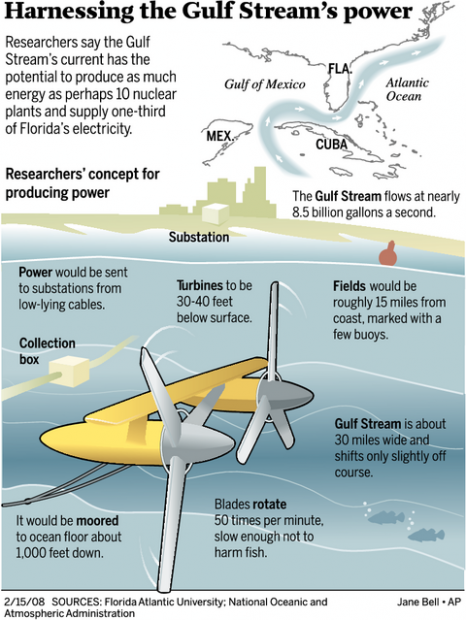
DANIA BEACH, Fla. — Just 15 miles off Florida's coast, the world's most powerful sustained ocean current — the mighty Gulf Stream — rushes by at nearly 8.5 billion gallons per second. And it never stops.
To scientists, it represents a tantalizing possibility: a new, plentiful and uninterrupted source of clean energy.
Florida Atlantic University researchers say the current could be used someday to drive thousands of underwater turbines, produce as much energy as perhaps 10 nuclear plants and supply one-third of Florida's electricity. A small test turbine is expected to be installed within months.
"We can produce power 24/7," said Frederick Driscoll, director of the university's Center of Excellence in Ocean Energy Technology.
Using a $5 million research grant from the state, the university is working to develop the technology in hopes that big energy and engineering firms eventually will build huge underwater arrays of turbines.
People are also reading…
From Oregon to Maine, Europe to Australia and beyond, researchers are looking to the sea — currents, tides and waves — for its infinite energy.
Because the technology is still taking shape, it is too soon to say how much it might cost. But researchers hope to make it as cost-effective as fossil fuels. Although the initial investment may be higher, the currents that drive the machinery are free.
Unknowns and risks abound, however. One fear is the "Cuisinart effect": The spinning underwater blades could chop up fish and other creatures.
Researchers said the underwater turbines would pose little risk to passing ships.
The equipment would be moored to the ocean floor, with the tops of the blades spinning 30 to 40 feet below the surface, because that's where the Gulf Stream flows fastest.
But standard navigation equipment on ocean vessels could easily guide them around the turbine fields if their hulls reached that deep, researchers said. David White of the Ocean Conservancy said much of the technology is largely untested in the outdoors, so it is too soon to say what the environmental effects might be.


