

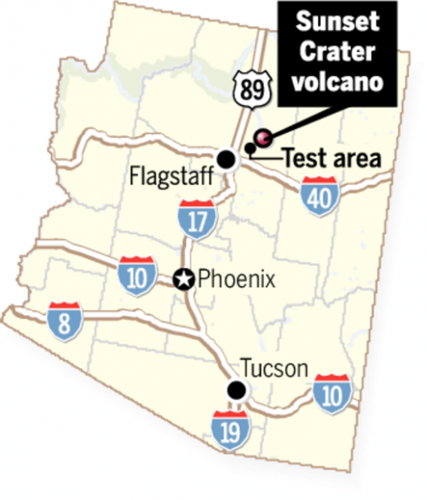
FLAGSTAFF — A team of NASA engineers work in a 1,000-acre volcanic bed near Sunset Crater testing the new or upgraded spacesuits and rovers intended to take take U.S. astronauts back to the moon.
It's been three decades since Apollo astronauts last walked on the moon. Technology has come a long way since astronauts got to Earth's far off natural satellite, and NASA, which is planning a return to the moon in 2020, wants the next generation of astronauts to be able to do more. Going back to do what someone did in the 1960s and '70s isn't going to cut it.
That's why NASA's D-RATS — Desert Research and Technology Studies — team is here at moon base Arizona. They're wrapping up the latest in a long series of field tests of prototype and improved gear at moon base Arizona. They've been coming since 1997, working just a stone's throw from where the Apollo astronauts tested gear and practiced for their missions in the '60s and '70s.
People are also reading…
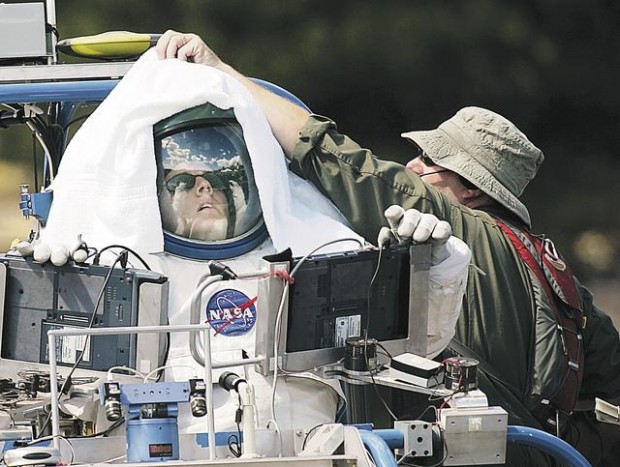
NASA's stiff-legged, shuttle-era spacesuits were meant for doing tool-in-hand mechanical chores outside the spacecraft while an astronaut's feet were clamped into footholds. But moon and Mars explorers will essentially be geologists and need to sit while they drive a rover, bend to look at things, kneel to pick up samples — and get back up.
"Even at one-sixth gravity, 280 pounds is not trivial," says NASA engineer Phil West, who worked on suit design and testing.
And at full Earth gravity here, walking through the test bed's granola-like volcanic gravel is clearly a struggle. It's hard enough in jeans and hiking boots, let alone in a 280-pound suit with limited mobility and visibility.
And this is nothing, in terms of heat and cold. Engineers working on the suits say they must be able to keep a human comfortable enough to work in extremes of hot and cold beyond anything on Earth.
But, says D-RATS test director Joe Kosmo, a 46-year veteran of NASA, this volcanic bed is one of the best places on Earth for simulating the moon's surface.
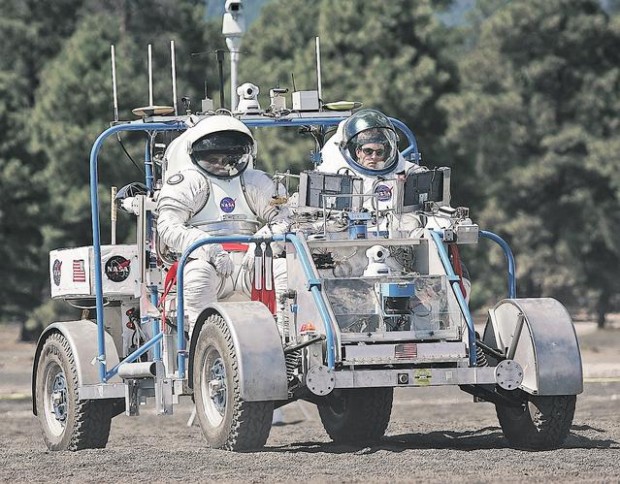
So, one at a time, a couple of space-suited engineers come out the back of a big white fifth-wheel trailer playing the part of the lunar module, ride an elevator platform down to ground level, walk to a mock-up air lock/automatic cleaning chamber about the size of a Porta John, come out the other side and take a seat in a four-wheel drive open-top rover. The cleaning chamber is a must because grimy dust on the moon, much like the abrasive volcanic dust here, caused problems for the Apollo astronauts.
It threatened to disable spacesuit zippers and could endanger astronauts' respiratory systems, said Amy Ross, a spacesuit engineer. Ross is an example of one of the things that has changed since the Apollo days, as one of the many women working out here, some only in their 20s.
The dust is just another of a seemingly endless series of problems that have to be solved for any new type of space mission. And if engineers are meant to solve problems, then this must be heaven.
Kosmo exemplifies the can-do attitude in the get-it-done corners of NASA. He reeks competence and confidence without seeming cocky. He has been around since the Apollo days, having worked near this very site with those early astronauts in the 1960s.
He's not exactly inconspicuous in his orange jumpsuit topped by a NASA cap with scrambled eggs, but he doesn't seem to tell anyone what to do. He's just there, a presence — people ask him questions, he gives them answers.
At one point he drives a banged-up old Ford pickup over to the press shelter and takes a load of reporters and photographers out onto the test bed so they can watch the two spacesuit testers doing a soil sampling simulation.
His comment about doing this the first time is brief: "We were able to do quite a remarkable thing in an eight-year period (Apollo): from knowing nothing to landing on the moon."
When it came to starting over, he said they "started out small," asking, "What does a planetary geologist do?"
NASA technical people know very little is truly impossible — some things might be too expensive (not their problem) or too prone to failure because the required materials or technology isn't up to life-and-death reliability yet (their problem).
In the case of the next-generation rover, that means combining advanced human function with robotic work. The rover design testing here can be driven by astronauts or run remotely by an operator with a joystick in a lunar module or thousands of miles away in Houston at Johnson Space Center.
But nothing is final, says engineer Geoff Yoder. Engineers will continue to try to improve and lighten gear. At $10,000 a pound to get things into space, weight is money, and every pound of one thing is a pound less of something else.
Watch a slide show from the test at azstarnet.com/slideshows
Did you know ...
The Apollo astronauts trained for their moonwalks and lunar-rover driving in Sunset Crater and its lava fields northeast of Flagstaff. Planetary scientists from the U.S. Geological Survey, Lowell Observatory and the Naval Observatory in Flagstaff helped map the moon in advance of the Apollo missions.


